Housing Starts Surge 19% but Permits Fall: The Contradictions Defining the US Consumer Outlook in Mid-2026
Housing Starts Surge 19% but Permits Fall: The Contradictions Defining the US Consumer Outlook in Mid-2026
The US housing market and consumer sector delivered a set of data in mid-July 2026 that defies simple characterization. On one hand, housing starts surged by a remarkable 19% in June, consumer sentiment improved unexpectedly, and the labor market remained tight with jobless claims at just 208,000. On the other hand, building permits — a leading indicator of future construction — declined by 3%, and the absolute level of consumer confidence remains well below historical averages. This combination of near-term strength and forward-looking caution captures the essential tension defining the US consumer outlook as the economy moves into the second half of 2026.
Housing Starts: A Dramatic Rebound in Construction Activity
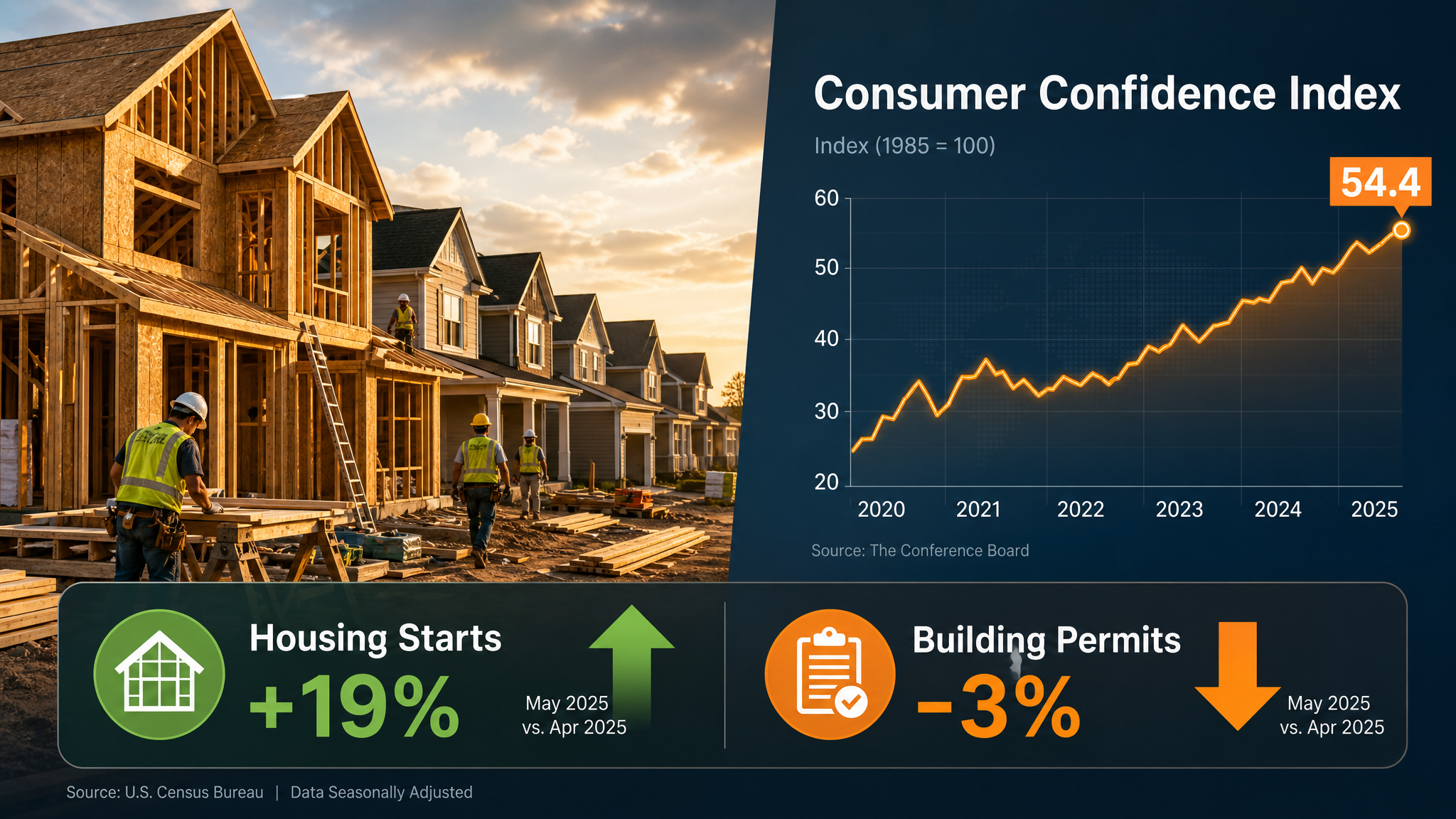
The headline number from the US Census Bureau's June housing report was striking: privately-owned housing starts rose 19.0% from the previous month to a seasonally adjusted annual rate of 1,427,000 units — significantly above the consensus forecast of 1.31 million. This dramatic rebound in construction activity suggests that homebuilders are responding to persistent demand for new housing inventory in a market where the supply of existing homes for sale remains historically constrained.
The surge in starts reflects several converging factors. First, the inventory of existing homes for sale has remained tight as homeowners with low-rate mortgages locked in during 2020-2021 are reluctant to sell and take on new mortgages at current rates. This "lock-in effect" has pushed buyers toward new construction, giving builders the demand visibility needed to break ground on new projects. Second, material costs have stabilized after the extreme volatility of the post-pandemic period, improving the economics of new construction. Third, some builders have been offering mortgage rate buydowns and other incentives to attract buyers, effectively subsidizing affordability at the point of sale.
Building Permits: A Cautionary Signal for the Pipeline
The optimism generated by the housing starts surge is tempered by the data on building permits, which declined 3.0% in June to a rate of 1.367 million. Building permits are a leading indicator of future construction activity — a builder must obtain a permit before breaking ground — so a decline in permits today signals a potential moderation in starts in the months ahead. This divergence between current activity (strong) and future pipeline (moderating) suggests that builders are working through a backlog of previously permitted projects while becoming more cautious about committing to new ones.
The caution reflected in permit applications likely stems from ongoing concerns about mortgage affordability. With the 30-year fixed mortgage rate remaining elevated — a direct consequence of the Federal Reserve's restrictive monetary policy — the pool of qualified buyers at current price levels is constrained. Builders who are completing projects started months ago are finding buyers, but the economics of starting new projects at current land, labor, and financing costs are more challenging, particularly for entry-level and first-time buyer segments of the market.
Consumer Sentiment: An Unexpected Improvement
On the consumer side, the preliminary reading of the University of Michigan's Consumer Sentiment Index for July climbed to 54.4, beating the consensus forecast of 51.0 and marking a notable improvement from June's 49.5 reading. While the absolute level remains below historical averages — reflecting the cumulative impact of inflation, higher interest rates, and global uncertainty — the upward trend suggests a potential turning point in household psychology.
The improvement in sentiment is likely driven by several factors: a stabilization in gasoline prices, continued strength in the labor market, and a gradual adjustment of consumer expectations to the "new normal" of higher prices. Importantly, the University of Michigan survey also tracks inflation expectations, which remain a key input for Federal Reserve policymakers. If consumers begin to expect lower inflation in the future, it could provide the Fed with additional confidence that its restrictive policy is working, potentially opening the door to rate cuts later in the year.
The Labor Market: The Foundation of Consumer Resilience
Underpinning both the housing market's resilience and the improvement in consumer sentiment is the continued strength of the US labor market. Initial jobless claims for the week ending July 11 fell to 208,000 — a decrease of 8,000 from the prior week and below the consensus forecast of 212,000. The low level of claims indicates that layoffs remain minimal, and the employment environment continues to support wage growth and consumer spending power.
A tight labor market is the single most important factor supporting the US consumer. As long as Americans are employed and earning wages that are growing faster than inflation — even if only marginally — they retain the capacity to service their debts, pay their mortgages, and continue spending on goods and services. This spending, in turn, supports corporate revenues and earnings, creating a virtuous cycle that has proven more durable than many economists expected in the face of the Fed's aggressive tightening cycle.
The full picture of consumer confidence for July will become clearer with the release of The Conference Board's Consumer Confidence Index on July 28. That report will provide additional granularity on consumers' assessments of current conditions versus their expectations for the future — a distinction that is particularly important as the economy navigates the second half of 2026 with elevated interest rates, persistent inflation, and a Federal Reserve that remains in "hawkish hold" mode. For now, the data suggests that the US consumer, while not immune to economic pressures, remains a potent and resilient force driving the domestic economy forward.
This content is for informational purposes only and does not constitute financial advice. Always consult with a qualified financial advisor before making investment decisions.

Comments
Post a Comment