Bear Steepener Alert: Why Rising Long-Term Treasury Yields Are Reshaping the US Bond Market
The US Treasury yield curve has finally exited its historic inversion—a 27-month period that began in July 2022 and ended in late 2024. For bond market watchers, this normalization should be cause for celebration. But the manner in which the curve has returned to a positive slope is raising new and important concerns. Rather than a "bull steepener"—where short-term rates fall as the Fed cuts—the market is experiencing a "bear steepener," where long-term yields are rising faster than short-term yields. This distinction has profound implications for investors, borrowers, and the broader economy.
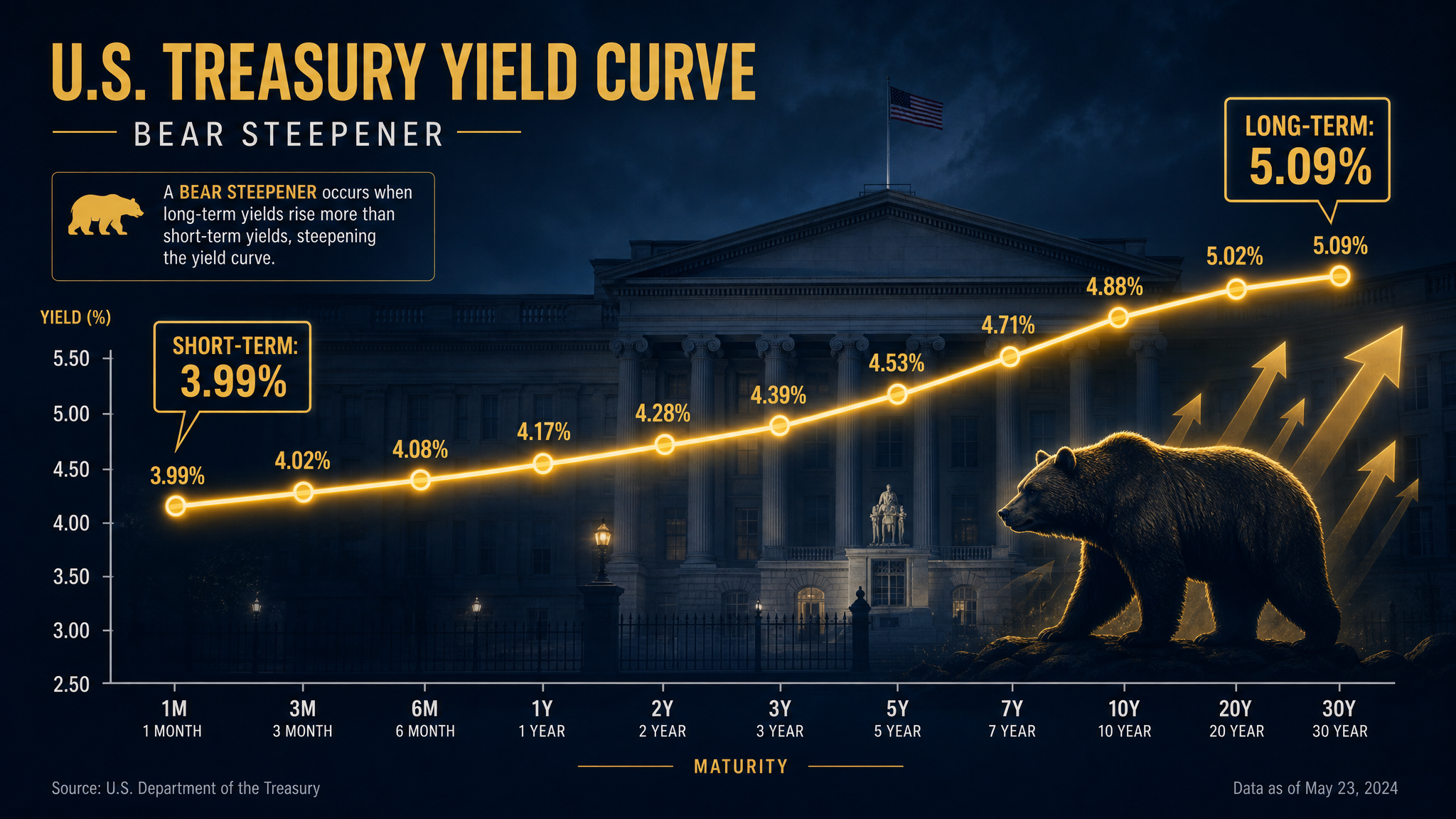
Reading the Yield Curve: July 2026
As of July 16, 2026, the US Treasury yield curve presents a clear picture of the bear steepening dynamic. The 2-year Treasury note yields 3.99%, while the 10-year note yields 4.41%—a positive spread of approximately 42 basis points. Moving further out the curve, the 20-year bond yields 4.57% and the 30-year bond yields a notably elevated 5.09%. This upward slope from short to long maturities is the textbook definition of a normal yield curve, but the forces driving it are anything but normal.
In a typical post-recession environment, yield curve steepening is driven by the Federal Reserve aggressively cutting short-term interest rates to stimulate growth. This "bull steepener" is generally positive for the economy and financial markets. The current environment is fundamentally different. Short-term rates are being held steady by a hawkish Fed, while long-term yields are rising due to concerns about fiscal deficits, heavy Treasury supply, and uncertainty about the long-term inflation outlook. This is the essence of the bear steepener: the curve is steepening for the wrong reasons.
The Term Premium: The Hidden Driver
The key concept for understanding the bear steepener is the "term premium"—the additional compensation that investors demand to hold long-term bonds rather than rolling over a series of short-term bonds. When uncertainty about the future is high, investors require a larger term premium to commit their capital for extended periods. In the current environment, two factors are driving the term premium higher.
First, the US fiscal deficit trajectory is alarming bond investors. Legislation passed in 2025 that extended tax cuts and increased infrastructure spending is projected to add over $4 trillion to the national debt over the coming decade. To fund this deficit, the Treasury must issue an enormous volume of new bonds, and the market must absorb this supply. When supply exceeds demand, prices fall and yields rise—exactly what is happening at the long end of the curve.
Second, uncertainty about the long-term inflation outlook is keeping investors cautious. The AI infrastructure boom, geopolitical energy price volatility, and the potential for trade policy disruptions all create scenarios where inflation could remain elevated for longer than the Fed's projections suggest. Bond investors, burned by the inflation surprise of 2021-2022, are demanding higher yields to compensate for this uncertainty.
Treasury Auctions: Adequate but Watchful
The practical manifestation of these dynamics is visible in Treasury auction results. The US government regularly auctions new debt across a range of maturities, and the results of these auctions provide real-time insight into investor demand. Key metrics include the bid-to-cover ratio (total bids relative to the amount offered), the auction tail (the difference between the final auction yield and the pre-auction market yield), and the proportion absorbed by primary dealers versus end investors.
In 2026, auction results have been adequate but variable. Some auctions for longer-duration bonds have shown softer demand, with occasional "tails" indicating that the market needed higher yields to clear the supply. While these have not indicated a systemic crisis, they serve as a warning signal that the market's capacity to absorb ever-increasing Treasury supply is not unlimited. Primary dealer takedowns—a proxy for weaker end-user demand—have been somewhat elevated, though they have remained within functional ranges.
Winners and Losers in a Bear Steepener
The bear steepening environment creates a complex set of winners and losers across the financial system. On the positive side, the banking sector benefits from a positively sloped yield curve, which expands net interest margins and supports profitability. This is one reason why financial stocks have been among the leaders in the current market rotation. Insurance companies and pension funds, which have long-duration liabilities, also benefit from higher long-term yields, which reduce the present value of their obligations.
On the negative side, rising long-term yields increase the cost of capital for businesses and consumers looking to finance long-term investments. Mortgage rates, which are closely tied to the 10-year Treasury yield, remain elevated, continuing to weigh on the housing market. Companies with significant long-term debt face higher refinancing costs. And for bond investors who hold existing long-duration securities, rising yields mean falling prices—a painful dynamic that has characterized the fixed-income market for much of the past several years.
What to Watch
For investors navigating the bear steepener, the key variables to monitor are the trajectory of the US fiscal deficit, the pace of Treasury issuance, and any signs that the Federal Reserve is moving closer to rate cuts. A genuine pivot toward easing by the Fed would likely transform the bear steepener into a bull steepener, providing relief to long-duration bond holders. Until that pivot materializes, the bond market will continue to grapple with the uncomfortable reality of a "higher-for-longer" interest rate environment driven as much by fiscal concerns as by monetary policy.
This content is for informational purposes only and does not constitute financial advice. Always consult with a qualified financial advisor before making investment decisions.