Big Tech's AI Capex Reckoning: Earnings Season Puts $725 Billion in Spending Under the Microscope
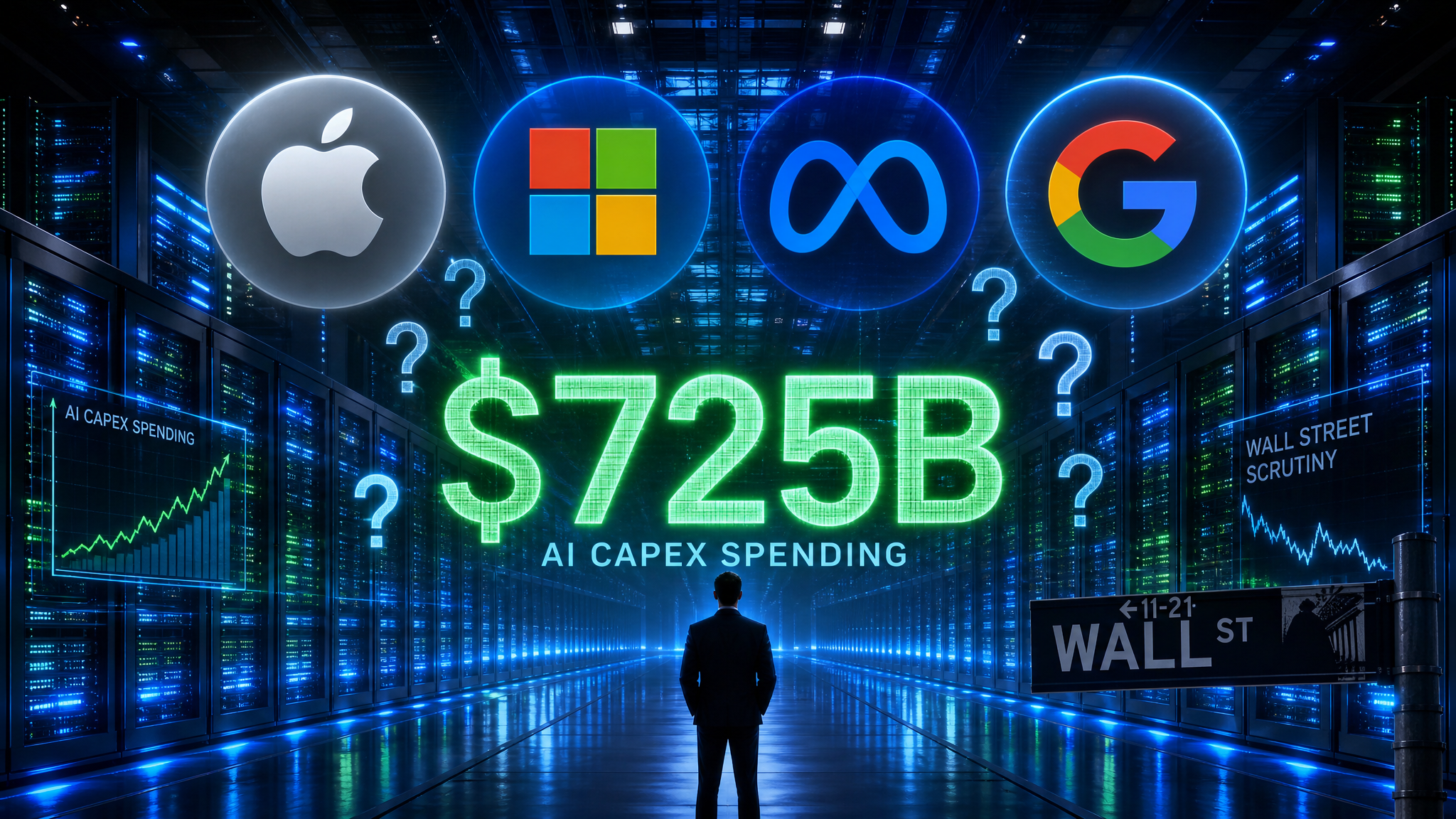
America's largest technology companies are collectively projecting capital expenditures approaching $725 billion for 2026—a staggering 77% increase over 2025. This unprecedented spending on artificial intelligence infrastructure has defined the Q2 2026 earnings season, transforming it from a routine quarterly check-in into a high-stakes referendum on whether the AI investment boom will deliver the returns that justify its extraordinary cost. The verdict from investors so far is nuanced: revenue growth is real, but patience for spending without a clear monetization timeline is running thin.
The New Investor Calculus
Something fundamental has changed in how Wall Street evaluates Big Tech earnings. For the past several years, investors rewarded companies that invested aggressively in AI, treating capital expenditure as a sign of strategic vision and competitive positioning. That era appears to be ending. In Q2 2026, the market's reaction to earnings reports has become highly sensitive to the relationship between spending and returns. Companies that beat revenue and earnings estimates but raised capex guidance without a clear monetization timeline have been punished, while those that can point to concrete evidence of AI-driven revenue growth have been rewarded.
This shift reflects a maturing of investor expectations. The initial excitement about AI's transformative potential has given way to a more sober assessment: at some point, the hundreds of billions being spent on data centers, chips, and AI models must translate into proportional earnings growth. The question is no longer whether AI will be transformative—it is when, and for whom.
Meta: The Cautionary Tale
Meta Platforms provided the starkest example of the new investor skepticism. Following its Q1 2026 report, the company's stock fell sharply despite posting its fastest revenue growth since 2021, with revenue reaching $56.3 billion and earnings per share of $10.44—both beating consensus estimates. The trigger for the sell-off was Meta's decision to raise its full-year 2026 capex guidance by another $10 billion to a range of $125 billion to $145 billion.
The move, coupled with the announcement of an 8,000-employee layoff to help offset costs, sent a troubling signal to the market: Meta is spending at an accelerating pace on AI infrastructure—particularly its new "Meta Superintelligence Labs"—without a defined payback period. CEO Mark Zuckerberg pointed to the success of AI-driven advertising tools, which have genuinely boosted ad revenue by 33% year-over-year. But analysts grew concerned that the company is making a massive bet on a future that may be years away from generating the profits needed to justify the investment.
Microsoft: Strong Cloud Demand Provides Cover
Microsoft navigated the capex scrutiny more successfully, thanks to its ability to point to concrete evidence of AI monetization. Its fiscal third-quarter report showed Azure cloud services growth accelerating to 40% year-over-year, beating expectations and reversing a trend of deceleration that had worried investors. The company also surpassed 20 million paid seats for its Microsoft 365 Copilot service—a tangible metric of enterprise AI adoption that investors can track and value.
However, even Microsoft was not immune to capex concerns. The company shocked investors with a 2026 capex forecast of $190 billion—a 61% year-over-year increase—citing rising memory and component costs driven by the broader AI infrastructure buildout. The market's relatively forgiving reaction to Microsoft's spending plans, compared to Meta's, reflects the difference between capex that is clearly tied to growing customer demand (Azure) and capex that is more speculative in nature.
Alphabet: The Earnings Season's Standout
Alphabet (Google) delivered what many analysts described as the standout report of the earnings season. Revenue reached $109.9 billion, beating estimates, and Google Cloud revenue surged 63% year-over-year—a figure that left little doubt about the monetization of AI infrastructure. Most impressively, Alphabet's cloud backlog swelled to a record $462 billion, providing extraordinary visibility into future revenue growth. This tangible evidence of demand helped buoy the stock even as the company raised its own 2026 capex guidance to between $180 billion and $190 billion.
Apple: The Supply Chain Canary
Apple's recent earnings report highlighted a different dimension of the AI capex boom—its inflationary ripple effects across the technology ecosystem. The company delivered a record-breaking quarter with $111 billion in revenue, driven by its high-margin Services division. However, management issued a stark warning: a global shortage of memory chips—a direct consequence of the massive AI server buildout by hyperscalers—is driving up component costs for Apple's hardware products. To protect its industry-leading margins, Apple signaled it would raise prices on premium hardware, a move analysts believe its loyal customer base will tolerate but that nonetheless represents a new cost pressure.
What Comes Next
The AI capex reckoning of Q2 2026 is unlikely to resolve quickly. The hyperscalers have committed to their spending plans and show no signs of pulling back. The key variable for investors is the pace at which this spending translates into revenue growth. Companies like Alphabet and Microsoft, which can already point to accelerating cloud revenue and growing enterprise AI adoption, are best positioned to weather investor scrutiny. Those that cannot yet demonstrate a clear return on their AI investments face a more challenging road ahead as the market's patience continues to thin.
This content is for informational purposes only and does not constitute financial advice. Always consult with a qualified financial advisor before making investment decisions.