Intel's 18A Breakthrough, TSMC's $265B Arizona Bet, and AMD's Rise: Inside the US Chip Sector's Mid-Cycle Reset
The US semiconductor industry — the engine of the market's first-half rally — entered a period of intense volatility and strategic re-evaluation in July 2026. While the long-term narrative of an AI-driven "supercycle" remains intact, with projections for the global semiconductor market to exceed $1.3 trillion, investors are now grappling with the second-order effects of this boom. The sector is experiencing what analysts are calling a "mid-cycle reset" — characterized by a sharp sell-off in crowded names, a rotation toward ancillary AI infrastructure players, and heightened scrutiny of valuations, capital expenditures, and geopolitical risks. Beneath the market turbulence, however, several structural developments are reshaping the competitive landscape in ways that will define the industry for years to come.
Intel's 18A Node: A Credibility-Defining Moment
Perhaps the most significant development in the US chip sector this month is Intel's progress on its 18A process node — the technology that CEO Lip-Bu Tan has staked his "IDM 2.0" foundry strategy on. Reports emerging in July indicate that Intel's 18A node has achieved an 85% yield rate, a threshold widely considered critical for commercial viability in advanced semiconductor manufacturing. This milestone is significant because yield — the percentage of functional chips produced from a given wafer — is the primary determinant of manufacturing economics and profitability.
More importantly, the 18A node is reportedly being evaluated by major technology companies including Nvidia, Microsoft, and Apple as a potential alternative to TSMC for certain chip designs. If Intel can secure even a portion of the manufacturing business from these hyperscalers, it would represent a transformative shift in the foundry landscape and validate years of investment in its manufacturing turnaround. The market has responded cautiously but with growing interest, recognizing that a credible Intel foundry business would reduce the industry's dangerous concentration of advanced manufacturing capacity in Taiwan.
TSMC's $265 Billion Arizona Commitment
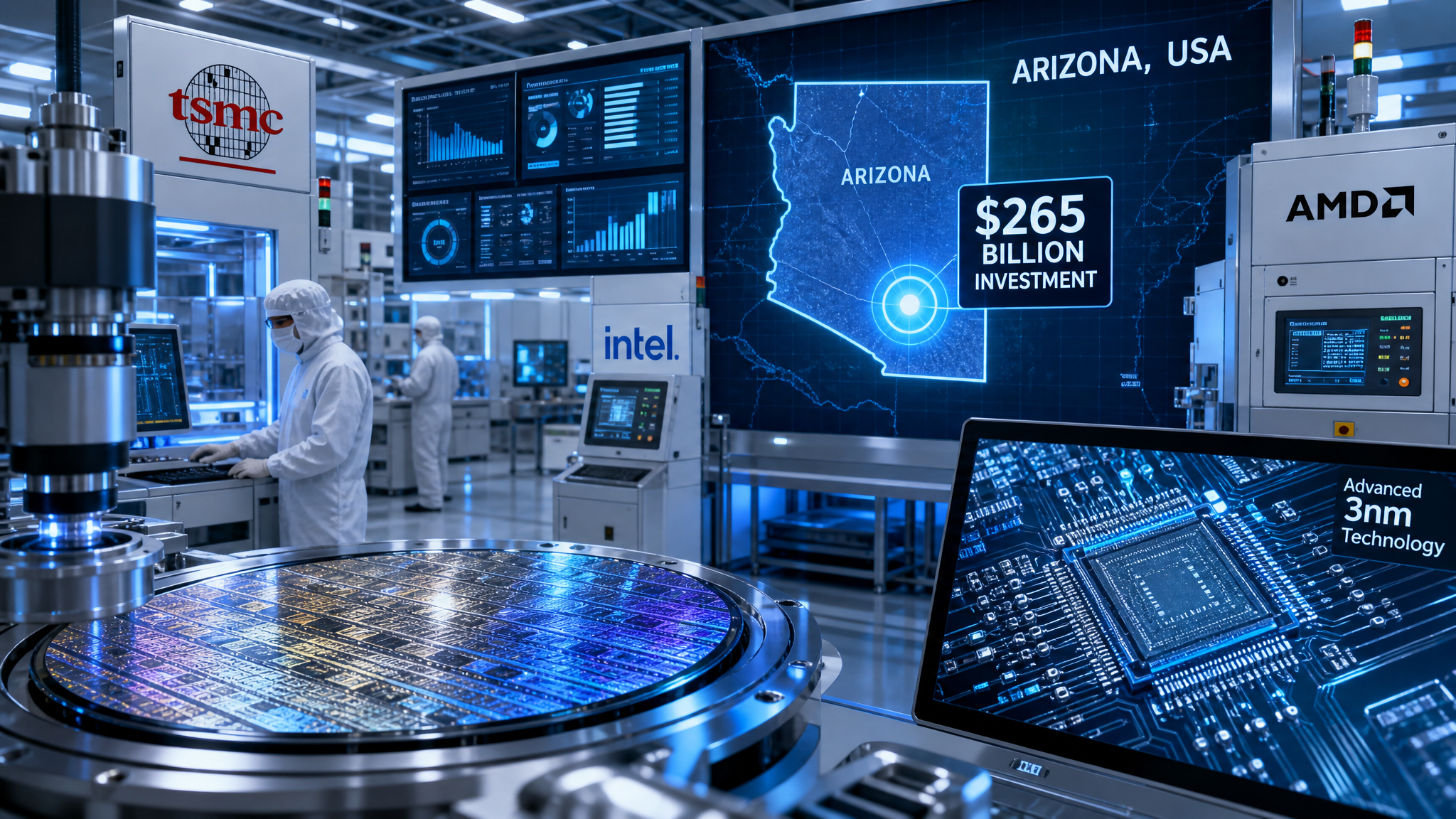
Taiwan Semiconductor Manufacturing Company (TSMC) made headlines in July with a massive expansion of its US investment commitment. The company announced an additional $100 billion in planned spending, bringing its total Arizona investment to $265 billion. This expanded plan includes provisions for up to 12 fabrication plants, including facilities for advanced 2-nanometer production and, critically, dedicated CoWoS (Chip on Wafer on Substrate) advanced packaging capacity.
The inclusion of advanced packaging in TSMC's Arizona expansion is particularly significant. Analyst reports have identified advanced packaging and the supply of High Bandwidth Memory (HBM) as the primary structural bottlenecks constraining the AI hardware supply chain. CoWoS technology, which allows multiple chips to be integrated into a single package with high-bandwidth interconnects, is essential for producing the AI accelerators that power large language models and other demanding workloads. By building CoWoS capacity in the US, TSMC is directly addressing the supply chain vulnerability that has limited AI chip production and aligns with US policy goals of creating a more resilient, domestic end-to-end semiconductor supply chain.
AMD Consolidates Its Position as Nvidia's Credible Challenger
While Nvidia continues to command between 70% and 86% of the AI accelerator market — a dominance anchored by its powerful CUDA software ecosystem — AMD has solidified its position as a credible second source for hyperscalers seeking to diversify their AI chip supply chains. AMD's MI300 and MI400 series GPUs have gained significant traction among cost-conscious cloud providers, with the company securing major deals with Meta and Oracle. AMD's competitive pricing strategy and its growing software ecosystem have made it an increasingly attractive alternative for workloads where CUDA compatibility is not a strict requirement.
The competitive dynamics between Nvidia and AMD are playing out against a backdrop of intensifying US-China tensions in the semiconductor space. While the US conditionally approved exports of Nvidia's H200 chips to China under a strict licensing framework, actual deliveries have been described by officials as "trivial." The Commerce Department has also moved to tighten enforcement, closing a loophole that allowed Chinese firms to acquire restricted chips through overseas subsidiaries. This regulatory uncertainty creates a persistent headwind for US chipmakers reliant on the Chinese market, while simultaneously accelerating China's push for semiconductor self-sufficiency through companies like Huawei and SMIC.
The Rotation Beyond Pure GPU Plays
The July sell-off in semiconductor stocks has accelerated a rotation that was already underway — from pure GPU plays toward other beneficiaries of the AI infrastructure buildout. Memory maker Micron Technology has attracted increased investor attention as demand for High Bandwidth Memory continues to outstrip supply. Networking specialist Broadcom has similarly benefited from the recognition that AI workloads require not just powerful processors but also high-speed interconnects and custom silicon for specific applications.
This broadening of the AI investment thesis reflects a maturing understanding of the semiconductor value chain. The initial phase of the AI boom was dominated by a simple narrative: more AI means more Nvidia GPUs. The current phase is more nuanced, recognizing that the bottlenecks in AI infrastructure are distributed across multiple layers — from advanced packaging and memory to networking and power management. Investors who can identify the specific chokepoints in this supply chain and the companies best positioned to address them will be better positioned to navigate the sector's mid-cycle reset and capture the long-term value creation that the AI supercycle promises.
This content is for informational purposes only and does not constitute financial advice. Always consult with a qualified financial advisor before making investment decisions.