Dual Blockade: How the Red Sea and Hormuz Crisis Is Reshaping EMEA Trade, Freight Rates, and Emerging Markets
The geopolitical landscape of mid-2026 is defined by an unprecedented simultaneous disruption to two of the world's most critical maritime trade arteries: the Red Sea and the Strait of Hormuz. This "dual blockade" has moved beyond a regional conflict to become a powerful driver of global inflation, supply chain instability, and a fundamental reordering of strategic and economic priorities across the EMEA region. The International Energy Agency has described the Hormuz disruption as the largest supply disruption in the history of the global oil market, and the combined effect of both crises is creating a systemic shock with far-reaching consequences for investors, businesses, and governments across Europe, the Middle East, and Africa.
The Mechanics of the Dual Blockade
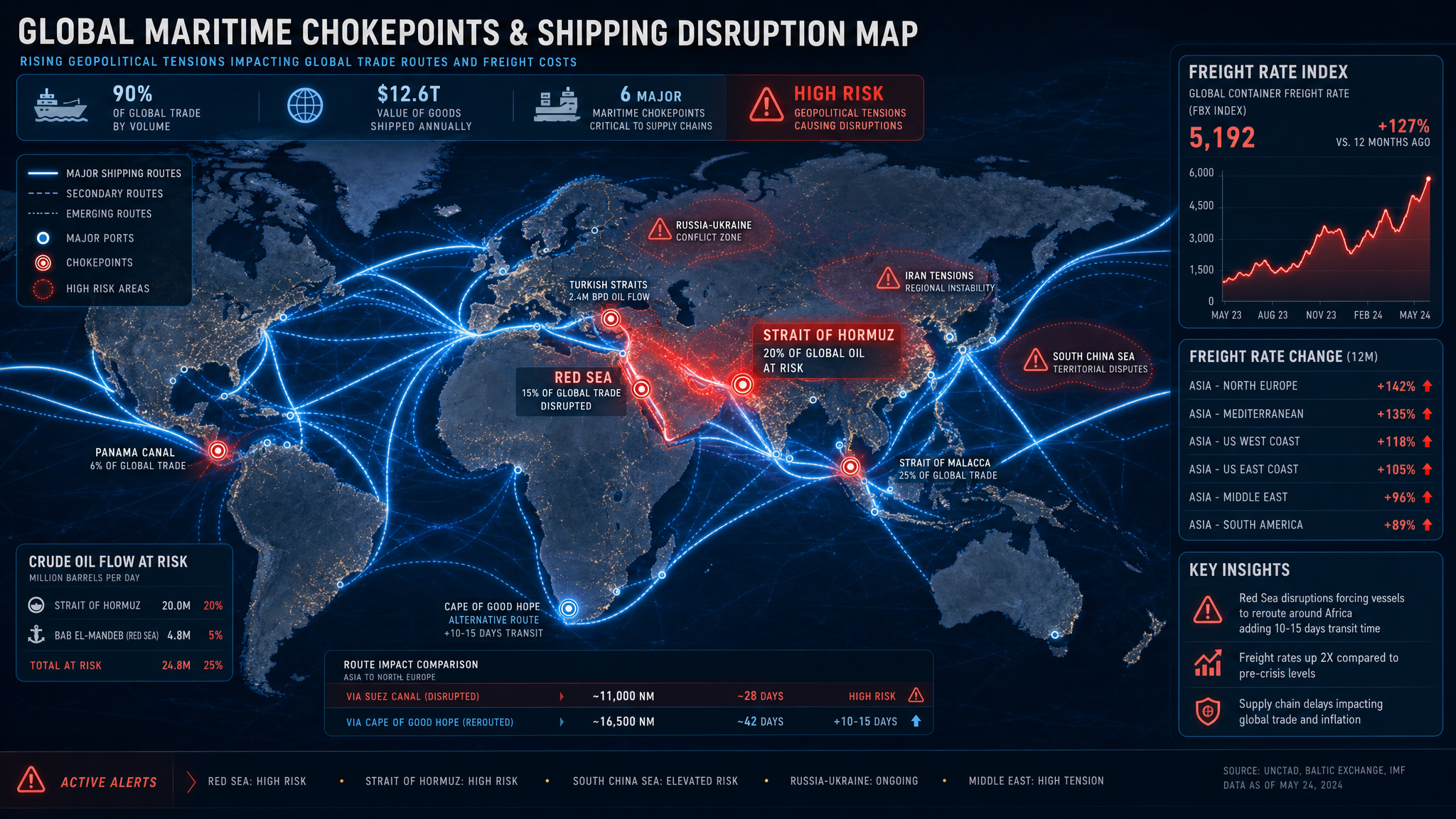
The Strait of Hormuz crisis stems from the effective closure of the waterway by Iran since late February 2026, enforced through naval mines and attacks on commercial vessels in response to the conflict with the U.S. and Israel. This action has trapped hundreds of ships and thousands of mariners, bringing tanker traffic to a near-standstill and disrupting approximately 20% of global oil and LNG trade. The U.S. has reinstated a naval blockade on Iranian oil exports, further tightening the physical energy market and sending Brent crude futures into backwardation.
Compounding this crisis are the ongoing Houthi attacks on shipping in the Red Sea, which have forced most major container lines to abandon the Suez Canal route — the fastest maritime link between Asia and Europe — in favor of the much longer and costlier journey around Africa's Cape of Good Hope. This rerouting adds 10 to 14 days to transit times, causing freight rates on major trade lanes to surge by 25-45% and tying up a significant portion of the global fleet. The simultaneous disruption of these two critical arteries has created a systemic shock, leading to severe congestion at transshipment hubs like Jebel Ali and rippling delays throughout global manufacturing and retail supply chains.
Freight Rates and Supply Chain Disruption
The impact on global freight markets has been dramatic. Container shipping rates on the Asia-Europe route have surged as carriers are forced to deploy more vessels to cover the longer Cape of Good Hope route, effectively reducing the available capacity on the market. The shortage of empty containers at key ports — a consequence of the longer transit times — is creating bottlenecks that are reminiscent of the supply chain disruptions seen during the COVID-19 pandemic. Retailers and manufacturers across Europe are facing longer lead times, higher logistics costs, and increased inventory uncertainty.
The tanker market has been even more severely affected. The effective closure of the Strait of Hormuz has created a bifurcated market, with tankers able to operate in the Persian Gulf commanding extraordinary premiums, while the broader tanker fleet is being redeployed on longer alternative routes. War risk insurance premiums for vessels transiting the region have surged to levels not seen since the Iran-Iraq War of the 1980s, adding further costs to the already elevated freight rates. Analysts warn that the inability of international naval forces to guarantee freedom of navigation sets a dangerous precedent, potentially encouraging other states to weaponize maritime chokepoints in future conflicts.
MENA Region: Growth Slows to 1.4%
The economic consequences for the Middle East and North Africa (MENA) region are severe and multifaceted. The IMF projects a sharp growth slowdown for the MENA region in 2026 to just 1.4%, with oil exporters facing contractions due to the disruption of their export routes and oil importers grappling with higher energy bills, tighter financial conditions, and weaker remittance flows. The crisis is creating a paradoxical situation where oil-rich nations are struggling to monetize their resources due to the very conflict that is driving up oil prices.
The IMF and World Bank are urging fiscal consolidation and targeted aid for vulnerable populations rather than broad, costly energy subsidies. However, the political pressures on governments in the region to shield their populations from the economic fallout are immense, creating a tension between fiscal prudence and social stability. Countries like Egypt, Jordan, and Lebanon — which are oil importers and heavily dependent on Suez Canal revenues and tourism — are particularly vulnerable to the dual blockade's economic consequences.
Sub-Saharan Africa: Debt Distress and Stagnating Growth
In Sub-Saharan Africa, the picture is similarly challenging. The region's growth is stagnating at 4.1%, while high debt-servicing burdens consume an increasing share of government revenues, limiting the capacity for investment and crisis response. Approximately 22 low-income countries are in or at high risk of debt distress, forcing a pivot towards domestic debt markets, which carries its own risks of crowding out private credit and raising borrowing costs for businesses.
The higher freight rates and energy costs resulting from the dual blockade are feeding directly into inflation across Sub-Saharan Africa, eroding the purchasing power of already vulnerable populations. Countries that are heavily dependent on food imports — which are transported by sea — are facing acute food security risks as higher shipping costs translate into higher food prices. The World Bank has warned that the crisis could reverse years of progress in poverty reduction across the region.
Strategic Realignments: Turkey's NATO Moment
Amid the turmoil, strategic alignments are shifting in ways that have significant implications for regional geopolitics and investment flows. The U.S. administration has signaled a potential rapprochement with Turkey, viewing Ankara as a key partner for regional security in a volatile Middle East. Discussions during a July NATO summit included the possibility of lifting sanctions on Turkey's defense industry and a prospective F-35 sale, contingent on the resolution of the S-400 missile system dispute. This move highlights a pragmatic re-evaluation of partnerships and could have significant implications for Turkish defense stocks and the broader investment climate in Turkey.
For investors with EMEA exposure, the dual blockade crisis underscores the importance of geopolitical risk assessment in portfolio construction. The crisis is not a temporary disruption — it reflects a structural shift in the willingness of state and non-state actors to weaponize maritime chokepoints as instruments of geopolitical leverage. Building resilience against this risk requires diversification across supply chains, careful assessment of logistics costs in investment models, and a heightened focus on the political risk premium embedded in EMEA asset valuations.
This content is for informational purposes only and does not constitute financial advice. Always consult with a qualified financial advisor before making investment decisions.