Goldman Sachs Flags 'Remarkable Retreat': Hedge Funds Dump Magnificent Seven as Put/Call Ratio Spikes
Wall Street's most sophisticated investors are executing a significant tactical repositioning. Prime brokerage data from Goldman Sachs, J.P. Morgan, and Morgan Stanley reveals that hedge funds have been aggressively reducing their exposure to the market's most crowded and high-flying technology stocks throughout July 2026. This "remarkable retreat" — Goldman's own characterization — is not a broad bearish call on US equities but rather a strategic maneuver to harvest profits, manage concentration risk ahead of earnings season, and navigate a market increasingly defined by extreme positioning and mechanical rebalancing flows.
The Magnificent Seven Exodus
According to Goldman Sachs Prime Brokerage, hedge funds initiated a significant reduction in technology sector exposure at the start of July. The selling was particularly focused on the "Magnificent Seven" stocks — Apple, Microsoft, Nvidia, Alphabet, Amazon, Meta, and Tesla — that had dominated market performance in the first half of 2026. Both gross and net exposure to this cohort fell to the lowest levels seen in 2026, representing a meaningful shift in institutional positioning after months of concentrated accumulation.
Goldman analysts characterized this move as a "positioning reset," driven by risk managers proactively trimming positions to mitigate vulnerabilities associated with crowded trades. A key trigger was the anticipation of significant mechanical rebalancing flows — specifically, quarter-end pension fund rebalancing that historically involves selling equities that have outperformed and buying underperforming asset classes. By reducing exposure ahead of these flows, hedge funds sought to avoid being caught on the wrong side of a technically-driven sell-off. The selling in semiconductor and tech hardware stocks extended for a fourth consecutive week as of mid-July.
J.P. Morgan Confirms the De-Risking Trend
J.P. Morgan's research team independently confirmed the de-risking trend, noting that the process began in June and was creating a tactical headwind for equities. Crucially, however, the bank's analysis suggested that institutional investors were not exiting the market entirely. Instead, capital was being reallocated from high-beta growth names to more defensive and cyclical sectors. There was a notable increase in long positions in broad market index ETFs — a way to maintain equity market exposure while reducing idiosyncratic, company-specific risk — alongside rotation into energy, real estate, consumer staples, and financials.
This pattern of "de-risking within equities" rather than "de-risking from equities" is an important distinction. It suggests that institutional investors remain constructive on the overall market outlook but are concerned about the specific risks embedded in the technology sector's extreme valuations and crowded positioning. The rotation into defensive sectors also reflects a hedge against the possibility that the Federal Reserve may need to raise rates further, which would disproportionately hurt high-multiple growth stocks.
Options Market: Fear Gauge Flashes Warning
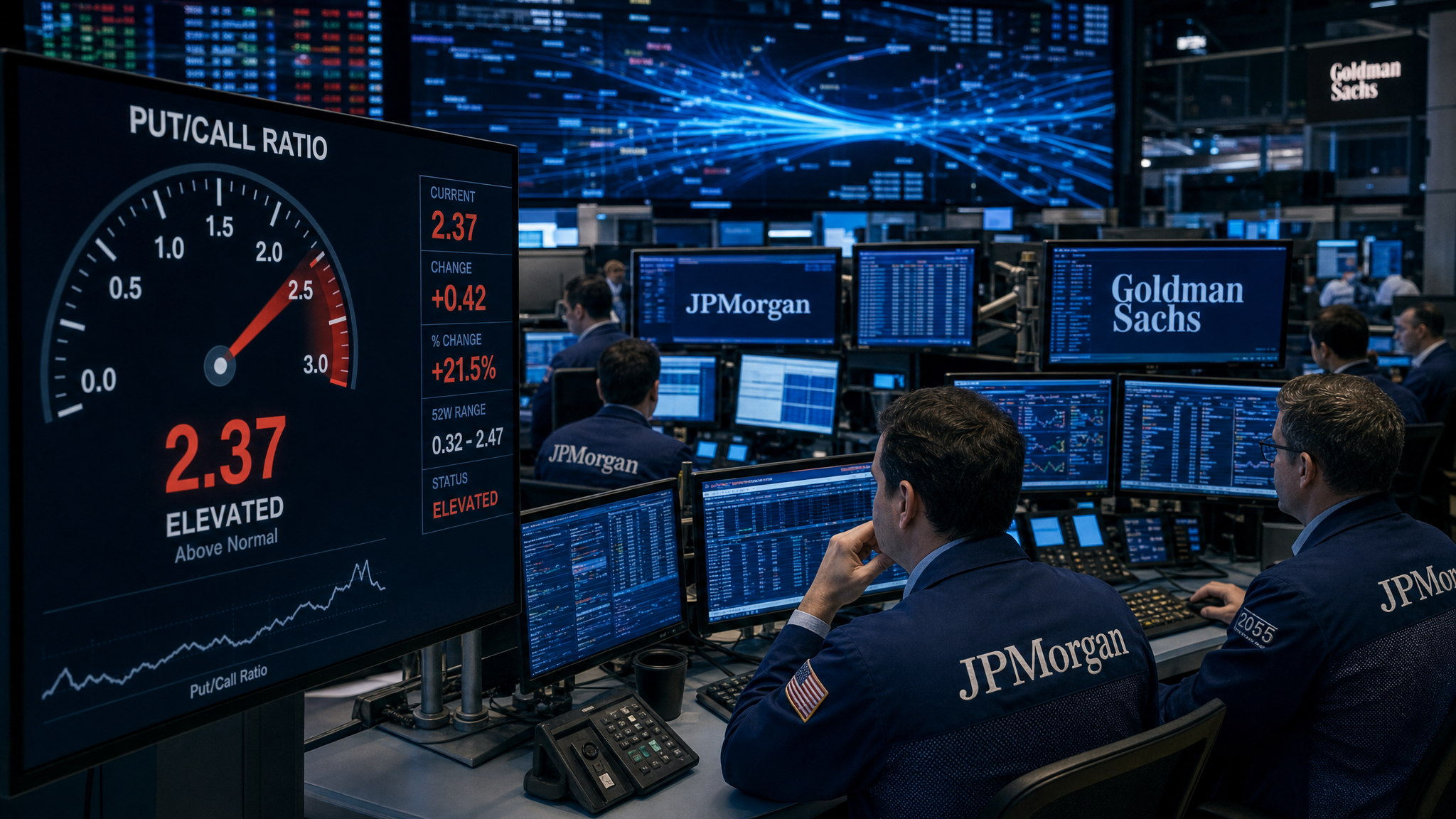
Activity in the derivatives market provided further confirmation of the cautious institutional turn. The Cboe Equity Put/Call Ratio — a key sentiment indicator that measures the ratio of bearish put options purchased relative to bullish call options — spiked to elevated levels during the week. The ratio reached 1.66 on July 14 before closing the week at 1.47. Readings consistently above 1.0 indicate that investors are buying more puts (bearish bets or hedges) than calls, signaling heightened market anxiety and a desire for downside protection.
Analysis of options flow in specific names showed a clear shift toward put-buying ahead of earnings announcements. Traders were paying elevated premiums for protection in names like JPMorgan and Tesla, reflecting uncertainty about whether these companies could deliver results that justify their current valuations. The elevated cost of options protection is itself a signal — it indicates that market participants are willing to pay a significant price to hedge against downside scenarios, which historically has been associated with periods of increased volatility.
Dark Pools: The Institutional Fingerprint
Off-exchange trading venues, commonly known as dark pools, continued to handle a substantial portion of US equity volume during this period of institutional repositioning. FINRA statistics and real-time data providers estimate that off-exchange venues — including dark pools and wholesale market makers — account for 40-45% of all US equity volume. In the first quarter of 2026, dark pools handled 40.3% of volume, with technology stocks like NVIDIA and Microsoft seeing the highest levels of net institutional buying pressure in these venues.
Traders and analysts monitor block trades and price-level clustering in dark pool prints for clues about institutional accumulation and distribution patterns. During periods of significant repositioning, dark pool activity can provide early signals of directional shifts before they become fully visible in public market data. The elevated dark pool volumes observed in technology stocks during July suggest that large institutions are actively managing their positions — a dynamic that retail investors and smaller funds should factor into their own risk assessments.
The collective evidence from Goldman Sachs, J.P. Morgan, Morgan Stanley, and derivatives markets points to a "smarter" institutional mindset in July 2026 — one that is less reliant on broad market momentum and more focused on active risk management, diversification, and tactical positioning ahead of a potentially volatile earnings season and Federal Reserve decision.
This content is for informational purposes only and does not constitute financial advice. Always consult with a qualified financial advisor before making investment decisions.