Philly Fed Surges to 41.4, Housing Starts Jump 19%: US Economic Data Defies Slowdown Fears
A flurry of US economic data released during the week of July 13, 2026, delivered a powerful counter-narrative to growing fears of a domestic slowdown. Standout reports from the manufacturing and housing sectors, combined with continued stability in the labor market and an unexpected improvement in consumer sentiment, painted a picture of an economy with more underlying momentum than many analysts had anticipated. The data complicates the Federal Reserve's calculus and raises important questions about the durability of the current expansion.
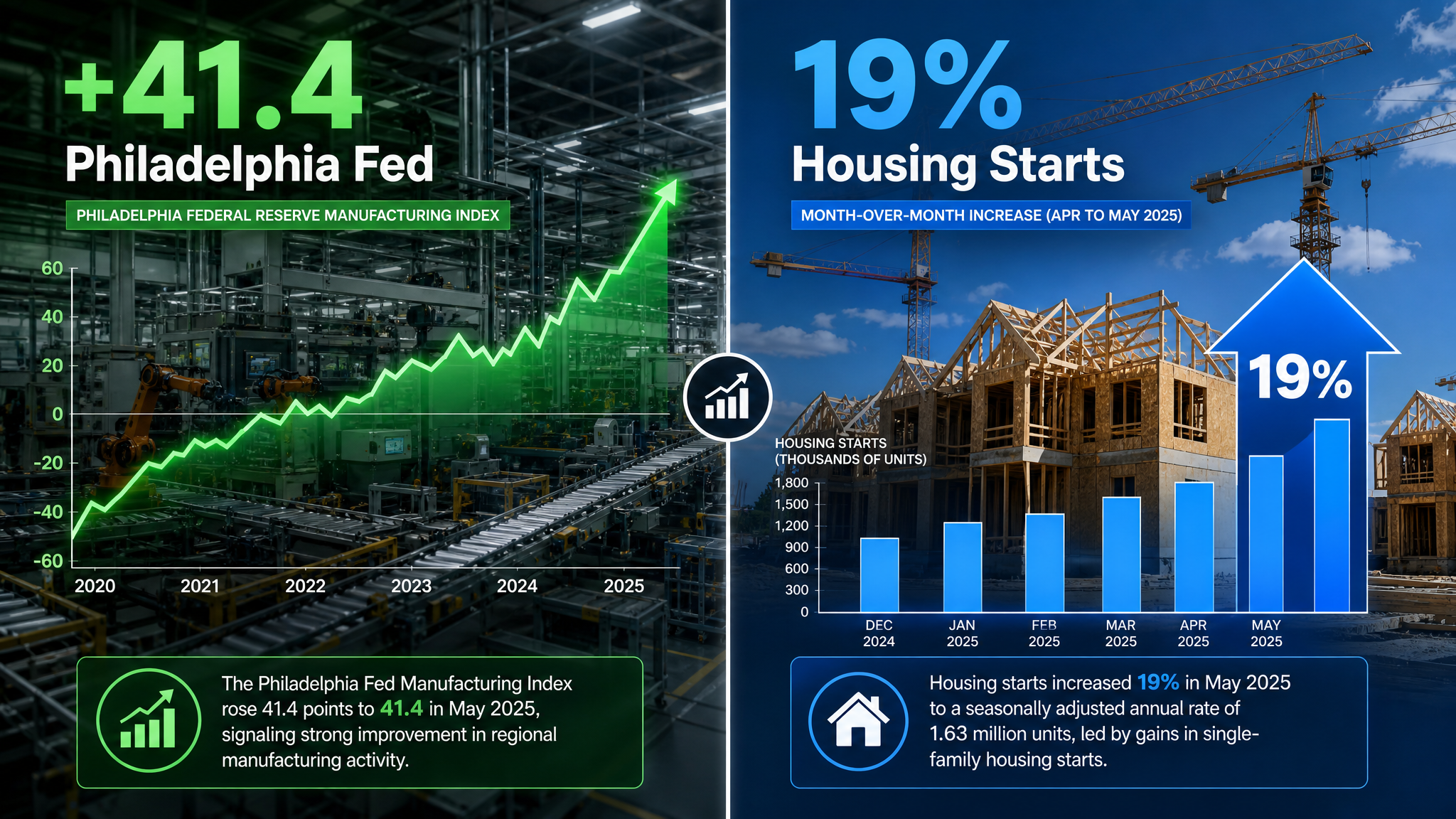
Philadelphia Fed Manufacturing Index: A Five-Year High
The most dramatic upside surprise came from the manufacturing sector. The Philadelphia Fed Manufacturing Index for July, released on July 16, surged to a reading of +41.4 — dramatically outperforming the consensus expectation of +13.0 and the prior month's reading of +10.3. The report noted that measures for general activity and new orders reached their highest levels in nearly five years, signaling a robust environment for factory activity in the Mid-Atlantic region.
While this regional survey reflects conditions in a specific geographic area, its strength is often viewed as a leading indicator for broader national manufacturing trends. The magnitude of the beat — more than three times the consensus forecast — suggests that the manufacturing sector may be experiencing a genuine acceleration, potentially driven by reshoring activity, defense spending, and AI-related infrastructure buildout. Broader national data showed more modest growth, with the Federal Reserve's report on industrial production indicating a 0.1% month-over-month increase in June, slightly below the 0.2% forecast, though year-over-year production was up a solid 1.1%.
Housing Starts: A 19% Monthly Surge
The housing market delivered an equally striking performance. According to a joint report from the US Census Bureau and the Department of Housing and Urban Development, housing starts soared to a seasonally adjusted annual rate of 1.427 million in June — a remarkable 19.0% monthly increase from May's revised figure and significantly above the consensus forecast of 1.31 million. The data points to a strong rebound in construction activity, suggesting that homebuilders are responding to persistent demand for new housing inventory in a market where existing home supply remains constrained.
However, a note of caution emerged from the forward-looking component of the report. Building permits — a leading indicator of future construction activity — dipped by 3.0% in June to a rate of 1.367 million. This divergence between current starts and future permits suggests that while builders are actively constructing today, their confidence in the pipeline of new projects may be moderating. Ongoing concerns about mortgage affordability, material costs, and buyer demand at current interest rate levels likely weigh on permit applications even as existing projects move forward.
Jobless Claims: Labor Market Remains Tight
The labor market, a critical pillar of the US economic expansion, continued to demonstrate remarkable tightness. Initial jobless claims for the week ending July 11 were reported at 208,000 — a decrease of 8,000 from the prior week and slightly below the consensus forecast of 212,000. The low level of claims indicates that layoffs remain minimal across the economy, reinforcing the view of a healthy job market that provides a strong foundation for consumer spending and overall economic activity.
The combination of strong manufacturing activity, robust housing construction, and a tight labor market creates a challenging environment for the Federal Reserve. Each of these data points argues against the need for near-term rate cuts, while simultaneously suggesting that the economy can withstand the current level of monetary policy restriction. For investors, this "Goldilocks" scenario — strong enough to avoid recession but not so hot as to force immediate rate hikes — is generally supportive of equity valuations, though it also means the Fed is unlikely to provide the rate-cut catalyst that some market participants have been hoping for.
Consumer Sentiment: An Unexpected Uptick
Adding to the positive data flow, the preliminary reading of the University of Michigan's Consumer Sentiment Index for July climbed to 54.4, topping forecasts of 51.0 and improving from the 49.5 recorded in June. While the absolute level of confidence remains below historical averages — reflecting ongoing concerns about inflation and global uncertainty — the upward trend suggests a potential turning point in household psychology. Consumers appear to be growing more comfortable with the current economic environment, even as they remain cautious about the future.
The full picture of consumer confidence for July will become clearer with the release of The Conference Board's Consumer Confidence Index on July 28. That report will provide additional granularity on consumers' assessments of current conditions versus their expectations for the future — a distinction that is particularly important in an environment where sentiment can shift rapidly in response to energy prices, employment conditions, and financial market performance.
Taken together, this week's data releases represent a meaningful challenge to the bearish narrative that has gained traction in recent weeks. The US economy, it appears, retains significant resilience — a fact that markets will need to incorporate as they navigate the second half of 2026.
This content is for informational purposes only and does not constitute financial advice. Always consult with a qualified financial advisor before making investment decisions.