European Equities Rotate Away From Tech: DAX, CAC 40 and STOXX 600 Navigate a Defensive Shift
European equity markets are experiencing one of the most significant sector rotations of 2026, as investors pivot decisively away from the artificial intelligence-driven technology rally that dominated the first half of the year. The pan-European STOXX 600, the German DAX, and the French CAC 40 are all navigating a new market regime defined by defensive positioning, selective cyclical exposure, and a sharp reassessment of technology valuations. Understanding the forces behind this rotation is essential for any investor with EMEA equity exposure.
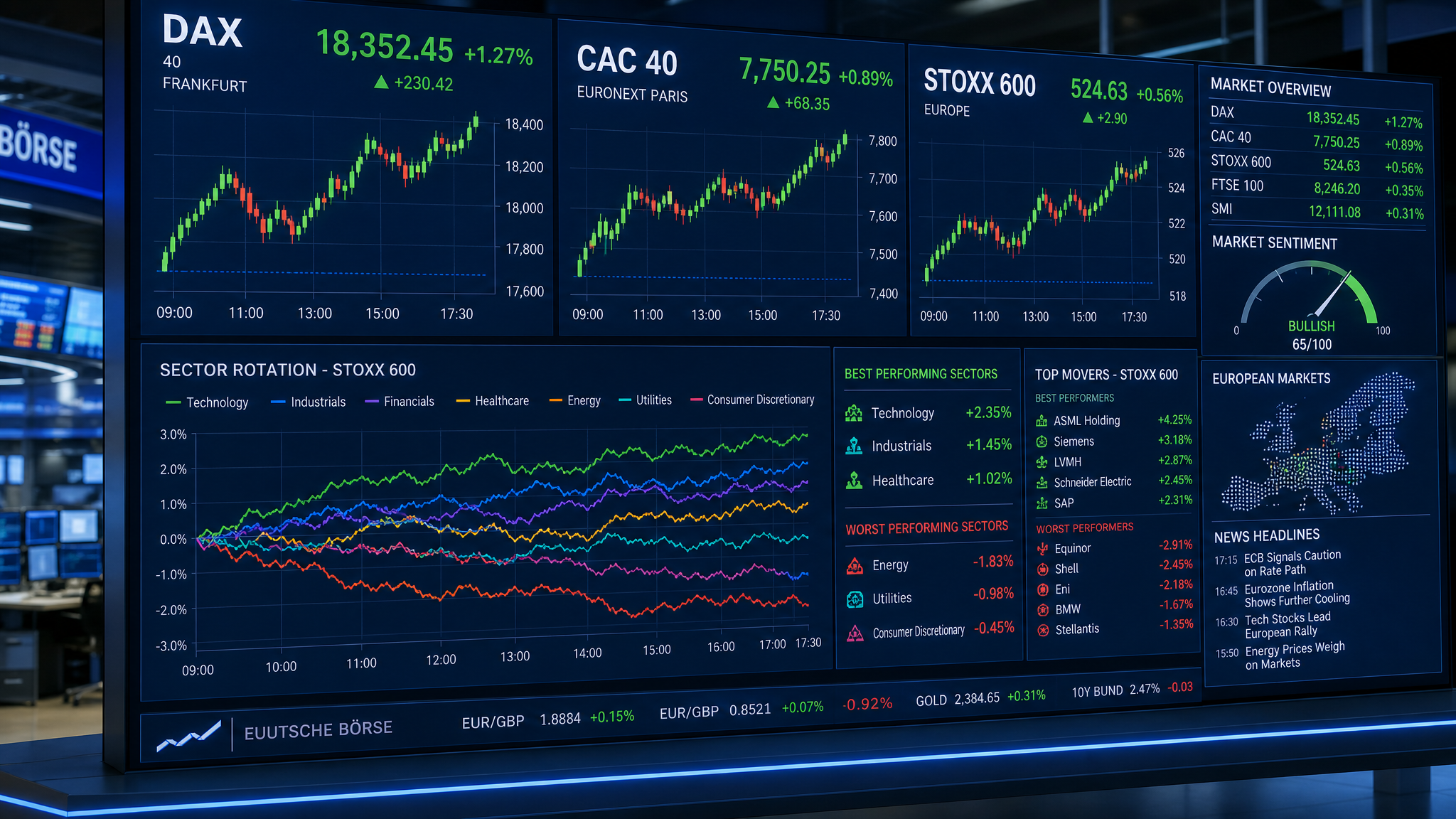
The Technology Sell-Off: What Triggered the Rotation?
The catalyst for the current rotation was a confluence of factors that eroded confidence in the sustainability of AI-linked valuations. Concerns mounted over potential delays in infrastructure spending by major AI hyperscalers, while the emergence of competitive large language models from Chinese technology firms challenged the assumption of Western dominance in the sector. The result was a sharp de-rating of European semiconductor and technology stocks.
ASML, the Dutch chip equipment giant and a bellwether for the European tech sector, saw its shares slip 3.9% in mid-July, reflecting broader anxiety about the near-term demand outlook for advanced chipmaking equipment. German industrial conglomerate Siemens, which has significant exposure to digital industries, fell 2.3% during the same period. The STOXX 600 technology sub-index recorded its largest single-day decline since February on June 23, falling 3.7%, and continued to experience sharp swings into July. The German DAX shed 0.59% in one session around July 15, weighed down by its technology and industrial components.
Winners of the Rotation: Defensives and Cyclicals
The capital flowing out of technology has found new homes in sectors that offer more predictable earnings streams and lower valuation risk. Healthcare has been the standout defensive winner, consistently outperforming during broader market pullbacks. During a notable tech-led downturn on July 7, the healthcare sector advanced 1.3%, demonstrating its role as a portfolio stabilizer. Pharmaceutical giants and medical device companies across the STOXX 600 have attracted significant inflows from risk-averse institutional investors.
Cyclical sectors, particularly banks and financial services, also benefited during periods when macroeconomic data softened expectations for aggressive central bank tightening. A weaker-than-expected U.S. jobs report in early July temporarily cooled Federal Reserve rate-hike fears, broadening the market rally beyond technology and allowing financials to participate. The French CAC 40 showed relative resilience, posting a modest 0.19% gain on days when the DAX was under pressure, partly due to its different sectoral composition and greater weighting toward luxury and consumer goods.
Earnings Season: The Energy Distortion
The second-quarter 2026 earnings season is amplifying the divergence across European sectors. LSEG I/B/E/S data projects that STOXX 600 companies will achieve average earnings growth of 16.7%, the strongest in over three years. However, this headline figure is deeply misleading. The energy sector is expected to see profits surge by over 125% year-on-year, driven by elevated oil and gas prices linked to Middle East supply disruptions. Strip out energy companies, and the earnings growth rate for the rest of the STOXX 600 falls to a far more modest 6.4%.
This energy distortion highlights the challenging environment for consumer-facing industries. In the first quarter of 2026, luxury stocks declined by over 20% and the auto sector fell by 11.5%, struggling with the dual pressures of inflation and shifting consumer demand. Upcoming results from major firms including SAP, Novartis, and Volkswagen will be critical in providing clarity on the underlying health of corporate Europe beyond the energy windfall.
The STOXX 600 at a Crossroads
The pan-European STOXX 600 hit an intraday record of 652.35 in early July before its momentum stalled. The Euro Area Stock Market Index (EU50) retreated to 6,254 points, reflecting a 1.10% monthly decline. This consolidation reflects the market's uncertainty about the durability of the rotation and the broader macroeconomic outlook. The ECB's cautious monetary policy stance, a fragile growth forecast of just 0.8% for the euro area in 2026, and persistent geopolitical risks from the Middle East all weigh on investor sentiment.
For investors, the key question is whether the defensive rotation represents a temporary repositioning or a more durable structural shift. The answer likely depends on the trajectory of energy prices, the outcome of the Q2 earnings season, and the ECB's next policy moves. In the near term, the market appears to be rewarding quality, predictability, and dividend yield over growth and momentum — a regime that favors the FTSE 100's composition over the more tech-heavy DAX and STOXX 600.
Key Levels and Investor Takeaways
For the DAX, the 18,000 level represents a key psychological support zone, while the CAC 40 is watching the 7,500 area. The STOXX 600's ability to hold above the 640 level will be closely monitored as a gauge of broader European market health. Investors should pay close attention to the upcoming earnings releases from SAP and Volkswagen, which will serve as important data points for the technology and industrial sectors respectively.
The rotation underway in European equities is not simply a flight from risk — it is a sophisticated repricing of growth expectations in a world where interest rates remain elevated, energy costs are high, and geopolitical uncertainty is structurally embedded. Navigating this environment requires a granular, sector-by-sector approach rather than broad index exposure.
This content is for informational purposes only and does not constitute financial advice. Always consult with a qualified financial advisor before making investment decisions.