Turkey's Managed Lira Decline: BIST 100 Volatility, 37% Rates, and the Inflation Tightrope
Turkey's financial markets in July 2026 present one of the most complex investment landscapes in the emerging market universe. The Central Bank of the Republic of Turkey (TCMB) is holding its benchmark one-week repo rate at a restrictive 37%, the Turkish Lira is testing new all-time lows against the U.S. dollar, and the BIST 100 equity index has shed 5.71% over the past month amid political shocks and persistent macroeconomic imbalances. Yet within this turbulence, some analysts see selective opportunities for investors willing to navigate the risks.
The TCMB's Restrictive Stance: Holding at 37%
The TCMB held its benchmark one-week repo rate at 37% for the third consecutive month at its June meeting, reaffirming its commitment to the orthodox economic program that has been in place since the government's policy pivot in 2023. Governor Fatih Karahan has been explicit: monetary policy will remain tight until a significant and sustained improvement in the inflation outlook is evident. The central bank has specifically flagged the July inflation data as a critical determinant for any future decisions on resuming the easing cycle that was paused in January 2026.
This hawkish stance is a direct response to Turkey's deep-seated inflation problem. Annual consumer price index (CPI) inflation eased slightly to 32.11% in June 2026, down from 32.61% in May, marking the lowest reading since March. The moderation was driven by slower price growth in housing and transportation. However, the improvement is fragile. Core inflation, particularly in services and rents, is reportedly re-accelerating, presenting a significant hurdle to the TCMB's disinflation path. The central bank has already been forced to revise its year-end 2026 inflation target upward to a range of 15-21%, partly due to energy price volatility stemming from the conflict in the Middle East.
The Lira's Managed Decline: USD/TRY at 47.18
The Turkish Lira has followed a path of steady, managed depreciation throughout 2026, a deliberate strategy designed to avoid the disorderly currency crashes that characterized earlier periods of Turkish economic instability. Despite this managed approach, the lira has consistently set new record lows against the U.S. dollar, reaching an all-time high for the USD/TRY pair of approximately 47.18 in July 2026. Over the preceding 12 months, the lira depreciated by nearly 17%.
The structural drivers of lira weakness are well-established and persistent. Turkey's wide inflation differential with its trading partners erodes the currency's real value continuously. A persistent current-account deficit, which widened to a 12-month rolling shortfall of $37.3 billion, creates a structural demand for foreign currency that the lira supply cannot easily offset. Muted foreign portfolio inflows compound the problem; May 2026 saw a net outflow of $3.1 billion from Turkish financial markets, further pressuring the currency. The EUR/TRY cross reflects this weakness, with the ECB's official reference rate on July 17 standing at approximately 53.91 TRY per euro.
BIST 100: Political Risk and Circuit Breakers
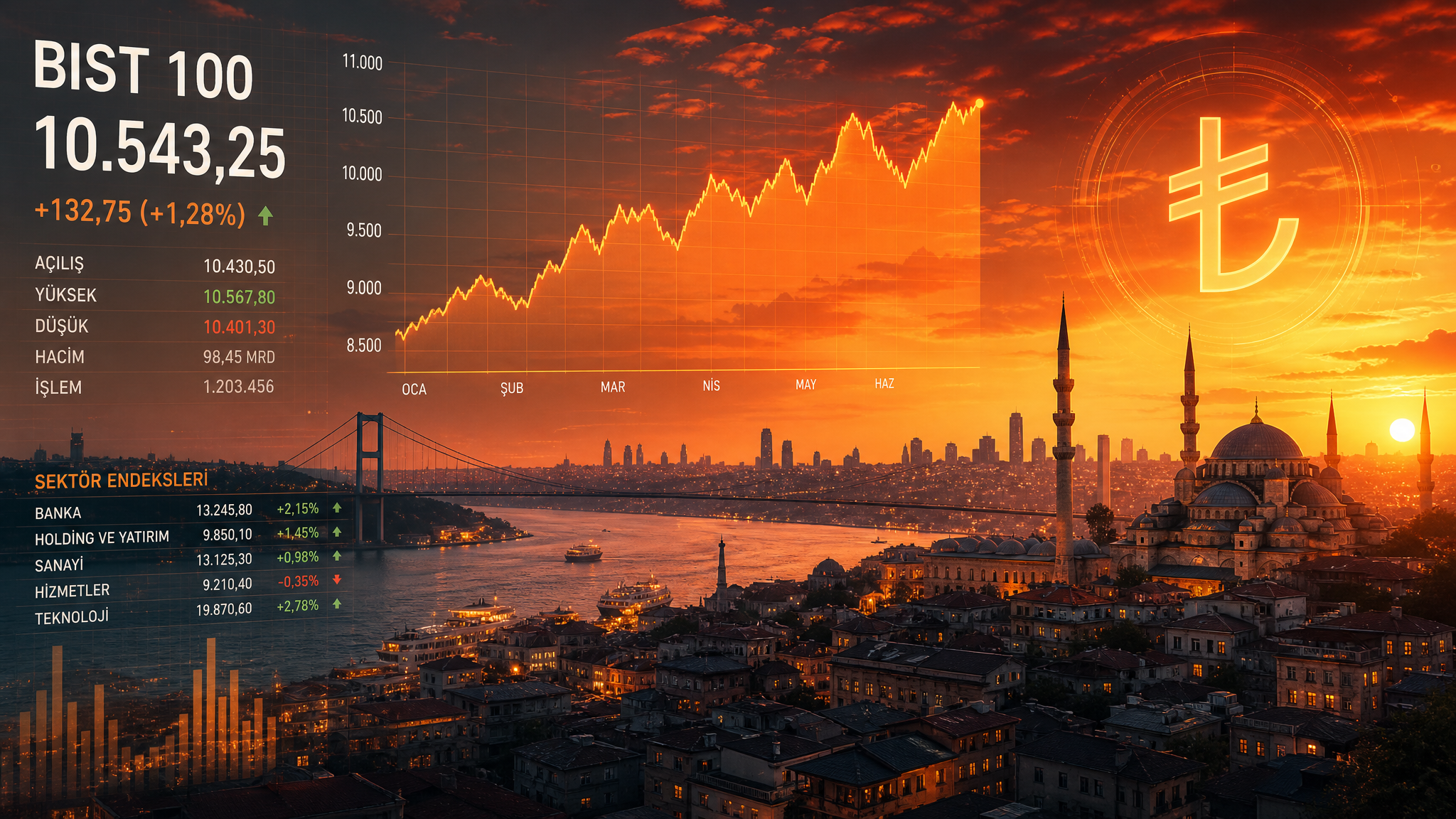
The BIST 100 equity index, which had achieved record highs at the start of 2026 on the back of declining borrowing costs and improving investor sentiment, has since faced significant turbulence. The index has fallen 5.71% over the past month, a decline that reflects both the challenging macroeconomic backdrop and the potent impact of political risk on Turkish markets.
A stark illustration of this political risk materialized in May, when a court ruling against an opposition leader triggered a 6% single-day plunge in the BIST 100, forcing market circuit breakers to be activated. This episode underscored the fragility of investor confidence and the speed with which political developments can translate into market dislocations. Foreign participation in Turkish financial markets remains at historically low levels, with foreign ownership of government bonds hovering around just 7%, far below the peaks seen in earlier years when Turkey was a favored emerging market destination.
The Investment Case: Risks and Selective Opportunities
Despite the challenging environment, some analysts argue that the current repricing of Turkish assets has created selective opportunities. The high nominal interest rate environment means that Turkish government bonds offer substantial yields for investors who can manage the currency risk. Domestic bond markets have seen some interest from local institutional investors, including pension funds, which are required to hold a portion of their assets in lira-denominated instruments.
In the equity market, sectors with strong pricing power and export revenues — particularly Turkish exporters who benefit from lira weakness — may offer relative value. However, the overall investment thesis for Turkey remains contingent on a credible and sustained disinflation trajectory. The July CPI data, due in early August, will be the next major catalyst. A significant upside surprise in inflation could force the TCMB to consider further tightening, while a continued moderation would open the door to a resumption of the easing cycle and potentially a recovery in the BIST 100.
The Path Forward: What Investors Should Watch
The key variables for Turkish markets in the coming months are clear. First, the monthly inflation prints will determine the TCMB's policy trajectory. Second, the current-account deficit needs to show signs of narrowing to reduce the structural pressure on the lira. Third, political stability is a prerequisite for any meaningful recovery in foreign investor participation. Finally, the global risk appetite for emerging markets, heavily influenced by the Federal Reserve's policy stance and the trajectory of the U.S. dollar, will set the external backdrop for Turkish assets.
Turkey's "mismatched metamorphosis" — where orthodox monetary policy battles against structural economic imbalances and political uncertainty — continues to define its market narrative. For investors, this means that Turkey remains a high-risk, high-potential-reward market where position sizing and risk management are paramount.
This content is for informational purposes only and does not constitute financial advice. Always consult with a qualified financial advisor before making investment decisions.