ECB's Tightrope: June Rate Hike Meets Cooling Inflation and Stagnant Growth
The European Central Bank is navigating one of the most delicate policy environments in its history. Having executed its first interest rate hike since September 2023 at its June 2026 meeting, the ECB now faces a rapidly evolving data landscape: euro area inflation has cooled faster than expected, growth forecasts have been revised sharply downward, and the ongoing energy crisis linked to Middle East tensions threatens to reignite price pressures at any moment. The result is a central bank caught between the imperative to restore price stability and the risk of tipping a fragile economy into recession.
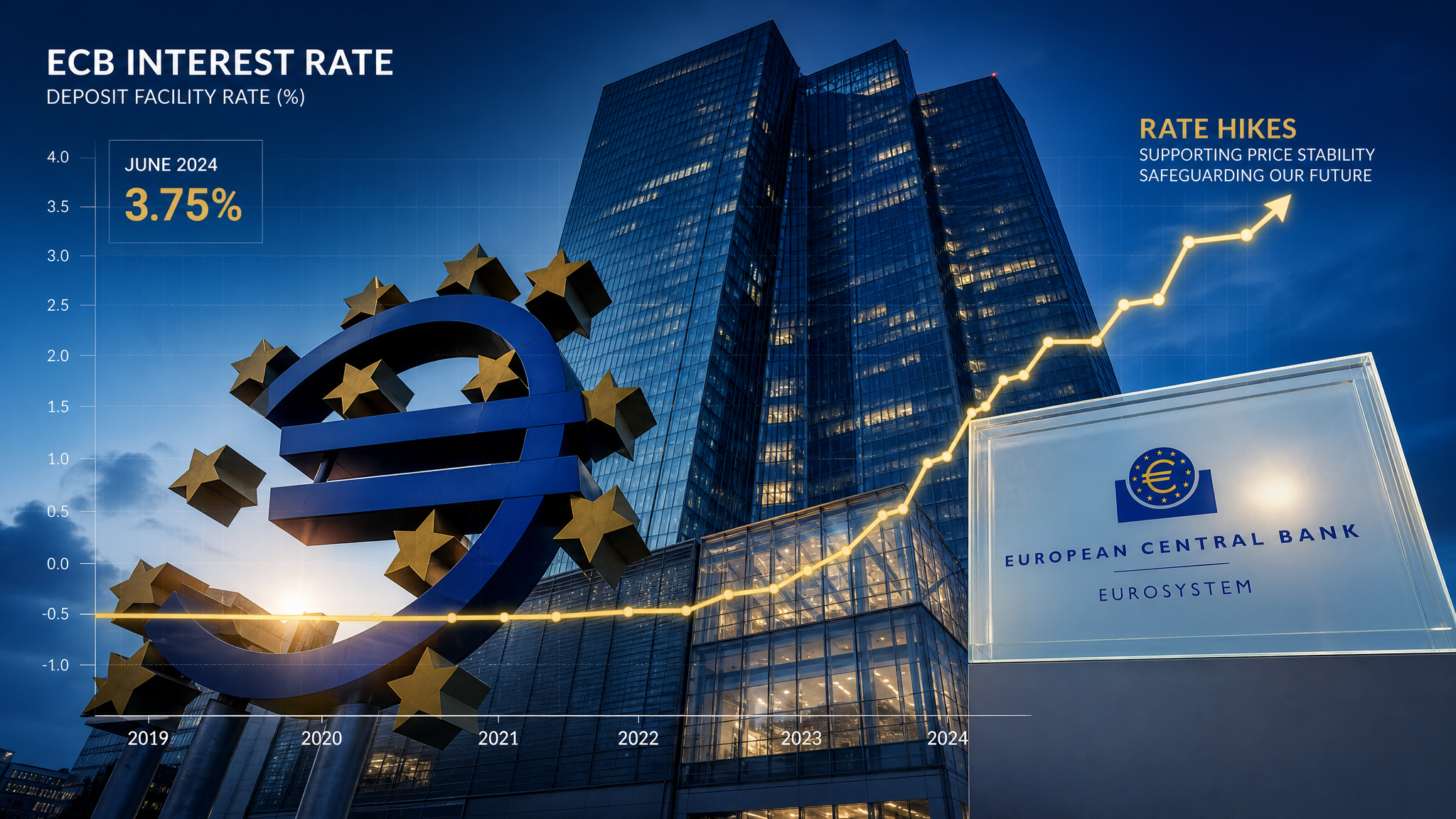
The June Hike: A Pivotal Decision
The ECB's Governing Council raised its three key interest rates by 25 basis points in June 2026, bringing the deposit facility rate to 2.25%. This decision marked a significant policy reversal after a period of rate cuts, and was driven by persistent inflationary pressures that were exacerbated by the energy price shock stemming from the conflict in the Middle East. The hike signaled that the ECB was not willing to allow inflation expectations to become unanchored, even at the cost of some near-term economic pain.
The decision was not without controversy within the Governing Council. Dovish members argued that the growth outlook was too fragile to absorb further tightening, while hawks maintained that the inflation risk was too significant to ignore. The compromise was a single 25-basis-point move accompanied by strong language emphasizing a data-dependent, meeting-by-meeting approach, with no pre-commitment to a future rate path. This deliberate ambiguity was designed to preserve maximum policy flexibility in an uncertain environment.
Cooling Inflation: A Welcome but Fragile Development
Fresh inflation data for June provided the ECB with some breathing room. Euro area annual inflation, as measured by the Harmonised Index of Consumer Prices (HICP), fell to 2.8% in June, down from 3.2% in May and coming in below market expectations of 3.0%. This was the lowest reading since February 2026 and represented a meaningful step toward the ECB's 2% target.
The decline was driven primarily by a significant cooling in energy price growth, which slowed to 8.5% from 10.8% in May. Crucially, other components also showed moderation: services inflation eased to 3.2% from 3.5%, and core inflation — excluding energy and food — fell to 2.4%. This broad-based moderation suggests that the ECB's past policy tightening is beginning to transmit through the economy, potentially easing the urgency for another imminent rate increase.
However, the ECB's own June staff projections forecast headline inflation to average 3.0% for 2026 as a whole, above the current reading, before falling to 2.3% in 2027 and 2.0% in 2028. These projections are heavily influenced by a higher assumed path for energy prices, creating a tangible upside risk to the inflation outlook. The ongoing instability in the Strait of Hormuz acts as a constant threat that could reignite energy-driven inflation across the bloc at any time, complicating the ECB's policy calculus significantly.
The Growth Dilemma: 0.8% Forecast for 2026
The battle against inflation is taking place against a backdrop of tepid economic growth. In its June assessment, the ECB revised its 2026 growth forecast for the euro area downward to just 0.8%, citing the war's impact on commodity markets, real incomes, and business confidence. This is a significant downgrade that reflects the real economic cost of the energy price shock and the broader uncertainty created by geopolitical instability.
The weak growth environment severely limits the ECB's room to maneuver. Overly aggressive tightening could tip the region's economy from stagnation into recession, particularly in countries like Germany, which is heavily exposed to energy-intensive industries and global trade. The manufacturing sector across the euro area has been under sustained pressure, with PMI readings consistently below the 50-point expansion threshold. Consumer confidence remains subdued as households grapple with elevated energy bills and the erosion of real purchasing power.
EUR/USD: Caught Between Two Central Banks
The euro's performance against the U.S. dollar reflects the difficult position the ECB finds itself in. The EUR/USD pair has been consolidating in a range around the 1.1437–1.1440 level, caught between the ECB's cautious hawkishness and the Federal Reserve's more restrictive stance. The Federal Reserve maintains a higher interest rate band of 3.50%–3.75% compared to the ECB's deposit rate of 2.25%, creating a structural yield advantage for the U.S. dollar that weighs on the euro.
Furthermore, ongoing Middle East tensions fuel safe-haven demand for the U.S. currency, adding another layer of pressure on the euro. On the technical front, the EUR/USD pair is in a medium-term downtrend. Key support is located in the 1.1370–1.1400 zone, and a sustained break below this area could open a path towards the 1.1220–1.1250 region. Immediate resistance is found at the former support zone of 1.1421–1.1441, with a more significant hurdle near 1.1500.
What Comes Next: The ECB's Data-Dependent Path
The ECB's next policy decision will be heavily influenced by the incoming data flow. Markets will be watching the July and August inflation prints closely for signs of whether the June moderation is a durable trend or a temporary blip. Any re-acceleration in energy prices, driven by a further escalation in the Middle East, could force the ECB's hand toward another hike. Conversely, a continued decline in inflation toward the 2% target, combined with deteriorating growth data, could open the door to a pause or even a discussion about future rate cuts.
For investors, the ECB's tightrope walk means that European fixed income markets will remain volatile and sensitive to data surprises. The spread between peripheral and core European sovereign bonds will be a key indicator of market stress. A scenario where the ECB is forced to hike aggressively into a weakening economy would likely widen these spreads and put pressure on the most indebted euro area economies. The ECB's ability to navigate this challenge without triggering a new sovereign debt crisis will be one of the defining financial stories of the second half of 2026.
This content is for informational purposes only and does not constitute financial advice. Always consult with a qualified financial advisor before making investment decisions.