FTSE 100 Outperforms as BoE Holds at 3.75%: UK's 'Active Hold' Strategy Explained
The United Kingdom's financial markets are telling a story of relative resilience in July 2026. The FTSE 100 has climbed to 10,600 points, outperforming its European peers, while the Bank of England maintains what can best be described as an "active hold" strategy — keeping rates at 3.75% while signaling readiness to act if inflation re-accelerates. The pound sterling is holding firm near 1.3450 against the dollar, supported by hawkish rate expectations. Understanding the mechanics of this UK market outperformance requires examining the BoE's policy calculus, the FTSE 100's unique composition, and the political backdrop of a new government.
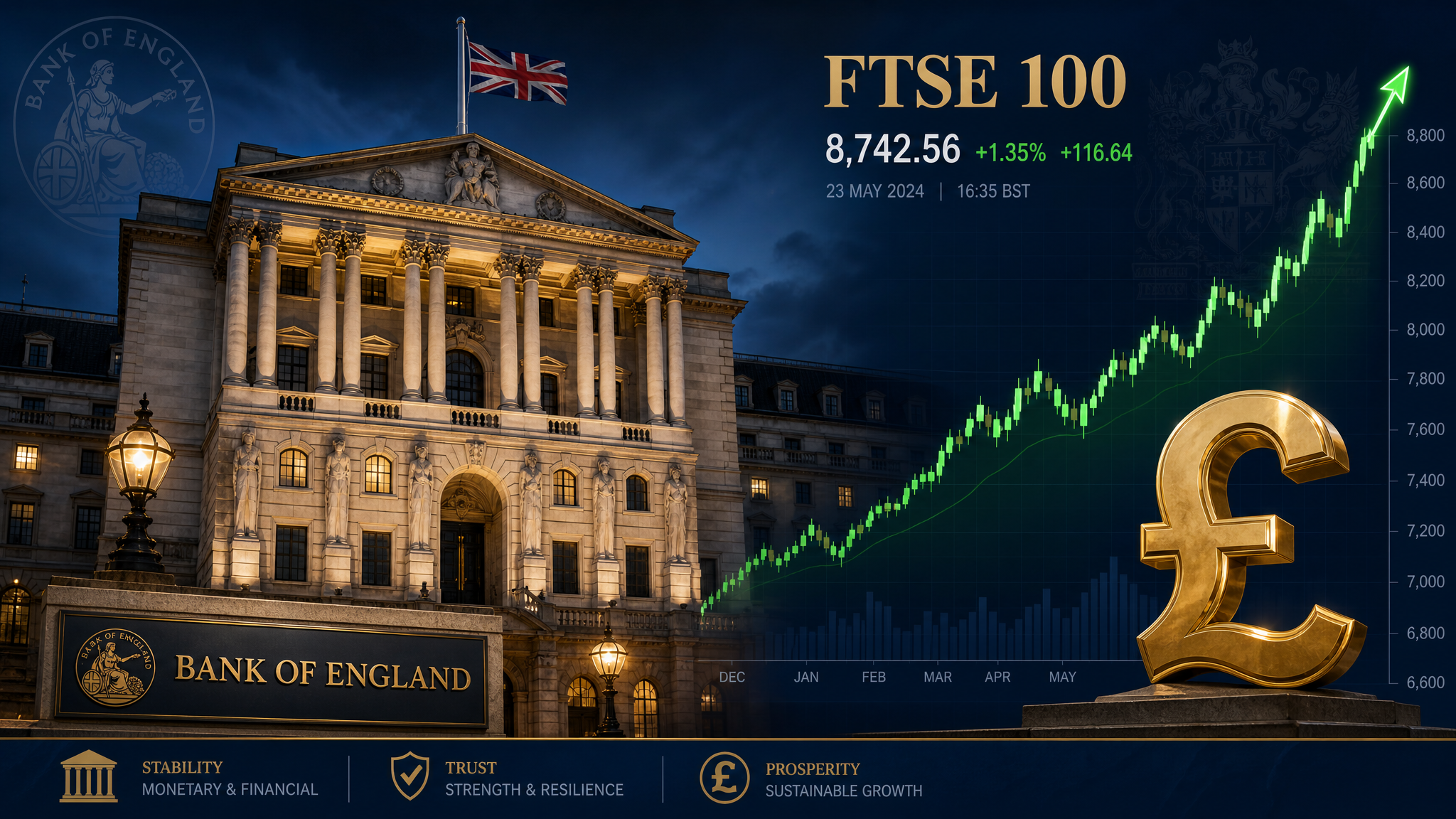
The Bank of England's 'Active Hold': A 7-2 Vote
The Bank of England's Monetary Policy Committee (MPC) voted 7-2 to hold the Bank Rate at 3.75% at its June meeting. The two dissenting members favored a 25-basis-point hike, underscoring the genuine debate within the committee about the appropriate policy path. This split vote is significant: it signals that the BoE is not complacent about inflation risks, even as it chooses to hold rates steady. The term "active hold" captures this posture — the BoE is watching, ready to act, but not yet convinced that further tightening is necessary given the current data flow.
The BoE's caution is rooted in a genuinely mixed macroeconomic picture. UK GDP grew by a marginal 0.1% in May 2026 after contracting by 0.1% in April, suggesting an economy that is barely treading water. Business surveys indicate that underlying momentum remains subdued, with the services sector — the backbone of the UK economy — showing signs of fatigue. The labor market is also clearly loosening: job vacancies have fallen to a five-year low of 707,000, and annual private sector wage growth has slowed to 2.9%, its lowest rate in over five years. This cooling in wage growth is particularly important for the BoE, as it reduces the risk of a wage-price spiral that could entrench inflation.
Inflation Still Above Target: The BoE's Core Challenge
Despite the softening labor market, CPI inflation remains above the BoE's 2% target, holding steady at 2.8% in the 12 months to May 2026. The BoE expects inflation to rise later in the year as higher energy costs — driven by the Middle East supply crisis — pass through to consumers via utility bills and transportation costs. This creates a challenging dynamic: the central bank must manage the economic adjustment to energy price shocks without unnecessarily compounding the economic weakness through excessive tightening.
The MPC's primary challenge is essentially a sequencing problem. If it hikes rates aggressively to combat the anticipated energy-driven inflation spike, it risks pushing an already fragile economy into recession. If it holds too long and inflation expectations become unanchored, it may need to tighten even more aggressively later. The "active hold" strategy is an attempt to thread this needle, buying time for more data while keeping the option of a hike firmly on the table. Money markets are currently pricing in a rate hike by the end of 2026, suggesting that investors believe the BoE will ultimately need to act.
FTSE 100 at 10,600: The Defensive Advantage
The FTSE 100's outperformance relative to the DAX and STOXX 600 is not accidental — it is a direct consequence of the index's unique composition. The FTSE 100 is heavily weighted toward dividend-paying stalwarts in the utility, energy, and consumer staples sectors, with relatively limited exposure to the high-growth technology stocks that have recently experienced a global sell-off. As investors rotated away from volatile AI-linked stocks, the FTSE 100's defensive characteristics made it an attractive destination for capital.
Utility companies including National Grid, SSE, and Severn Trent recorded notable gains in mid-July, benefiting from their regulated revenue streams and high dividend yields, which become more attractive in a risk-off environment. Energy giants Shell and BP have also benefited from rising oil prices linked to Middle East tensions, providing a natural hedge for the index against the very geopolitical risks that are weighing on other markets. The FTSE 100 has risen 1.93% over the past month, a meaningful outperformance compared to the DAX's decline and the STOXX 600's consolidation.
Not all FTSE 100 components are thriving, however. Luxury goods company Burberry saw its stock fall 6.4% after warning that the regional conflict in the Middle East was impacting tourist spending, a reminder that even defensive indices contain pockets of vulnerability. The divergence between energy and utility winners and consumer discretionary losers reflects the broader theme of the current market environment.
GBP/USD at 1.3450: Political Transition and Rate Expectations
The pound sterling has demonstrated notable resilience against the U.S. dollar, with the GBP/USD pair trading around 1.3454 after reaching a multi-week high of 1.3560. The pound's strength is supported by two key factors. First, hawkish monetary policy expectations: with money markets fully pricing in another Bank of England rate hike by the end of 2026, the interest rate differential between the UK and the U.S. is expected to narrow, reducing the dollar's yield advantage. Second, the political transition to a new Labour government under Andy Burnham has been received with cautious optimism by markets, removing a layer of political uncertainty that had previously weighed on sterling.
Technically, the GBP/USD pair faces significant resistance in the 1.3450–1.3475 area. A failure to break convincingly above this level could lead to a pullback, with key support identified near the 1.3300 level. The pair remains sensitive to both UK economic data releases and shifts in global risk appetite, which can quickly alter the dollar's safe-haven demand.
Outlook: Can the FTSE 100's Outperformance Persist?
The FTSE 100's relative outperformance is likely to persist as long as the current market regime — characterized by elevated energy prices, risk aversion, and a preference for yield over growth — remains in place. The index's high dividend yield, currently among the most attractive of major global indices, provides a structural support that is particularly valuable in an environment of elevated inflation and interest rate uncertainty. However, investors should be aware that the FTSE 100's energy-heavy composition also makes it vulnerable to a sharp reversal in oil prices, which could occur if Middle East tensions de-escalate or if global demand weakens significantly.
This content is for informational purposes only and does not constitute financial advice. Always consult with a qualified financial advisor before making investment decisions.