India Consolidates as Vietnam's FTSE Upgrade Widens the ASEAN Market Divide
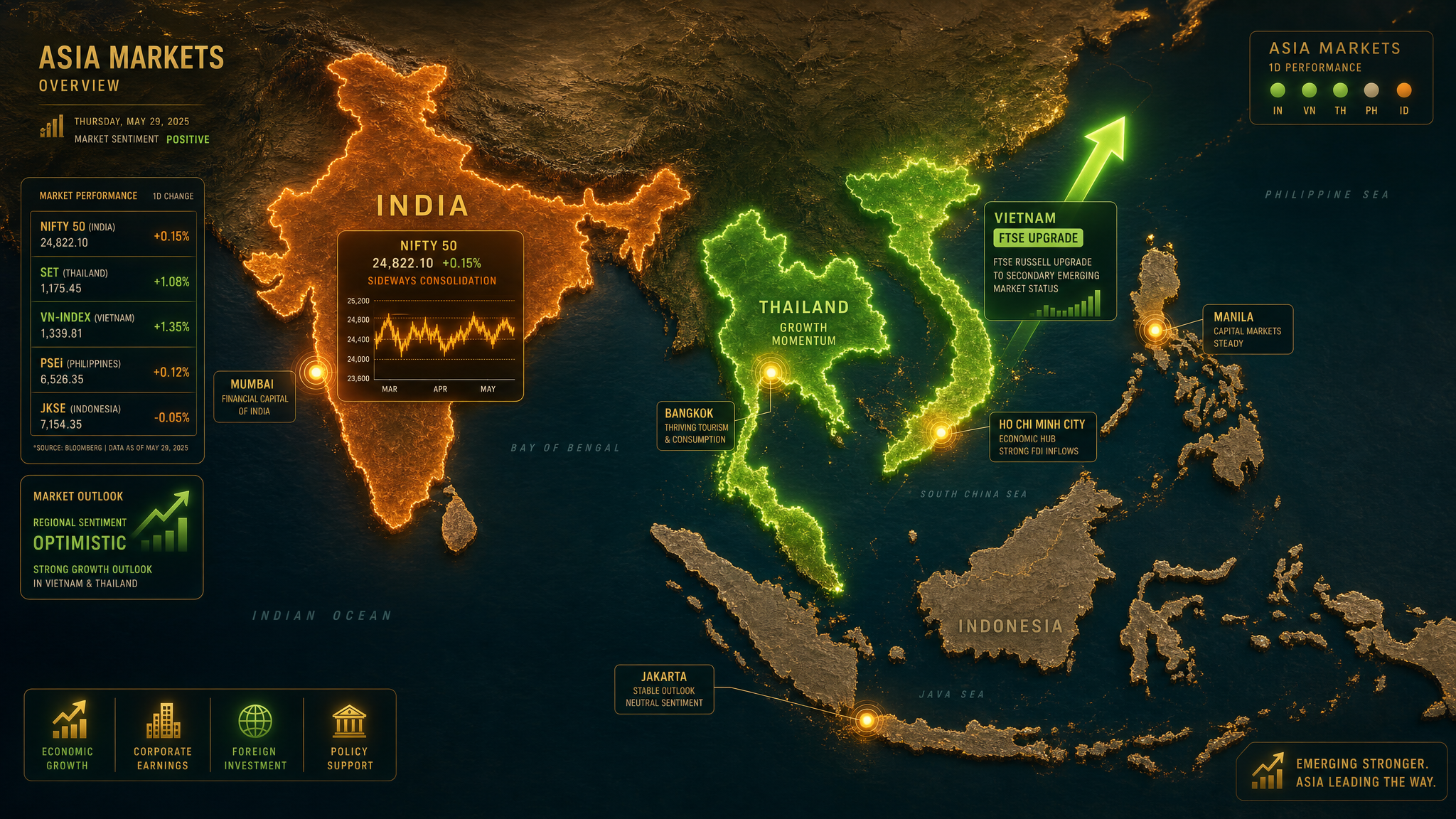
Southeast Asia's equity markets are telling very different stories in 2026 — and the divergence is widening. India's Nifty 50 is consolidating in a well-defined range, waiting for Q1 FY27 earnings to provide directional clarity. Vietnam is preparing for a landmark FTSE Russell reclassification to Secondary Emerging Market status that could unlock billions in passive inflows. Thailand has surged 23% year-to-date. Indonesia has struggled with governance concerns. The Philippines remains down 6% for the year. The lesson is clear: "ASEAN" is not an investment thesis — it is a geographic label that obscures more than it reveals.
For investors seeking exposure to Southeast Asia's long-term growth story, the current environment demands catalyst-based market selection rather than regional allocation.
India: Range-Bound and Earnings-Dependent
India's Nifty 50 has been trading in a well-defined range, with analysts identifying support around 23,800–24,000 and resistance near 24,500–24,600. The index has been neither decisively bullish nor bearish — a reflection of the competing forces at work in the Indian economy. On the positive side, IT and banking sectors have provided periods of support, and domestic institutional buying has helped offset earlier foreign outflows. On the negative side, the RBI's revised FY27 CPI projection of 5.1% limits the scope for monetary easing, and energy costs remain a headwind.
The next directional catalyst for Indian equities is Q1 FY27 earnings season. Corporate results will determine whether the market can break above the 24,500–24,600 resistance zone or whether it retreats toward the 23,800 support level. IT sector earnings will be particularly closely watched, given the sector's sensitivity to global technology spending and the rupee's trajectory. Banking earnings will provide a read on credit quality and loan growth — two variables that are critical for assessing the health of India's domestic economy.
The RBI's neutral stance — holding the repo rate at 5.25% while raising its inflation forecast — means that rate-sensitive sectors face a period of uncertainty. The central bank has limited room to ease given elevated inflation, but the growth slowdown (FY27 GDP forecast revised down to 6.6% from 6.9%) limits the case for tightening. Indian equities are therefore in a holding pattern, waiting for earnings clarity and policy signals before making their next significant move.
Vietnam: The Clearest Catalyst in the Region
Vietnam has the most clearly defined near-term catalyst of any market in Southeast Asia: FTSE Russell's reclassification of Vietnam to Secondary Emerging Market status, effective September 21, 2026. This is not a rumor or a possibility — it is a scheduled event with a published implementation timeline.
The inclusion will be phased: 10% in September 2026, 20% in March 2027, 35% in June 2027, and the final 35% in September 2027. Vietnam's projected weight in the FTSE Emerging Markets index is approximately 0.35%. Estimated active and passive inflows range from $3.4 billion to $10.4 billion — a wide range that reflects uncertainty about how much active manager interest will accompany the passive rebalancing.
The reclassification is the culmination of years of market infrastructure improvements, including reforms to settlement systems, foreign ownership limits, and market access procedures. Vietnam's equity market has already been pricing in some of this upgrade — a selected ETF proxy delivered a 40.8% annualized return over the relevant period — but the actual inclusion event is likely to generate additional inflows as passive funds are forced to add exposure.
The key risks to monitor are implementation quality and foreign-access readiness. If settlement or custody issues emerge during the initial inclusion phase, they could dampen the inflow impact. Investors should focus on liquidity, settlement infrastructure, and foreign-access readiness rather than treating the entire estimated flow range as guaranteed.
Thailand: Strong Performance, Structural Questions
Thailand's SET index has been one of the region's best performers in 2026, reportedly up 23% year-to-date by June. The rally has been driven by export strength, attractive dividend yields, and electronics sector recovery. However, Thailand's dependence on energy imports and its exposure to political uncertainty create structural risks that could limit the sustainability of the rally.
For investors, Thailand offers genuine near-term momentum but requires careful monitoring of political developments and energy cost trends. The market's strong performance has also reduced the valuation discount that made it attractive earlier in the year.
Indonesia and the Philippines: Governance and Confidence Challenges
Indonesia's equity market has been one of the region's underperformers, with a selected ETF proxy delivering an annualized return of -24.1% over the relevant period. The weakness has been linked to MSCI concerns over regulation, governance, and concentrated ownership, alongside fiscal and rupiah worries. The government's Danantara initiative — a sovereign wealth fund-style vehicle — has attracted attention but has not yet translated into the kind of market confidence that drives sustained equity inflows.
The Philippines remains down 6% for the year despite long-term growth estimates of approximately 5.7%–6.7%. Energy costs, infrastructure controversies, and natural disasters have weighed on confidence. Strong demographic and GDP forecasts are insufficient equity catalysts without improved earnings visibility and policy execution — a lesson that applies across the region.
The Selection Framework: Catalysts Over Labels
The performance dispersion across Southeast Asian markets — from Vietnam's 40%+ annualized returns to Indonesia's -24% — illustrates why regional labels are dangerous investment shortcuts. The markets that are outperforming share a common characteristic: they have visible, near-term catalysts that are driving capital allocation decisions. Vietnam has its FTSE upgrade. Thailand has export momentum and dividends. India has earnings season.
The markets that are underperforming share a different characteristic: they lack credible near-term catalysts and face governance or policy uncertainty that makes it difficult for investors to build conviction. Until Indonesia and the Philippines can demonstrate credible reform progress and earnings recovery, they are likely to remain at the back of the regional queue.
This content is for informational purposes only and does not constitute financial advice. Always consult with a qualified financial advisor before making investment decisions.