BOJ, BOK, PBOC and RBI Diverge as Asian Currency Risks Intensify
Asia's central banks are not moving in a common direction — and that divergence is becoming one of the most important drivers of regional currency and equity markets in 2026. The Bank of Japan has raised rates to approximately 1.0%, the Bank of Korea has tightened to 2.75%, the Reserve Bank of India is holding at 5.25% with a neutral stance, and the People's Bank of China is supporting liquidity without cutting its benchmark rate. Four major central banks, four different policy regimes, and four very different implications for investors.
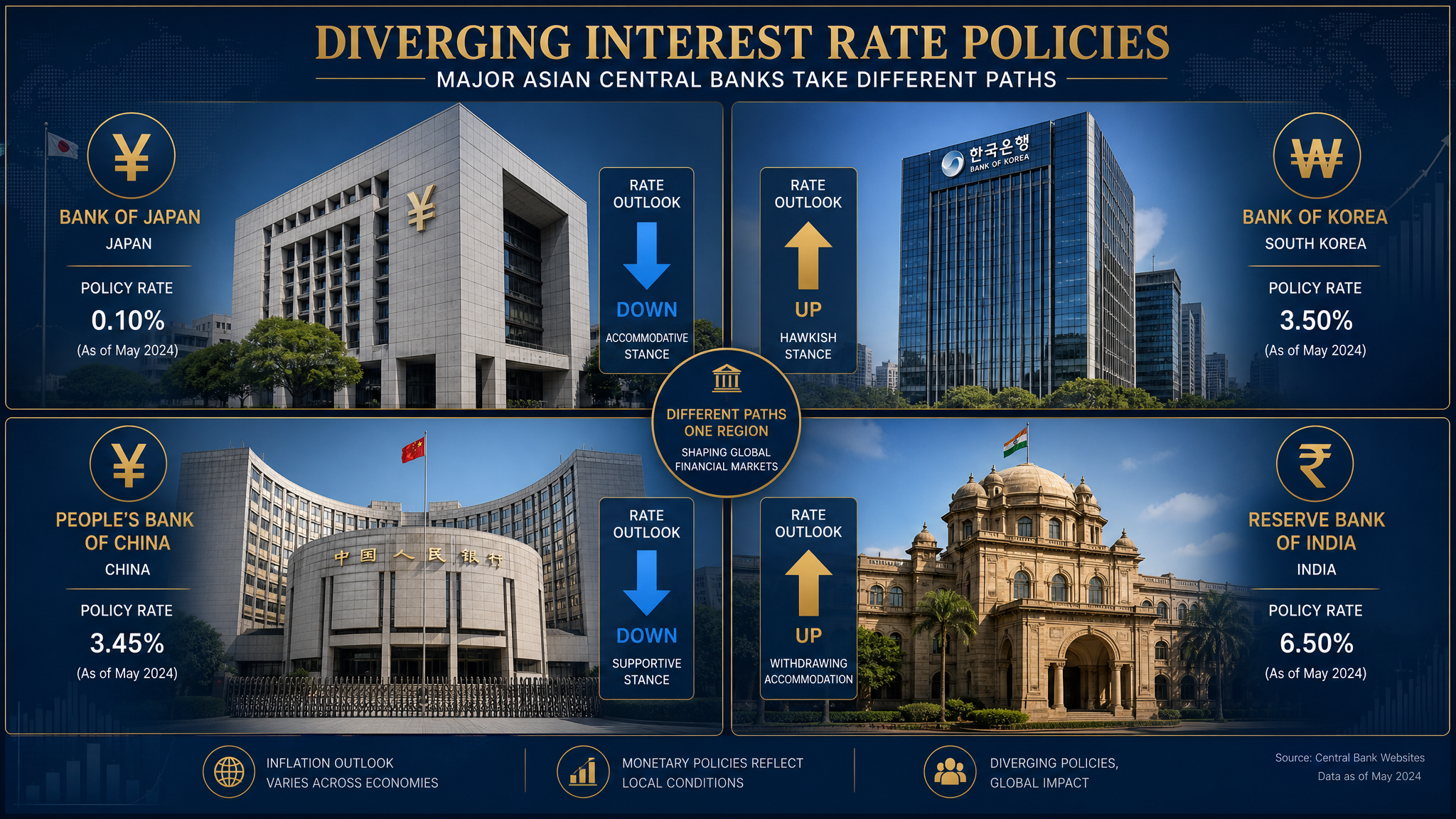
Understanding this divergence — and its transmission through currency markets — is essential for anyone building Asia-Pacific exposure in the current environment.
Japan: Rate Hikes That Haven't Strengthened the Yen
The Bank of Japan's June decision to raise its overnight call-rate target to approximately 1.0% — the highest level since 1995 — was supposed to signal a new era of monetary normalization. In theory, higher rates should attract capital inflows and strengthen the yen. In practice, USD/JPY has remained stubbornly near 160–162, a level that reflects the enormous interest rate differential between Japan and the United States rather than any near-term convergence.
The BOJ's April outlook projected FY2026 core CPI in the 2.5%–3.0% range, with June wholesale inflation running at 7.1%. These figures support the case for continued tightening, and most analysts expect a further increase to 1.25% by year-end. But the yen's weakness at current levels creates a policy dilemma: a weak currency raises import costs and inflation, potentially requiring faster tightening, while faster tightening risks destabilizing an equity market that has already corrected sharply.
The 160–162 range in USD/JPY should be monitored as a zone of heightened intervention attention. Japanese authorities have previously intervened in currency markets when yen weakness became disorderly, and a sustained move above 162 could trigger a policy response. However, the sources do not provide a formal intervention threshold, and investors should treat any specific level as a monitoring zone rather than a guaranteed trigger.
Korea: Tightening Into a Semiconductor Shock
The Bank of Korea's unanimous decision to raise its base rate to 2.75% on July 16 — the same day the KOSPI fell 6.37% — illustrates the difficult position facing Asian central banks that are tightening into market volatility. The BOK cited June inflation of 3.2%, accelerating household loan growth, rising housing prices around Seoul, and won volatility as justifications for the move.
The won's trajectory tells the story of the policy impact. The currency moved from the mid-1,500 range against the dollar toward the upper 1,400s following the rate decision — a meaningful appreciation that reflects the market's interpretation of the BOK's hawkish signal. A renewed move back toward the mid-1,500s, particularly if accompanied by rising inflation, would strengthen the case for additional tightening and create further headwinds for Korean equities.
The BOK's decision is not simply anti-growth. It addresses genuine overheating and financial stability risks that have been building alongside the semiconductor export boom. Household debt, housing prices, and inflation are all running above comfortable levels, and the central bank is right to address them — even if the timing, coinciding with a global tech selloff, was unfortunate.
China: Liquidity Support Without a Rate Signal
The PBOC's approach stands in sharp contrast to its Japanese and Korean counterparts. Rather than adjusting its benchmark seven-day reverse-repo rate — held at 1.40% — the central bank has focused on targeted liquidity operations. It introduced an overnight facility at 1.25%, injected 1.4 trillion yuan through six-month outright reverse repos, and expanded its standing swap arrangement with the Hong Kong Monetary Authority to 500 billion yuan.
This approach reflects the PBOC's preference for managing funding conditions without sending a broad easing signal that could weaken the yuan or inflate asset bubbles. The yuan has remained relatively stable under active central-bank management despite weak domestic demand and unfavorable rate differentials — a testament to the PBOC's willingness to use its full toolkit to maintain currency stability.
The critical question is whether targeted liquidity support can substitute for the kind of demand-side stimulus that would actually move the needle on retail sales and property investment. The evidence so far suggests it cannot — but the PBOC appears to be betting that structural reforms and export strength can compensate for the domestic demand shortfall.
India: Neutral Stance, Rising Inflation Forecast
The Reserve Bank of India held its repo rate at 5.25% in June and maintained a neutral stance — but the accompanying projections were less comfortable than the headline decision suggested. The RBI raised its FY27 CPI projection to 5.1% from 4.6%, while lowering its growth projection to 6.6% from 6.9%. These revisions reflect the impact of energy costs and global uncertainty on India's inflation and growth outlook.
The RBI also liberalized selected foreign-investment and deposit rules and stated it would manage excessive exchange-rate volatility without targeting a specific band. This approach gives the central bank flexibility to respond to currency pressures without committing to a fixed intervention level — a pragmatic stance given the uncertainty in global markets.
For Indian markets, the neutral stance means that rate-sensitive assets face a period of uncertainty. The RBI has limited room to ease given the elevated inflation forecast, but the growth slowdown limits the case for tightening. The result is a central bank in a holding pattern, waiting for clearer signals from both the inflation and growth data before making its next move.
The Investment Implication: Country-by-Country Analysis Is Essential
The divergence across Asian central banks means that regional generalizations are increasingly dangerous. Japanese importers, Korean leveraged growth stocks, Indian rate-sensitive assets, and Chinese liquidity beneficiaries face fundamentally different policy environments. Investors who treat "Asian monetary policy" as a single variable will make systematic errors in their positioning.
The most important analytical discipline in this environment is connecting equity and currency calls to specific domestic policy constraints — not to generalized dollar direction or global risk sentiment. The central bank divergence is the story; the individual currency and equity implications are the investment opportunity.
This content is for informational purposes only and does not constitute financial advice. Always consult with a qualified financial advisor before making investment decisions.