KOSPI Rout Exposes AI Concentration Risk While ASX 200 Defensives Hold Firm
Two Asia-Pacific equity markets, two very different stories. South Korea's KOSPI plunged 6.37% to 6,820.60 on July 16, 2026 — one of its worst single-day performances in years — as a global semiconductor selloff combined with a surprise central bank rate hike to trigger circuit breakers and sidecars. Meanwhile, Australia's ASX 200 held relatively steady near 8,800, supported by banks and defensive sectors that provided a buffer against the technology-driven turbulence sweeping through North Asian markets.
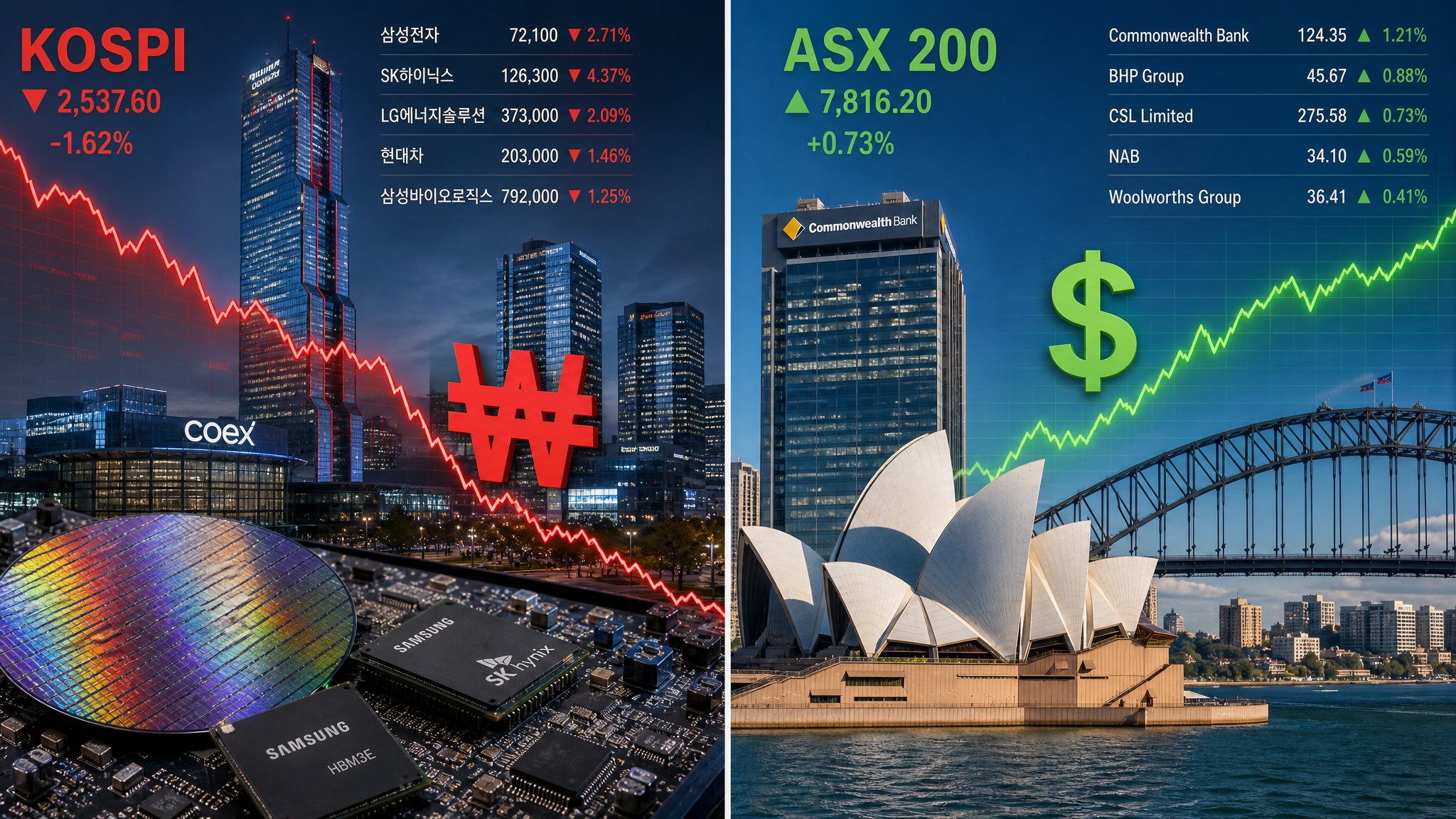
The contrast between these two markets offers a powerful case study in how benchmark composition and sector concentration can matter more than country-level growth narratives during periods of AI-driven market stress.
Korea's Perfect Storm: Chips, Rates, and Leverage
The KOSPI's 6.37% decline was the product of three forces converging simultaneously. First, the global AI hardware selloff hit Korea's most important companies with particular severity: SK Hynix fell approximately 11.5% and Samsung Electronics dropped roughly 8.8% in a single session. These two companies alone account for a substantial portion of the KOSPI's market capitalization, meaning their declines had an outsized impact on the index.
Second, the Bank of Korea delivered a unanimous 25-basis-point rate increase to 2.75% on July 16 — the same day as the equity selloff. The BOK cited June inflation of 3.2%, accelerating household loan growth, rising housing prices around Seoul, and won volatility as justifications for the move. The timing was unfortunate: a rate hike that might have been absorbed calmly in a stable market environment instead amplified the selling pressure on rate-sensitive growth stocks.
Third, leveraged single-stock ETFs reportedly amplified the market's moves in both directions, contributing to the speed and severity of the decline. This structural factor means that future KOSPI corrections could be faster and deeper than fundamental analysis alone would suggest — a risk that investors in Korean equities need to price into their position sizing.
Korea's Macro Backdrop: Stronger Than the Selloff Suggests
It would be a mistake to read the KOSPI's 6.37% decline as a verdict on Korea's economic fundamentals. The BOK's rate decision was accompanied by an upward revision to its 2026 growth forecast — the central bank now expects growth to exceed its previous 2.6% projection, driven by robust semiconductor exports and investment. The rate hike is not a sign of economic distress; it is a sign of an economy running hot enough to generate inflation and financial stability concerns.
Korea's semiconductor sector, despite the short-term pain, remains structurally well-positioned. SK Hynix is a leading supplier of high-bandwidth memory chips that are essential for AI training workloads, and Samsung's foundry ambitions continue to attract significant investment. The current selloff reflects a repricing of AI-related valuations globally, not a fundamental deterioration in Korea's competitive position in the memory and logic chip markets.
The won's movement — from the mid-1,500 range against the dollar toward the upper 1,400s — also reflects the BOK's tightening signal. A stronger won reduces import inflation but can weigh on export competitiveness. Investors should monitor whether the won stabilizes in the upper 1,400s or resumes its weakening trend, as the latter would strengthen the case for additional BOK tightening.
Australia's Defensive Resilience: A Different Kind of Market
The ASX 200's relative stability near 8,800 during the same period reflects a fundamentally different market structure. Australia's benchmark is heavily weighted toward financials, materials, and consumer staples — sectors that are far less exposed to the AI hardware cycle than Korea's semiconductor-dominated KOSPI. When technology stocks globally came under pressure, Australian banks acted as a "safe harbour," healthcare outperformed, and consumer staples provided ballast.
The materials sector was not immune to pressure — BHP reduced its FY27 copper production guidance, reflecting uncertainty about Chinese demand — but the impact was contained. Australia's diversified sector exposure meant that weakness in one area was offset by strength in others, a dynamic that simply does not exist in a market as concentrated as the KOSPI.
The Reserve Bank of Australia held its cash rate at 4.35% in June, with May headline inflation at 4.0% and trimmed-mean inflation rising to 3.6% from 3.4%. Consumer sentiment improved 4.1% in July but remains in the bottom 10% of its 50-year history — a reminder that Australia's domestic economy faces its own challenges even as its equity market holds up relatively well. Key data releases scheduled for late July — June labour figures on July 23 and June CPI on July 29 — will be critical for determining whether the RBA has room to ease or must maintain its restrictive stance.
The Investment Lesson: Concentration Is a Risk Factor
The Korea-Australia divergence illustrates a principle that is easy to overlook during bull markets but becomes painfully obvious during corrections: benchmark concentration is itself a risk factor. The KOSPI's heavy weighting toward a handful of semiconductor names means that a global AI repricing event can produce index-level moves that bear little relationship to the broader Korean economy.
For investors building Asia-Pacific equity exposure, the lesson is clear: country-level growth narratives are insufficient guides to equity risk. Understanding sector composition, leverage dynamics, and policy sensitivity is equally important — and sometimes more important — than getting the macro call right.
This content is for informational purposes only and does not constitute financial advice. Always consult with a qualified financial advisor before making investment decisions.