AI's Power Problem: Why Grid Constraints Are Becoming the Binding Limit on the Infrastructure Buildout
The artificial intelligence infrastructure buildout has generated enormous capital commitments — Meta alone has announced a target of 5 gigawatts of power capacity and more than $50 billion in AI-related capital expenditure. But a growing body of evidence suggests that the binding constraint on AI expansion is no longer capital availability or chip supply. It is electricity. Six major grid operators across the United States are now managing interconnection queues that stretch years into the future, data center vacancy rates have fallen to 1.4%, and construction activity in the sector is running at an annualized rate of $51 billion. The collision between virtually unlimited AI demand and a power grid that was not designed for this scale of concentrated load is reshaping the economics of the technology sector in ways that extend far beyond the companies building the data centers themselves.
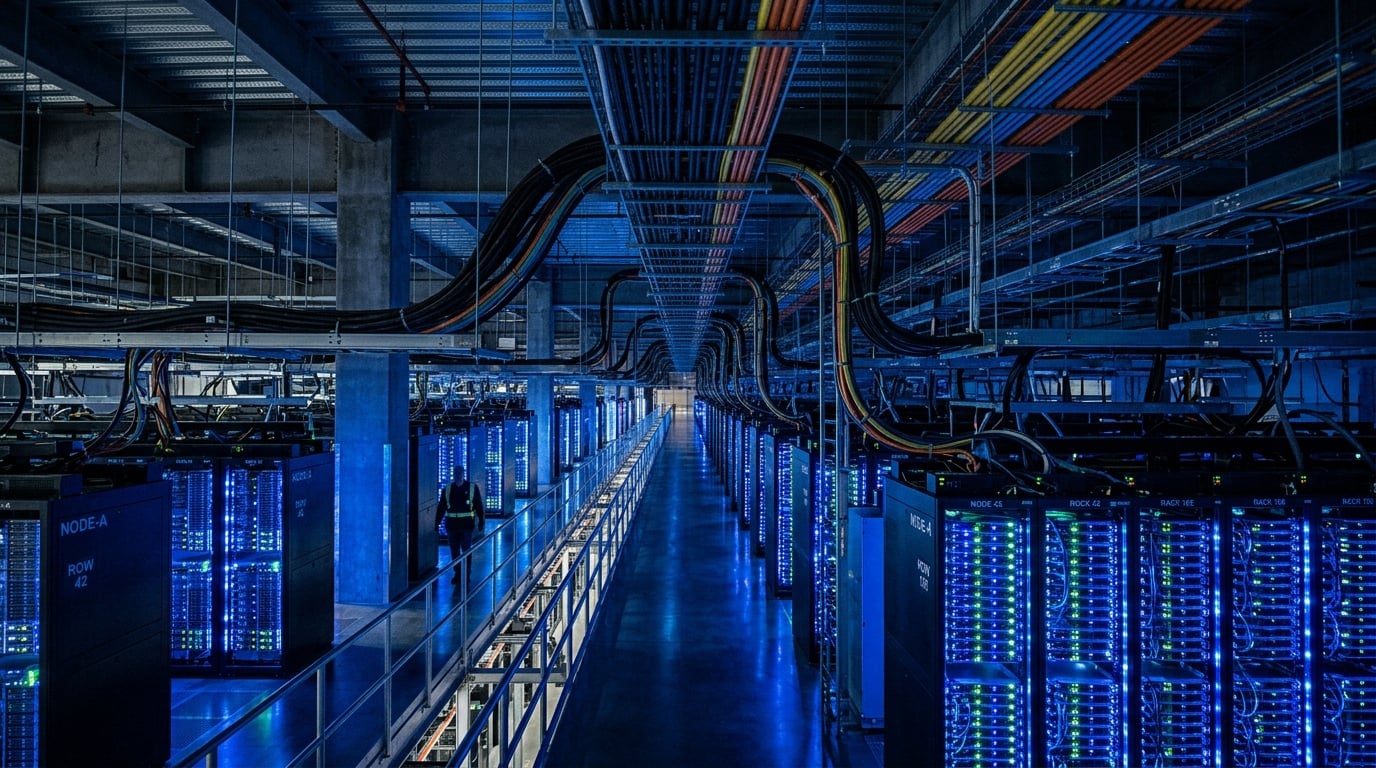
The Scale of the Commitment
Meta's 5 GW power target is a useful anchor for understanding the magnitude of the challenge. Five gigawatts is roughly equivalent to the output of five large nuclear power plants, or the electricity consumption of a mid-sized U.S. city. Committing to that level of power consumption requires not just building data centers but securing long-term power purchase agreements, navigating utility interconnection processes, and in many cases funding transmission infrastructure upgrades that benefit the broader grid. The $50 billion capital expenditure figure covers the full stack: land, buildings, servers, networking equipment, cooling systems, and the power infrastructure to run them.
Meta is not alone. Microsoft, Google, Amazon, and a growing number of hyperscale operators have made comparable commitments, and the aggregate demand for new power capacity from the AI sector is now large enough to be a material factor in utility planning cycles that typically operate on 10-to-20-year horizons. The mismatch between the speed of AI demand growth and the pace of grid expansion is the fundamental tension driving the current constraint.
The Interconnection Queue Problem
In the United States, connecting a new large power consumer to the grid requires navigating an interconnection study process managed by regional transmission organizations and independent system operators. Six major grid operators are currently managing queues that, in aggregate, contain hundreds of gigawatts of pending requests — far more than the grid can accommodate in the near term. The studies required to assess the impact of a new large load on grid stability can take two to four years to complete, and the results often require the applicant to fund transmission upgrades that benefit other users of the grid.
For AI companies, this means that even if they have the capital to build a data center and the chips to fill it, they may not be able to power it on the timeline their business plans require. The interconnection queue is effectively a rationing mechanism for grid access, and the companies that navigate it most effectively — by securing sites in regions with available capacity, by co-locating with existing power generation, or by funding transmission upgrades proactively — will have a structural advantage over those that do not.
Vacancy Rates and Construction Activity
The data center vacancy rate of 1.4% is a measure of how little available capacity exists in the market today. In a normal commercial real estate market, a vacancy rate below 5% is considered tight. At 1.4%, the data center market is effectively sold out, meaning that any company that needs additional compute capacity in the near term must either build new facilities — with all the lead time that entails — or pay a significant premium for the limited space that is available. The $51 billion annualized construction rate reflects the industry's response to this shortage, but construction timelines of 18 to 36 months mean that the supply response will not arrive quickly enough to relieve the current constraint.
Winners and Losers in the Power Constraint Era
The power constraint creates a differentiated competitive landscape within the AI infrastructure ecosystem. Companies that own or control power generation assets — whether through direct ownership of renewable energy projects, long-term power purchase agreements, or co-location with nuclear plants — are better positioned than those that rely entirely on utility-provided power. Industrial companies that supply grid equipment, transformers, and power management systems — like GE Vernova, whose $24.2 billion order intake reflects exactly this demand — are direct beneficiaries of the constraint, because every new data center and every grid upgrade requires their products.
For the hyperscale operators themselves, the power constraint is both a challenge and a moat. Companies that have already secured power capacity and built out their infrastructure have a significant advantage over new entrants who must navigate the interconnection queue from scratch. The constraint therefore tends to entrench the position of the largest players while raising the barriers to entry for smaller competitors. It also creates a strong incentive for AI companies to invest in energy efficiency — reducing the power consumption per unit of compute — as a way of stretching their existing power capacity further.
The Investment Implication
For investors, the power constraint thesis suggests that the most durable beneficiaries of the AI buildout may not be the chip designers or the software platforms, but the companies that enable the physical infrastructure: power equipment manufacturers, transmission developers, cooling technology providers, and utilities with available capacity in data center-dense markets. The constraint is real, it is measurable, and it is not going away on a short timeline. That makes it one of the more reliable structural themes in the current investment landscape.
This content is for informational purposes only and does not constitute financial advice. Always consult with a qualified financial advisor before making investment decisions.
Discussion