ASEAN's Energy-Security Premium Is Splitting the Region Into Winners and Losers
When Brent crude trades above $100 a barrel and ASEAN foreign ministers gather to express "serious concern" over Middle East hostilities and their implications for regional energy supply, the instinct is to treat Southeast Asia as a single trade. It is not. The Middle East energy shock and renewed South China Sea tension are dividing ASEAN assets by import dependence, fiscal capacity, domestic energy supply and maritime exposure in ways that make country selection more important than regional allocation. The July 20 Philippine military report of a Chinese Coast Guard incident near Second Thomas Shoal—with Beijing describing Philippine conduct as provocative—added a geopolitical dimension that further differentiates national risk profiles.
Building the Four-Factor Country Screen
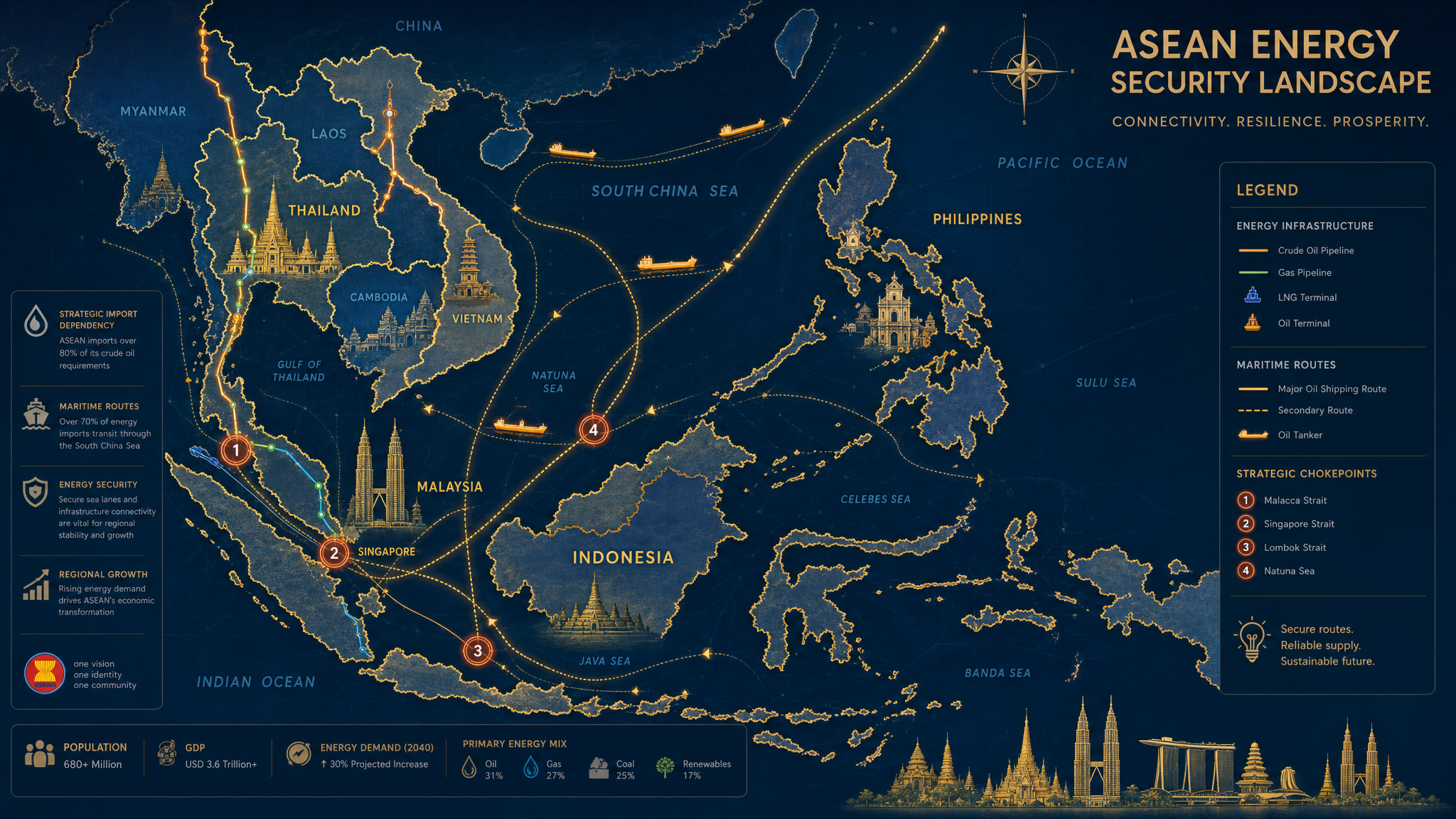
A useful framework for navigating ASEAN in the current environment involves four factors: energy balance (net importer versus net exporter), fiscal buffer (capacity to subsidise energy costs without damaging public finances), industrial composition (energy-intensive manufacturing versus services or technology), and maritime exposure (dependence on shipping lanes that pass through contested waters or near conflict zones).
Malaysia and Indonesia are net energy exporters. Higher oil and LNG prices improve their terms of trade, increase government revenues from hydrocarbon production and support their currencies. The risk for both is that domestic energy subsidies—which both countries maintain to protect consumers—can erode the fiscal benefit of higher prices if governments choose to absorb the cost rather than pass it through. Indonesia's coal exports also benefit from elevated thermal-coal prices, which have risen as Asian utilities substitute coal for expensive LNG.
Thailand and the Philippines are net energy importers with limited fiscal buffers. Higher oil prices increase their import bills, widen current-account deficits and put downward pressure on their currencies. Thailand's tourism-dependent economy faces an additional headwind if higher energy costs reduce discretionary spending. The Philippines faces the additional complication of being the ASEAN chair in 2026 and the country most directly involved in South China Sea territorial disputes, creating a geopolitical risk premium that other ASEAN members do not share to the same degree.
LNG Scarcity and the Coal Substitution Effect
Asian LNG imports were recovering in July, drawing cargoes away from Europe and tightening the global LNG market. For ASEAN countries that rely on LNG for power generation—particularly Singapore, which has no domestic energy production—higher LNG prices translate directly into higher electricity costs for industry and households. Singapore's position as a financial and logistics hub means that its energy costs affect the competitiveness of the entire regional supply chain that uses Singapore as a hub.
The coal substitution effect is significant. When LNG becomes expensive or unavailable, utilities in Thailand, the Philippines, Vietnam and Indonesia shift toward coal-fired generation. This supports coal prices and benefits Indonesian and Australian coal exporters, but it raises electricity costs for energy-intensive manufacturers and creates environmental trade-offs that complicate long-term investment decisions. Vietnam's electronics manufacturing sector, which has attracted significant foreign direct investment as a China+1 destination, is particularly sensitive to electricity cost and reliability.
Maritime Incidents Become Financial Inputs
The South China Sea Code of Conduct negotiations—with the Philippines seeking completion by end-2026 and the 26th ASEAN-China senior officials' meeting held in Kuala Lumpur in May—represent a diplomatic process that markets are watching as a risk-management framework rather than a geopolitical narrative. The practical question is whether incidents like the July 20 confrontation near Second Thomas Shoal will escalate in ways that affect commercial shipping, insurance costs or investment confidence.
Maritime risk affects markets before physical disruption occurs. War-risk insurance premiums rise when incidents are reported, increasing the cost of shipping goods through contested waters. Freight rates can spike on uncertainty even when actual cargo flows are uninterrupted. Companies that maintain inventories of imported components or raw materials face working-capital pressure when delivery times become uncertain. These financial effects are real and measurable even when the geopolitical situation stops short of actual conflict.
Where Investors Should Look for Differentiation
The energy-security premium in ASEAN is creating differentiated opportunities across sectors. Malaysian semiconductor assemblers and data-centre suppliers benefit from technology demand and are partially insulated from oil-price shocks by their energy-exporter status. Indonesian commodity producers—coal, palm oil, nickel—benefit from elevated commodity prices. Singapore banks and logistics companies benefit from regional trade flows but face higher operating costs from energy prices.
Thai and Philippine consumer stocks face headwinds from higher energy costs and potential currency weakness. Vietnamese electronics exporters face electricity-cost pressure but benefit from continued China+1 investment flows. Regional airlines face a direct fuel-cost shock that is difficult to hedge fully at current oil prices.
The key analytical point is that ASEAN is not a monolithic trade in the current environment. The energy-security premium is a differentiating factor, not a uniform headwind or tailwind. Country selection, sector allocation and currency exposure all matter more than they did when oil was below $80 and the South China Sea was relatively quiet.
This content is for informational purposes only and does not constitute financial advice. Always consult with a qualified financial advisor before making investment decisions.
Discussion