Australia Is Trading Two Economies: Domestic Inflation Meets China's Uneven Mining Demand
Australian assets are caught between two macro stories that are moving in different directions. Domestically, the Reserve Bank of Australia is holding its cash-rate target at 4.35%—effective since June 17—as it monitors an economy where unemployment rose to 4.4% in June and May CPI came in at 4.0% year-on-year, down from 4.2% in April. Externally, the mining sector's earnings depend on the composition of Chinese demand, which is currently split between strong copper buying—imports reached a nine-month high by July 20—and weak iron ore demand from a construction sector where PMI remained below 50 at 49.0 in June. The ASX 200 and the Australian dollar are pricing both stories simultaneously, making them poor proxies for either force in isolation.
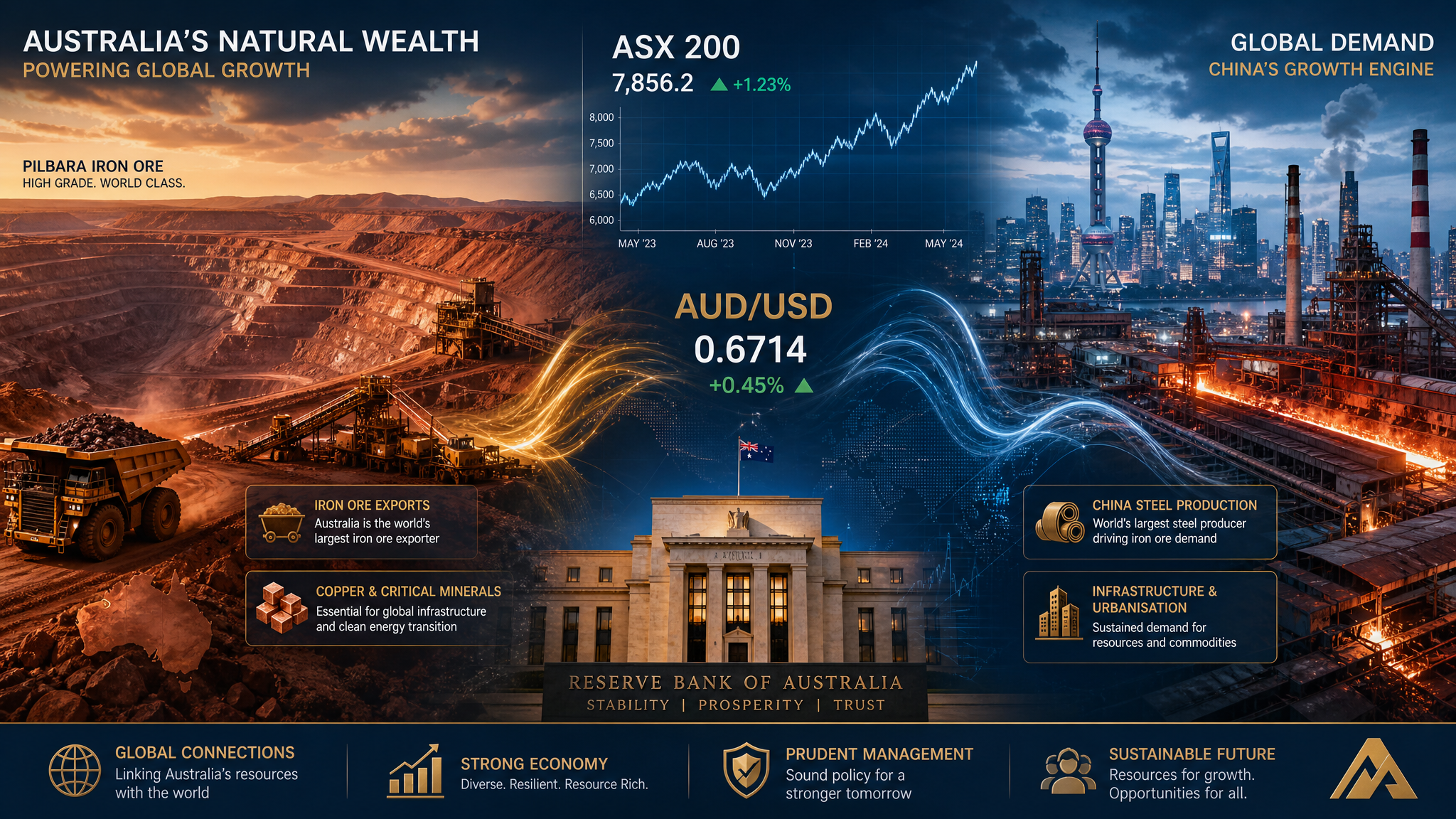
The RBA's Domestic Dilemma
The RBA's August 10–11 meeting, with the decision and quarterly Statement on Monetary Policy due August 11, will be the next major domestic catalyst. The central bank is navigating a labour market that is softening—unemployment at 4.4% and an employment-to-population ratio of 64.0% in June—while inflation remains above target at 4.0% on the May CPI reading. The June CPI, scheduled for release on July 29, will be a critical input to the August decision.
The RBA's challenge is that the inflation it is fighting is partly structural—driven by services, housing costs and labour market tightness—and partly imported, driven by energy prices and global supply chains. Monetary policy is effective against demand-driven inflation but less effective against supply-side cost pressures. At 4.35%, the cash rate is already restrictive by historical standards, and the softening labour market suggests that the tightening is having its intended effect on demand. The question is whether inflation is falling fast enough to justify holding, or whether the persistence of 4.0% CPI requires further action.
Copper Versus Iron Ore: China's Two-Speed Demand
For Australian miners, the relevant question is not China's headline GDP growth rate but the composition of that growth. China's June industrial output rose 5.3% year-on-year, driven by high-tech equipment manufacturing, electric vehicles and green infrastructure. This composition is copper-intensive: EVs use roughly four times as much copper as conventional vehicles, and grid infrastructure for renewable energy requires substantial copper wiring. Chinese copper imports reaching a nine-month high by July 20 is therefore a direct consequence of the industrial policy priorities that Beijing has been pursuing since 2023.
Iron ore tells the opposite story. China's construction PMI remained below 50 at 49.0 in June, and first-half fixed-asset investment contracted 5.7%. Steel demand from the construction sector—which historically consumed the majority of China's iron ore imports—remains weak. Iron ore prices have been under pressure through late June and into July, reflecting this structural shift in Chinese demand composition. BHP and Rio Tinto, which are both major iron ore and copper producers, are therefore experiencing divergent earnings dynamics within their own portfolios.
The AUD as a Composite Signal
The Australian dollar, trading around 0.69 against the US dollar in late July, is attempting to price both the domestic monetary story and the external commodity story simultaneously. A higher RBA rate is theoretically supportive of the AUD by attracting yield-seeking capital. But if the rate is high because inflation is persistent, it also signals that the domestic economy is under stress, which is negative for growth-sensitive assets. Meanwhile, the commodity story is mixed: copper strength is positive for the AUD, but iron ore weakness is negative, and the net effect depends on the relative weight of each commodity in Australia's export basket.
Iron ore remains Australia's largest single export commodity by value, which means that iron ore price weakness has a larger direct impact on the trade balance and terms of trade than copper strength. The AUD's 0.69 level reflects a market that is discounting some iron ore weakness while giving partial credit for copper demand and the RBA's relatively high rate.
The Mining Sector's Earnings Split
For equity investors in the ASX 200, the mining sector's earnings split creates a stock-selection challenge. Companies with higher copper exposure—including OZ Minerals (now part of BHP following the 2023 acquisition) and copper-focused producers—are benefiting from Chinese demand. Companies with higher iron ore exposure face a more difficult earnings environment. BHP and Rio Tinto, as diversified miners, are partially hedged across both commodities, but their iron ore divisions remain the largest earnings contributors and are therefore more exposed to the construction-sector weakness.
The banking sector, which is the other major component of the ASX 200, faces a different set of pressures: higher rates have supported net interest margins, but rising unemployment and potential mortgage stress create credit-quality concerns. The two-speed dynamic within the ASX—mining facing a commodity composition challenge, banks facing a credit-quality challenge—means that the index-level performance obscures significant sector divergence.
Australia's investment story in the second half of 2026 will be shaped by three catalysts: the June CPI release on July 29, the RBA's August decision and Statement on Monetary Policy, and the trajectory of Chinese copper and iron ore demand as Beijing's industrial policy priorities continue to evolve. Investors who treat the ASX as a simple China-proxy or a simple rate-sensitive market will miss the nuance that makes Australian assets genuinely complex to analyse in the current environment.
This content is for informational purposes only and does not constitute financial advice. Always consult with a qualified financial advisor before making investment decisions.
Discussion