Asia-Pacific FX Divergence: How Five Central Banks Are Pulling Regional Currencies in Different Directions
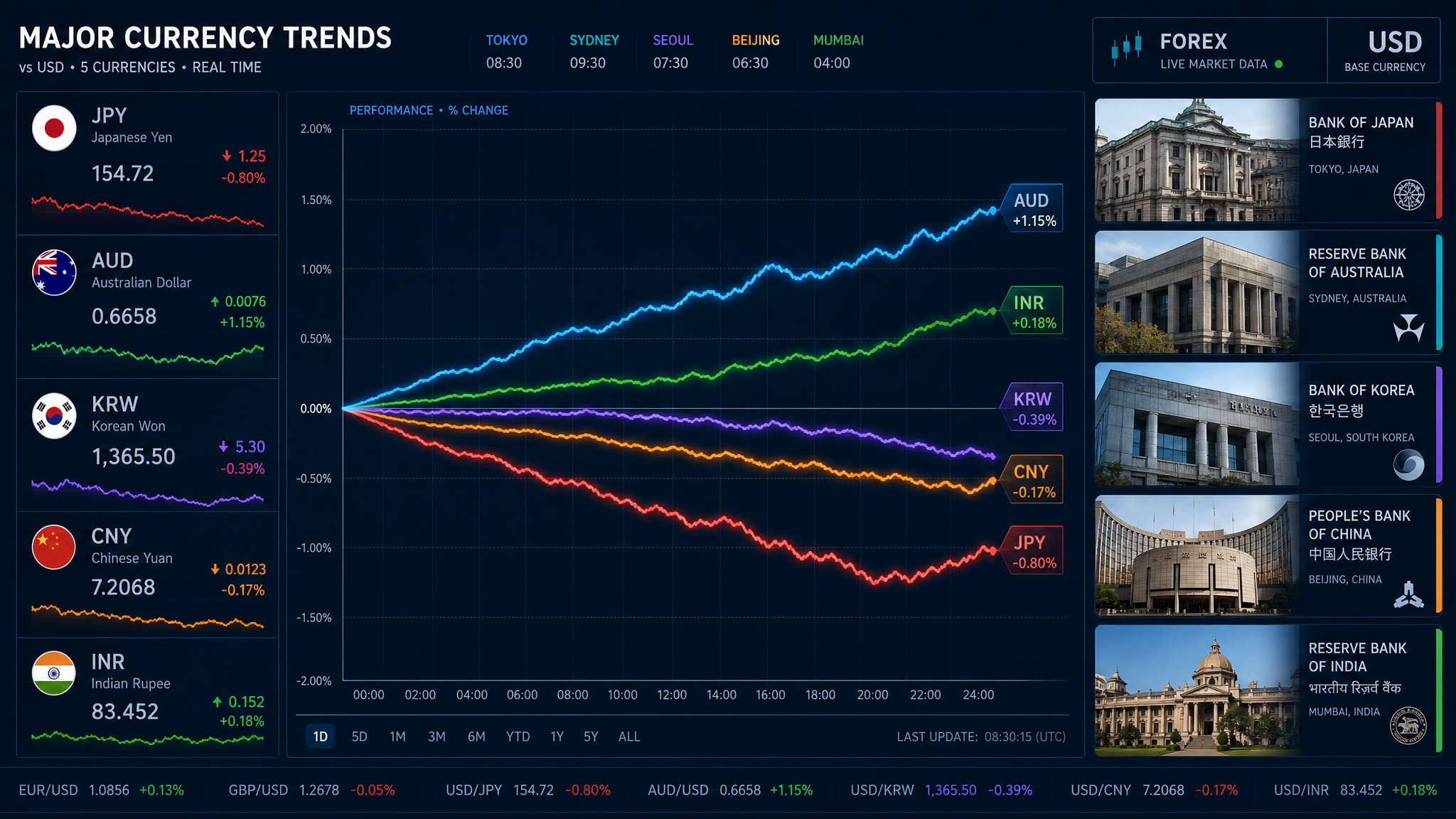
Asia-Pacific foreign exchange markets in late July 2026 are not moving as a bloc. USD/JPY has been trading in the 162–164 range, reflecting a Bank of Japan that has raised rates to 1.0% but remains far below the Federal Reserve's level. AUD/USD is around 0.69, caught between a restrictive RBA at 4.35% and mixed commodity signals. USD/KRW was indicated around 1,484.86 by mid-July after touching 1,561.5 on June 5, reflecting the Bank of Korea's July 16 rate hike to 2.75%. USD/CNY is trading in the 6.78–6.80 range under PBOC management. USD/INR remains under depreciation pressure as India's oil import bill rises. The divergence across these pairs reflects five central banks pursuing different policy objectives in response to different domestic conditions—and the cross-currency dynamics are creating both risks and opportunities for regional investors.
The Yen: Structural Weakness With an Intervention Ceiling
USD/JPY in the 162–164 range represents a yen that is historically weak by post-Plaza Accord standards. The BOJ's June rate hike to 1.0% provided a brief yen-supportive signal, but the 700-plus basis-point differential between the BOJ's policy rate and the Federal Reserve's rate means that carry-trade dynamics continue to favour yen selling. Investors borrow in yen at low rates and invest in higher-yielding currencies, creating persistent selling pressure on the yen.
The Ministry of Finance has demonstrated willingness to intervene in the foreign-exchange market when yen weakness becomes disorderly, but intervention is a tactical tool rather than a strategic solution. It can slow the pace of depreciation and create uncertainty for carry traders, but it cannot sustainably reverse a rate differential of this magnitude. The BOJ's July 30–31 meeting is therefore being watched not just for the policy-rate decision but for any signals about the pace of future tightening that might narrow the rate differential and reduce carry-trade incentives.
The Australian Dollar: Commodity and Rate Crosscurrents
AUD/USD at approximately 0.69 reflects a currency that is receiving partial support from the RBA's 4.35% cash rate—one of the higher rates among developed-market central banks—while facing headwinds from mixed commodity signals. Iron ore weakness is a negative for the AUD because iron ore is Australia's largest export commodity. Copper strength is a partial offset. The net commodity effect is modestly negative given iron ore's larger weight in Australia's export basket.
The RBA's August 10–11 meeting is the next major catalyst for the AUD. If the June CPI (due July 29) shows further disinflation, the RBA may signal that the tightening cycle is complete, which would remove a key support for the currency. If CPI remains sticky, the RBA may hold or signal further tightening, which would be AUD-supportive. The currency is therefore in a holding pattern ahead of two sequential data releases that will determine the near-term policy trajectory.
The Korean Won: Rate Hike Meets Chip-Cycle Uncertainty
The BOK's July 16 rate hike to 2.75% was intended partly to support the won, which had weakened significantly to 1,561.5 per dollar in early June. The subsequent recovery to around 1,484.86 by mid-July reflects both the rate signal and a broader stabilisation in Asian currencies. However, the won's trajectory is heavily influenced by semiconductor export expectations, which drive Korea's current-account surplus and foreign investor sentiment toward Korean equities.
If Samsung's July 30 full results and forward guidance disappoint—as the preliminary guidance's market reaction suggested was possible—foreign investors may reduce Korean equity exposure, creating won-selling pressure that partially offsets the rate-hike support. The won is therefore caught between a monetary-policy tailwind and a chip-cycle headwind, with the balance depending on how AI-infrastructure spending expectations evolve in the coming weeks.
The Yuan: Managed Stability Under External Pressure
USD/CNY in the 6.78–6.80 range reflects PBOC management of the exchange rate within a band that balances export competitiveness against capital-flow stability. China's large trade surplus provides a structural source of dollar supply that supports the yuan, but capital-account pressures—including concerns about property-sector debt and domestic growth—create outflow pressure that the PBOC manages through daily fixing and reserve requirements.
The yuan's stability is a policy choice rather than a market outcome. The PBOC has the tools and reserves to maintain the current range, but a significant escalation in US-China trade tensions or a sharp deterioration in domestic growth could test that commitment. For regional investors, the yuan's managed stability provides a degree of predictability that other Asian currencies lack, but it also means that the yuan does not fully reflect the underlying economic pressures that are visible in China's data.
The Rupee: Oil Vulnerability and Inflow Engineering
USD/INR remains under pressure as India's oil import bill rises with Brent above $100. The RBI's foreign-currency inflow programs have provided a buffer, but the rupee's exact late-July level is uncertain across different data sources, with secondary material placing it around 96.00–96.55 against the dollar. The RBI's August 3–5 MPC meeting will be watched for any signals about whether the rate stance will shift or the inflow facilities will be extended.
The cross-currency picture across Asia-Pacific in late July 2026 is one of genuine divergence driven by different monetary policy cycles, different commodity exposures and different external vulnerabilities. Investors who treat Asian currencies as a single risk-on/risk-off trade are missing the structural differentiation that makes currency selection as important as asset-class selection in the current environment.
This content is for informational purposes only and does not constitute financial advice. Always consult with a qualified financial advisor before making investment decisions.
Discussion