Asian Crypto Trading Hours: Bitcoin as a Macro Risk Barometer in a 24-Hour Market
Cryptocurrency markets do not close when Asian equity exchanges open, and that structural feature is increasingly shaping how Bitcoin and Ethereum behave during Tokyo, Hong Kong and Singapore trading hours. In a period when Asian equity markets are experiencing significant volatility—driven by BOJ policy uncertainty, KOSPI semiconductor swings, and ASEAN energy-security concerns—crypto price action during Asian hours is functioning less as an independent asset class and more as a continuous risk-sentiment barometer that reflects the same macro forces driving equities, with the added dimension of 24-hour liquidity and no circuit breakers.
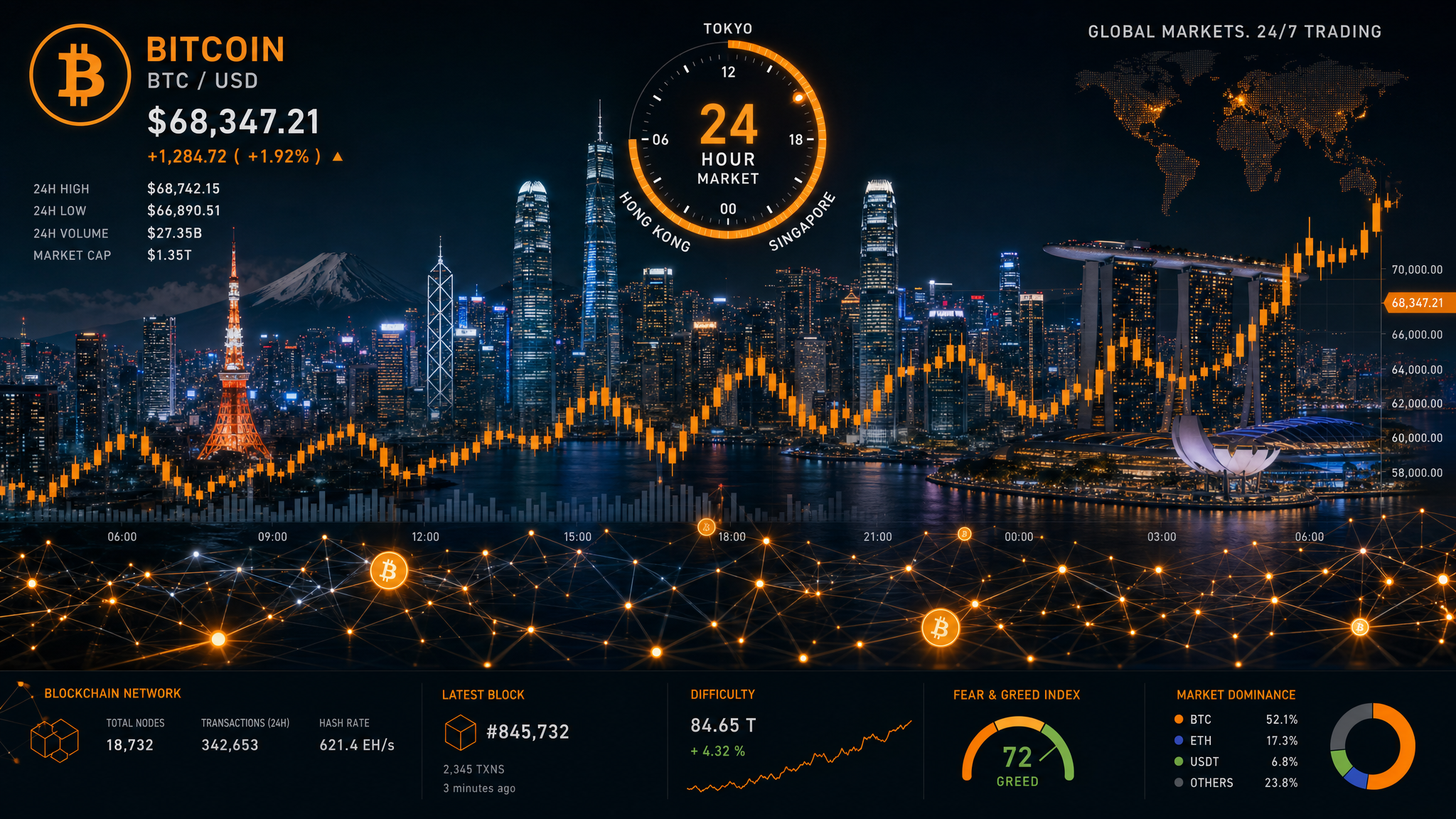
The Asian Hours Crypto Dynamic
The crypto market's 24-hour structure means that price discovery during Asian trading hours is influenced by a combination of regional retail and institutional flows, overnight developments from US and European markets, and the macro sentiment generated by Asian equity and forex markets. When the Nikkei opens sharply lower or the KOSPI experiences a semiconductor-driven selloff, crypto markets often reflect that risk-off sentiment within minutes—not because crypto is directly affected by Japanese inflation or Korean chip exports, but because the same institutional investors who hold both asset classes adjust their overall risk exposure simultaneously.
This correlation is not constant. During periods of crypto-specific catalysts—regulatory announcements, exchange failures, major protocol upgrades—crypto can decouple from equity sentiment and move independently. But in the absence of such catalysts, the correlation between crypto and equity risk sentiment during Asian hours has been notably higher in 2026 than in previous years, reflecting the growing institutional participation in crypto markets and the increasing use of crypto as a liquid risk-management instrument.
Bitcoin's Role as a Liquidity Indicator
One of the more analytically useful ways to interpret Bitcoin's price action during Asian hours is as a liquidity indicator. Because crypto markets are always open and have no circuit breakers, they can absorb and reflect risk-sentiment changes faster than equity markets, which have opening auctions, trading halts and market-maker obligations that slow price discovery. When institutional investors need to reduce risk quickly—for example, in response to an unexpected macro development overnight—crypto markets are often the first to move because they offer immediate liquidity without the friction of equity market mechanisms.
This means that sharp Bitcoin moves during Asian hours can sometimes be leading indicators of equity market sentiment rather than lagging reflections of it. A significant Bitcoin selloff in the early hours of the Tokyo session, before Japanese equity markets open, may signal that institutional investors are reducing overall risk exposure in anticipation of a difficult equity open. Conversely, Bitcoin stability or strength during Asian hours can provide a degree of reassurance about risk appetite before equity markets open.
Ethereum and the DeFi Activity Signal
Ethereum's price action during Asian hours carries an additional dimension: it reflects activity on decentralised finance protocols, which are disproportionately active during Asian trading hours due to the geographic concentration of DeFi users and developers in East and Southeast Asia. When DeFi activity is high—measured by gas fees, transaction volumes and protocol revenues—Ethereum demand increases, which can support the price independently of broader macro sentiment.
In the current environment, DeFi activity has been influenced by the same macro forces affecting traditional finance: higher interest rates in traditional markets reduce the relative attractiveness of DeFi yields, while market volatility increases demand for on-chain hedging and leverage. The interaction between traditional monetary policy and DeFi activity is a relatively new phenomenon that is becoming more important as institutional participation in DeFi grows.
The Volatility Asymmetry
One structural feature of crypto markets that is particularly relevant during Asian hours is the volatility asymmetry between upside and downside moves. Crypto markets tend to fall faster than they rise, because leveraged long positions are liquidated automatically when prices fall below margin thresholds, creating cascading selling pressure. During Asian hours, when liquidity is lower than during US or European hours, these liquidation cascades can be more severe because there are fewer market makers and institutional buyers to absorb the selling.
This asymmetry means that risk management during Asian crypto trading hours requires particular attention to leverage and position sizing. A macro shock that produces a 2% equity selloff can produce a 5–10% crypto selloff if it triggers a wave of leveraged liquidations, particularly if the shock occurs during the lower-liquidity Asian session. Conversely, the same asymmetry means that recovery rallies can be sharp when short positions are squeezed.
What Asian Crypto Traders Are Watching
In the current macro environment, Asian crypto traders are monitoring several key inputs: the BOJ's July 30–31 meeting for signals about yen direction and risk appetite; Samsung's July 30 full results for signals about tech-sector sentiment; the RBA's August 11 decision for signals about global rate trajectories; and Brent crude's trajectory for signals about inflation and risk-off pressure. These are all traditional macro inputs, not crypto-specific catalysts—which itself illustrates how far the asset class has evolved from its early days as an independent, macro-uncorrelated alternative.
The maturation of crypto as an asset class is visible in its behaviour during Asian trading hours: more correlated with macro sentiment, more responsive to institutional flows, and more integrated with the broader financial system than at any previous point in its history. For investors who treat crypto as a pure speculation, this evolution is irrelevant. For those who treat it as a portfolio component or a risk-management tool, understanding its macro correlations during Asian hours is increasingly essential.
This content is for informational purposes only and does not constitute financial advice. Always consult with a qualified financial advisor before making investment decisions.
Discussion