Bank of England Outlook: UK Private Pay and Vacancies Signal Cooling
The UK's headline wage growth figure of 3.4% for regular pay in the March–May period looks reassuring at first glance — it is positive in real terms and suggests that households are not being squeezed. But the aggregate conceals a significant divide between the public and private sectors that has direct implications for the Bank of England's next policy decision, scheduled for 30 July. When public-sector pay is growing at 5.5% and private-sector pay at only 2.9%, the question is which number better reflects the underlying inflationary pressure in the economy.
The Bank of England's Current Position
The Bank of England held Bank Rate at 3.75% in June by a 7–2 vote. June CPI inflation was reported at 2.6%, but the Bank and independent economists view that reading as a likely near-term low, with inflation expected to rise toward 3.3% by the end of 2026 as energy costs feed through. The 30 July decision will be accompanied by a full Monetary Policy Report, giving the Monetary Policy Committee the opportunity to revise its forecasts and signal its intentions for the remainder of the year.
The economy grew 0.6% in the first quarter of 2026, and a separate estimate put three-month growth through May at 0.7% — a performance that leads the G7 on some measures. Yet the June composite PMI fell to 49.4, signalling a contraction in private-sector activity. The gap between the GDP data and the PMI signal is one of the key uncertainties the MPC must navigate.
The Labour Market Dashboard
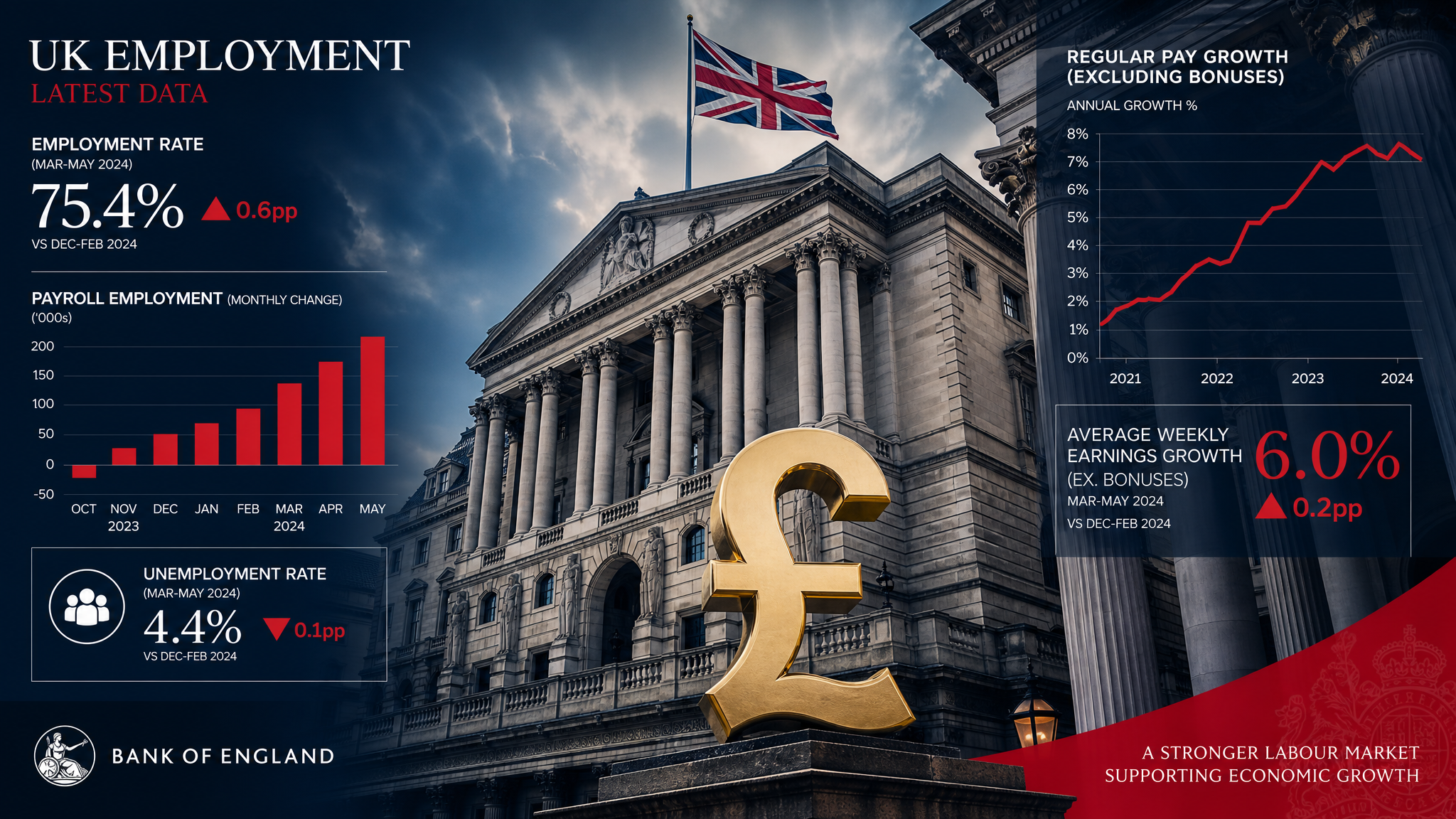
The ONS July labour market release provides a detailed picture that is more nuanced than the headline unemployment rate of 4.9% suggests. The employment rate was 75.1%, up 0.1 percentage point on the quarter but down 0.1 point on the year. Payrolled employment fell by an estimated 30,000 over the three months to May — a small but directionally significant decline that suggests employers are beginning to reduce headcount rather than simply slow hiring.
Vacancies fell by 7,000, or 0.9%, to 712,000 in April–June. The unemployment-to-vacancy ratio stands at 2.5, meaning there are now 2.5 unemployed workers for every vacancy — a ratio that has risen from the historic lows of 2022 and indicates that the labour market is loosening. Total pay grew 4.3%, boosted by bonus payments, while CPI-adjusted real regular pay rose only 0.4% and real total pay rose 1.3%.
The Public-Private Pay Divide
The most important compositional detail in the July release is the public-private pay split. Public-sector regular earnings grew 5.5%, reflecting government pay awards and the timing of settlements. Private-sector regular earnings grew only 2.9% — a rate that, at current inflation, leaves real private-sector wages barely positive. If private-sector pay is a better guide to market-generated wage pressure than the aggregate, the labour market may be considerably less inflationary than the headline 3.4% figure implies.
This distinction matters for the Bank of England because the wage-price loop that the MPC most fears is driven by private-sector bargaining, not by government pay awards. A public-sector settlement that lifts the aggregate wage measure without reflecting private-sector dynamics could lead the MPC to overestimate underlying inflationary pressure. The ONS itself advises caution with short-term Labour Force Survey movements because of volatility and ongoing methodological changes.
Two Policy Scenarios for 30 July
The MPC faces two plausible paths. In the hold scenario, private pay at 2.9%, falling vacancies and declining payrolled employment provide enough evidence of labour-market cooling to justify keeping Bank Rate at 3.75%. The June inflation reading of 2.6%, even if temporary, reduces the urgency of further tightening, and the PMI contraction signal argues against adding additional restraint to an economy that may already be slowing.
In the tightening scenario, the Bank's own projection of inflation rising to 3.3% by year-end, combined with resilient Q1 GDP growth and the risk that energy costs feed into wage and price setting, justifies a further increase. The 7–2 vote in June suggests that the majority of the MPC is not yet convinced that enough has been done, but the two dissenters who voted for a cut indicate that the committee is genuinely divided.
What Investors Should Watch
For investors in UK gilts and sterling-denominated assets, the 30 July decision and Monetary Policy Report are the key near-term events. A hold accompanied by a downward revision to the inflation forecast would likely support gilts and put modest downward pressure on short-term yields. A rate increase or an upward revision to the inflation path would have the opposite effect. The private-sector pay figure and the vacancy trend are the two labour-market indicators most worth monitoring in the weeks ahead — they are more informative about underlying inflationary pressure than the headline unemployment rate or the aggregate wage measure.
This content is for informational purposes only and does not constitute financial advice. Always consult with a qualified financial advisor before making investment decisions.
Discussion