European Stocks 2026: DAX Autos, CAC Luxury and STOXX 600 Earnings
European equity benchmarks have delivered impressive headline numbers in 2026, with the STOXX Europe 600 reaching an intraday record of 652.35 on 3 July and the DAX touching 25,087.18 on 14 July. Yet beneath the aggregate performance lies a composition problem that investors cannot afford to ignore: much of the earnings acceleration is driven by energy, while two of the continent's most important industrial franchises — German automakers and French luxury groups — face distinct and deepening structural pressure.
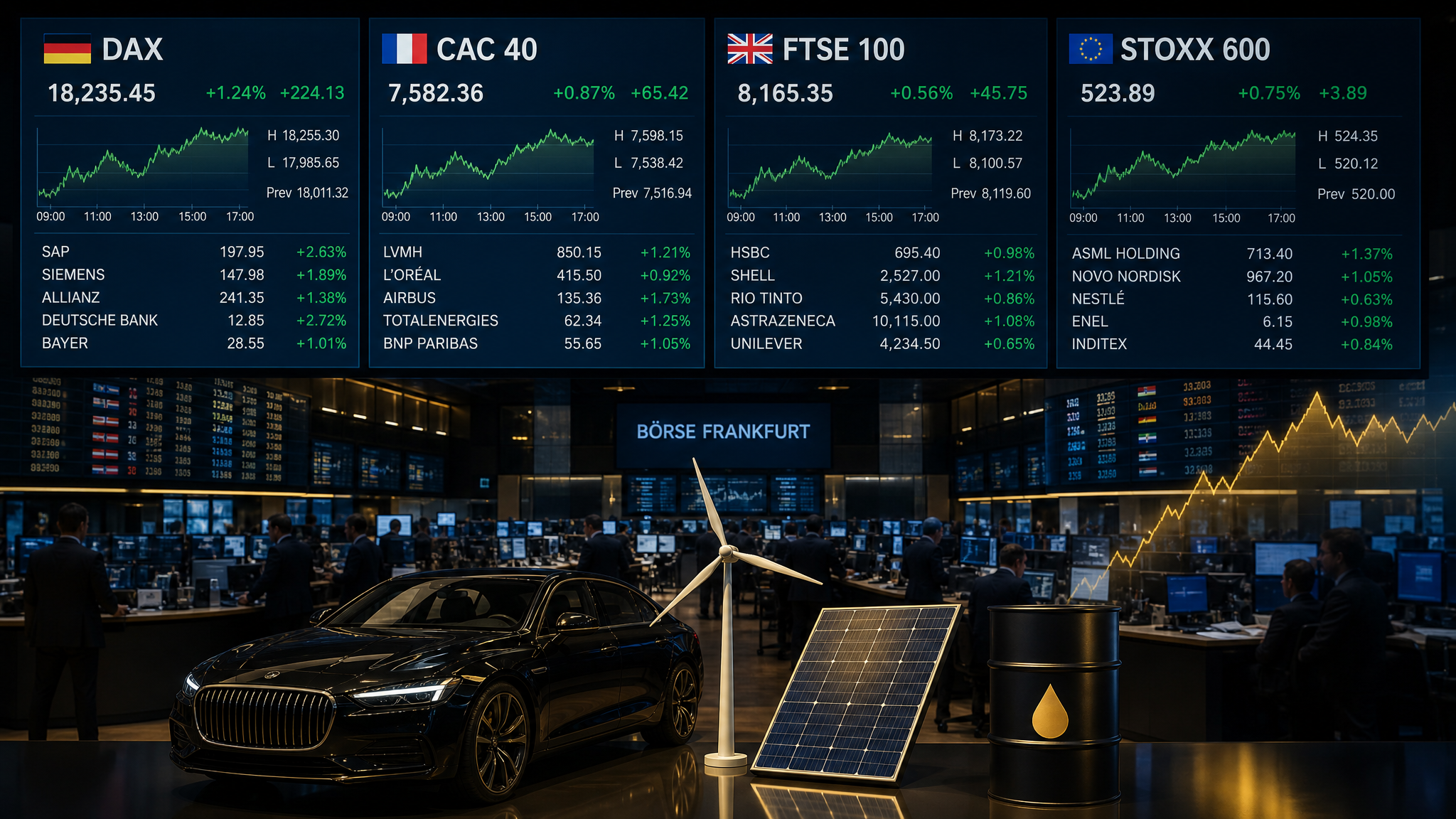
The Aggregate Earnings Picture
According to LSEG I/B/E/S data, expected second-quarter earnings growth for STOXX 600 companies stands at 17.3%, with energy earnings projected to surge 122.6%. Strip out energy, and that headline figure falls to 7.2% — still respectable, but a very different story. Revenue growth is estimated at 11.5%, the strongest since Q4 2022, yet the quality of that growth varies sharply by sector and country.
The CAC 40 closed at 8,299 on 23 July, down 1.6% in the session, as luxury and consumer-discretionary names sold off sharply. LVMH fell 4.3%, Hermès 3.4%, Kering 4.8% and L'Oréal 3.1% in a single session. Meanwhile, Thales gained 5.1% and TotalEnergies rose 2.5%, illustrating the divergence within the same national index. The FTSE 100 crossed 10,000 on 2 January 2026 after a 22% rise in 2025, though an exact late-July close was not verified at the time of writing.
The DAX's China and Tariff Problem
Volkswagen reported second-quarter operating profit of €3.5 billion, down almost 10% year on year and well below the €4.3 billion LSEG consensus. More significantly, the company revised its 2026 revenue outlook from growth of 0%–3% to a possible decline of as much as 3%. Volkswagen's China deliveries fell 36.6% in Q2, contributing to an 8.6% decline in global sales. BMW, Mercedes-Benz and Porsche recorded China sales declines of between 30% and 41% year on year in the same period.
The structural challenge is more serious than one weak quarter. Chinese competitors update their product ranges more frequently and have established stronger positions in electric vehicles, while German groups remain more dependent on internal-combustion models. Volkswagen is reportedly considering reducing as many as 100,000 jobs and struggling to find alternative uses for facilities in Hanover, Zwickau, Emden and Neckarsulm. BMW has forecast a 2026 automotive EBIT margin of only 4%–6%, citing tariffs and Chinese competition as material pressures.
The CAC 40's Luxury Sensitivity
French luxury valuations remain acutely sensitive to Chinese consumer demand, global tourism flows and company-specific turnarounds. LVMH had already fallen 8.2% after its January results raised doubts about the pace of sector recovery. The 23 July session confirmed that the luxury trade remains fragile: when Chinese demand signals weaken or global risk appetite retreats, the CAC 40 bears a disproportionate cost relative to other European benchmarks.
The contrast with energy and defence is instructive. TotalEnergies and Thales represent a different earnings engine — one driven by commodity prices and government procurement rather than discretionary consumer spending. Investors who buy the CAC 40 as a single "European equities" trade are implicitly taking a view on Chinese luxury demand, whether they intend to or not.
The FTSE 100's Different Composition
The FTSE 100 offers a different earnings mix. Its largest constituents include energy majors, global financial services firms and internationally exposed industrials. Rolls-Royce, for example, reported a 40% increase in 2025 annual profit in February and upgraded its 2026 forecasts, reflecting aerospace and data-centre exposure rather than continental consumer sensitivity. This does not make the FTSE immune to global risk-off moves, but it does mean that the UK benchmark's earnings drivers differ materially from those of the DAX or CAC 40.
Dollar-based investors must also account for currency translation. A strong euro or pound can amplify local-market returns in dollar terms, while depreciation can erode them. The full currency analysis belongs in a separate discussion, but the translation effect is a real component of total return for non-European investors.
What This Means for Investors
The investor decision is whether to access European equities through a broad regional vehicle or to select country and sector exposures deliberately. A broad benchmark captures the energy rebound but also embeds challenged automakers and luxury groups. Country indices can diverge significantly even when the macro narrative appears shared.
The 17.3% aggregate earnings growth figure is real, but it is not evenly distributed. Investors who treat "European equities" as a single trade may find that their returns depend heavily on whether energy prices hold, whether Chinese demand recovers and whether German automakers can execute a credible restructuring. Composition-aware analysis, rather than a single "buy Europe" thesis, is the more defensible approach in the current environment.
This content is for informational purposes only and does not constitute financial advice. Always consult with a qualified financial advisor before making investment decisions.
Discussion