Fed Holds Firm as Import Prices Surge: Why One Month of Disinflation Won't Change Policy
The Federal Reserve's policy stance entering the July 28–29 FOMC meeting is more restrictive than the latest monthly inflation readings might suggest. The federal funds target range remains at 3.50%–3.75% following the unanimous June 17 decision to hold, and recent communications from Fed Governors Christopher Waller and Lisa Cook make clear that a single favorable inflation report will not be sufficient to shift the Committee's posture. The reason is straightforward: the data mix is more complicated than the headline numbers imply, and the Fed is reading it that way.
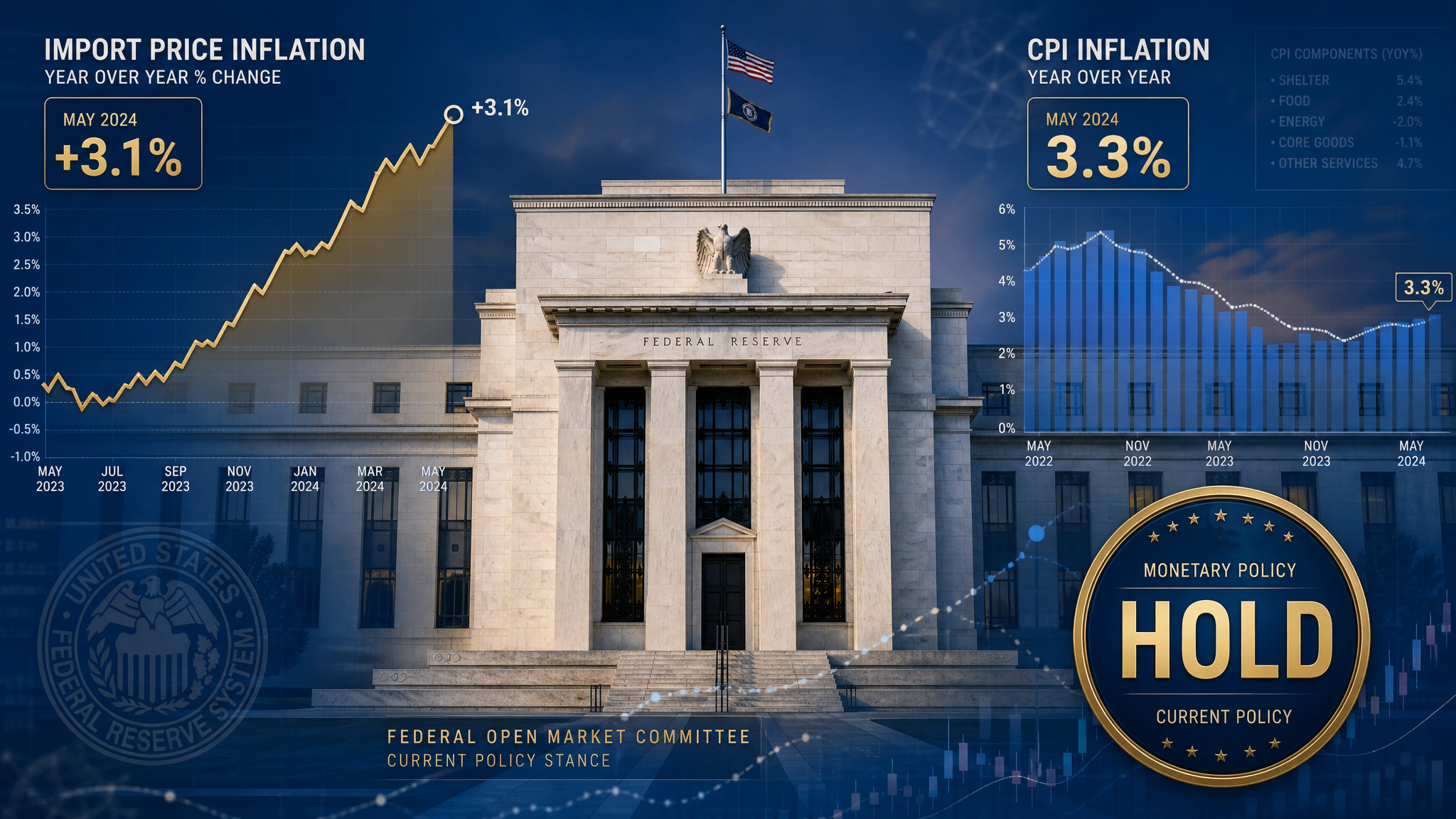
The Import Price Shock That Complicated the Disinflation Story
The most significant data surprise of the week came not from the consumer price index but from import prices. June import prices rose 0.3% month-over-month when economists had expected a decline of 0.8% — a miss of more than a full percentage point. On an annual basis, import prices were up 7.1%, the largest year-over-year increase since August 2022. Prices for imports from China rose 0.9% in June alone, the largest monthly increase since January 2008.
This matters because it directly challenges the interpretation that the inflation problem has been resolved. Domestic headline measures benefited substantially from lower energy costs in June, with the energy index falling 5.7% as US-Iran tensions temporarily eased. But import-price pressure suggests that businesses reliant on foreign inputs are still facing rising costs — costs that have not yet fully passed through to consumer prices but could do so in coming months. Manufacturing activity also eased in June while factory prices paid remained elevated, reinforcing the picture of uneven price pressure across the economy.
What Fed Officials Are Actually Saying
Governor Christopher Waller described policy as being at a "crossroads" in a July 13 speech. He cited core inflation rising from 3.0% in December 2025 to 3.4% in May 2026, with increases across both goods and services categories. Waller said further tightening could be necessary if that trajectory persists, while also noting that employment remains near its maximum sustainable level — meaning the labor market is not providing a strong argument for easier policy.
Governor Lisa Cook similarly said the balance of risks had shifted toward inflation in a July 15 speech. She characterized inflation as "unacceptably" high while noting an unemployment rate of 4.2%, and identified supply shocks, energy and food costs, and investment-related demand as contributors to price pressure. The shared message from both officials is more important than differences in phrasing: the labor side of the Fed's dual mandate is not currently providing a compelling case for rate cuts, giving the Committee greater latitude to respond to inflation persistence.
The June FOMC minutes, released on July 8, revealed disagreement beneath the unanimous hold decision. Some participants saw a case for tighter policy because of persistent inflation, while others identified scenarios in which inflation could ease. The unanimous vote should not be interpreted as unanimity about the future policy direction — it reflects agreement on the current decision, not on the distribution of risks going forward.
Consumer Sentiment Improved, But the Improvement Is Fragile
The week's data were not uniformly negative. The preliminary University of Michigan consumer sentiment index rose to 54.4 in July from 49.5 in June, beating the 51.0 consensus estimate. Even after the improvement, however, sentiment remained 11.8% below the prior-year level — a reminder that the absolute level of confidence is still historically depressed even as the monthly change was encouraging.
The University of Michigan itself flagged the fragility of the improvement. Much of the gain in sentiment was tied to lower gasoline prices, which in turn reflected the temporary easing of US-Iran tensions that allowed energy costs to fall in June. With crude oil now rising again — WTI reached $82.49 and Brent $88.10 in the week of July 14–17 — the gasoline-price tailwind that supported sentiment could reverse quickly. If it does, the July improvement may prove to be a one-month anomaly rather than the beginning of a sustained recovery in consumer confidence.
The Two-Sided Economy the Fed Must Navigate
The data picture the Fed faces is genuinely two-sided. On the encouraging side: domestic headline inflation benefited from lower energy costs, the two-year Treasury yield fell to 4.18% on July 17 as markets priced in some disinflation progress, and consumer sentiment improved more than expected. On the discouraging side: core inflation has been rising, not falling, since December 2025; import prices surged in June; manufacturing input costs remain elevated; and the oil market is now sending a renewed inflationary signal.
These signals are not mutually exclusive. Consumers can feel temporarily better as gasoline prices fall while producers and importers continue to encounter cost pressure. The correct narrative is not "disinflation won" or "inflation reaccelerated" — it is that price pressure has become more uneven and company-specific, making the aggregate inflation picture harder to read and the Fed's job correspondingly more difficult.
What the July 28–29 Meeting Could Reveal
The July meeting will not produce a rate change under any realistic scenario — the probability of a July increase had fallen to approximately 14% by the end of the week, down from roughly 40% earlier in the month, as the favorable domestic inflation data temporarily reduced tightening expectations. But the statement and press conference will be closely watched for signals about the September meeting and beyond.
Key questions for investors include: Will the Fed acknowledge the import-price surprise as a material risk, or treat it as noise? Will Chair Kevin Warsh — who said the June inflation decline did not represent "mission accomplished" — maintain that hawkish framing in the face of improving headline data? And will the Committee signal any change in its assessment of the balance of risks between inflation and employment?
The answers will determine whether the modest decline in Treasury yields seen during the week of July 14–17 represents the beginning of a genuine easing in financial conditions or a temporary reprieve that the Fed will push back against. For businesses planning financing decisions and investors positioning for the second half of 2026, the distinction is consequential. The Fed is telling markets to focus on persistent inflation, not one month's relief — and the import-price data suggest that message is well-founded.
This content is for informational purposes only and does not constitute financial advice. Always consult with a qualified financial advisor before making investment decisions.
Discussion