Oil, Yields & Equities: The Cross-Asset Warning From Wall Street's Latest Sell-Off
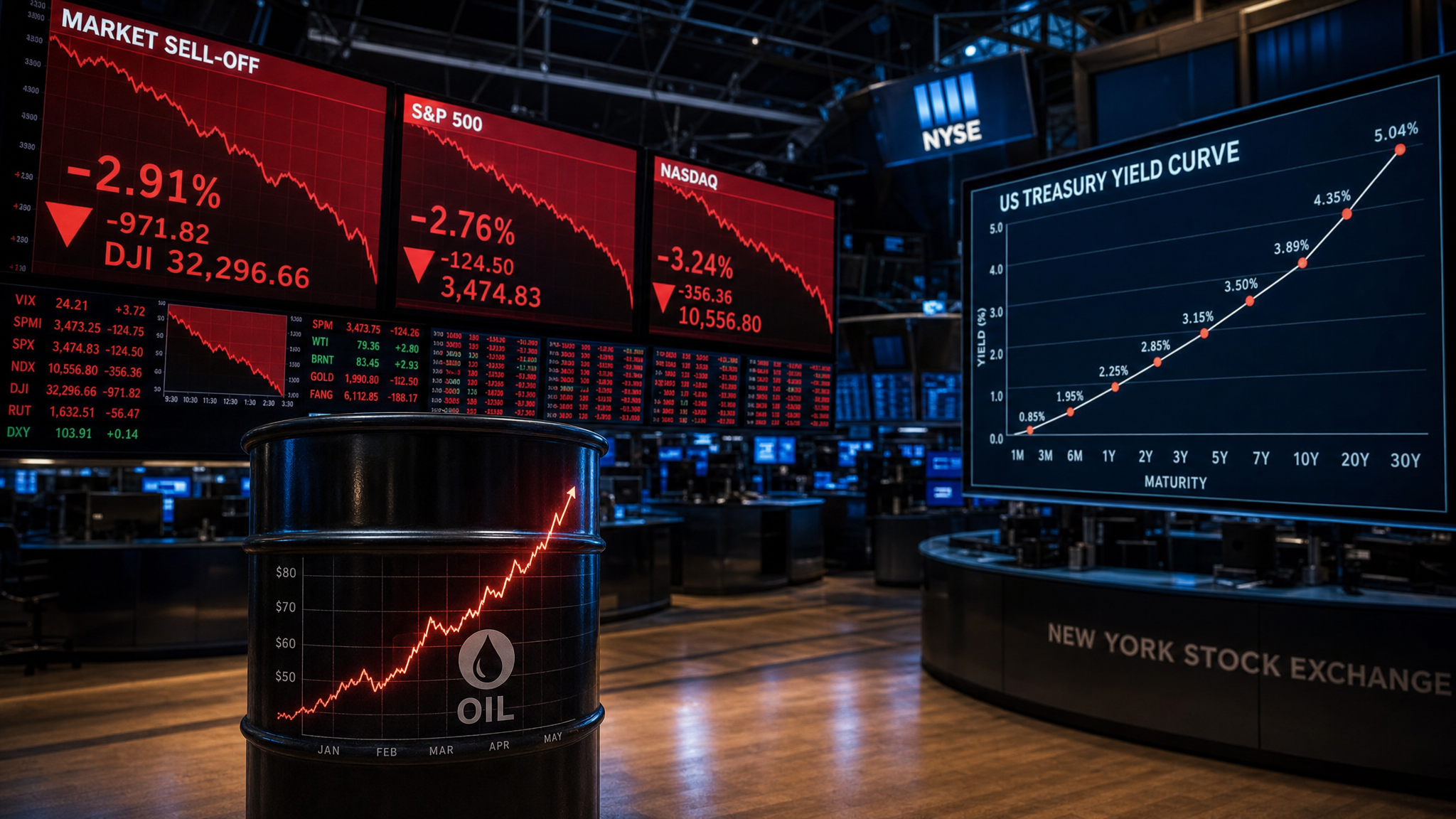
Wall Street closed the week of July 14–17 with a broad decline that defied simple categorization. The S&P 500 fell 1.01% to 7,457.69, the Nasdaq Composite dropped 1.4% to 25,520.24, and the Dow Jones Industrial Average lost 0.77% to 52,146.42. For the full week, the losses were steeper: the Nasdaq shed 2.9%, the S&P 500 gave back 1.6%, and the Dow retreated 0.9%. What made this sell-off analytically significant was not its magnitude but its internal logic — equities fell while Treasury yields moved lower and oil surged, a combination that sends conflicting signals about the true nature of the risk environment.
The Dominant Driver: Geopolitical Risk Transmitted Through Oil
The clearest adverse signal came from crude oil markets. WTI crude rose 4.5% on the week to $82.49 per barrel, while Brent gained 4.6% to $88.10. The catalyst was an intensification of US-Iran tensions, including reports of strikes against military and infrastructure targets. At the center of market concern was the Strait of Hormuz, through which approximately 20% of global oil traffic passes. A proposed 20% protection fee for Strait traffic was briefly floated and then abandoned in favor of trade arrangements, temporarily easing pressure — but subsequent military escalation pushed crude higher again.
Oil matters to equity investors for reasons that go beyond energy-sector earnings. An energy shock raises operating and transportation costs across the economy even when other price categories are moderating. It can also undermine consumer confidence if the recent decline in gasoline prices — which helped lift the University of Michigan sentiment index to 54.4 in July from 49.5 in June — reverses. The University of Michigan itself noted that the improvement could prove fragile under that condition.
Bonds Provided Relief, But Not Clean Confirmation
Treasury yields generally declined during the week following favorable domestic inflation data. The two-year yield was reported at 4.18% on July 17, while the ten-year yield had traded near 4.57% earlier in the week. Under normal circumstances, falling yields reduce the discount-rate pressure on equities and support valuations — particularly for growth and technology stocks that dominate the Nasdaq.
Yet stocks still declined. This weakens any simplistic conclusion that lower market rates are automatically bullish. The bond move also faces a durability test: lower energy prices played a substantial role in June's favorable inflation readings, while the latest oil rally points in the opposite direction. If crude sustains its advance, the disinflation narrative that drove yields lower could unravel quickly, removing the one supportive factor that had emerged during the week.
The Nasdaq's Underperformance Signals Valuation Sensitivity
The consistent ranking across both daily and weekly performance — Nasdaq weakest, S&P 500 in the middle, Dow least weak — is analytically meaningful. The Nasdaq's heavier weighting toward high-multiple technology and growth companies makes it more sensitive to changes in the discount rate and risk appetite. When the index underperforms by a wide margin, it typically signals that investors are reassessing the premium they are willing to pay for future earnings, not merely reacting to near-term economic data.
This dynamic is particularly important in the current environment. The Nasdaq had been the primary beneficiary of the AI-driven rally that dominated much of 2025 and early 2026. A sustained period of underperformance relative to the Dow — which is more heavily weighted toward industrials, financials, and consumer staples — would suggest a broader rotation away from growth and toward value, compounding the sector-rotation pressures already visible in recent weeks.
A Three-Way Tension: Oil, Yields, and Risk Appetite
The most important analytical challenge for investors is that the three major cross-asset signals are not telling the same story. Oil is rising, which is inflationary and margin-negative. Treasury yields are falling, which is normally supportive but may reflect risk aversion rather than genuine disinflation. Equities are declining, which could reflect either the oil threat, the valuation reset, or both simultaneously.
Investors should resist the temptation to anchor on any single signal. The correct framework is to monitor the interaction between all three. If oil retreats and yields remain lower while equities stabilize, the disinflation narrative regains control and the sell-off may prove temporary. If oil continues to rise and yields follow, the regime becomes materially less supportive — particularly for rate-sensitive and margin-sensitive assets. If equities weaken while yields fall and oil rises simultaneously, risk aversion is dominating, and preserving liquidity becomes the priority over adding exposure.
What Investors Should Watch Next
The July 28–29 FOMC meeting is the next major scheduled catalyst. Markets will be watching whether the Fed acknowledges the oil-driven inflation risk or maintains its focus on the favorable domestic price data from June. Any signal that the Committee is prepared to tighten further in response to energy-driven inflation would represent a significant shift in the policy narrative and could amplify the pressure on equities.
Beyond the Fed, the trajectory of US-Iran tensions will determine whether the oil spike is a temporary geopolitical premium or the beginning of a sustained supply disruption. A resolution that removes the Strait of Hormuz risk would likely allow crude to retrace, yields to stabilize, and equities to recover. An escalation that threatens actual supply flows would do the opposite — and would do so at a moment when corporate margins are already under scrutiny from the Q2 earnings season.
The week's sell-off was not a routine correction. It was a cross-asset warning that the benign inflation-relief narrative of early July is more fragile than it appeared. Oil is the key variable: its next sustained move will determine whether lower Treasury yields remain a tailwind or are overwhelmed by renewed inflation and margin risk.
This content is for informational purposes only and does not constitute financial advice. Always consult with a qualified financial advisor before making investment decisions.
Discussion