Japan's Ambush Playbook: How the MOF Is Rewriting Yen Intervention Tactics in 2026
For decades, Japan's Ministry of Finance (MOF) operated on a predictable script when the yen came under pressure: officials would issue increasingly stern verbal warnings — a practice known as "jawboning" — giving currency traders ample time to unwind short positions before any direct market action. That era is over. In a significant strategic pivot confirmed by Reuters sources in early July 2026, the MOF has adopted what market participants are now calling "ambush" intervention tactics, deliberately abandoning advance signals to maximise losses on yen short-sellers and restore credibility to Japan's currency defence.
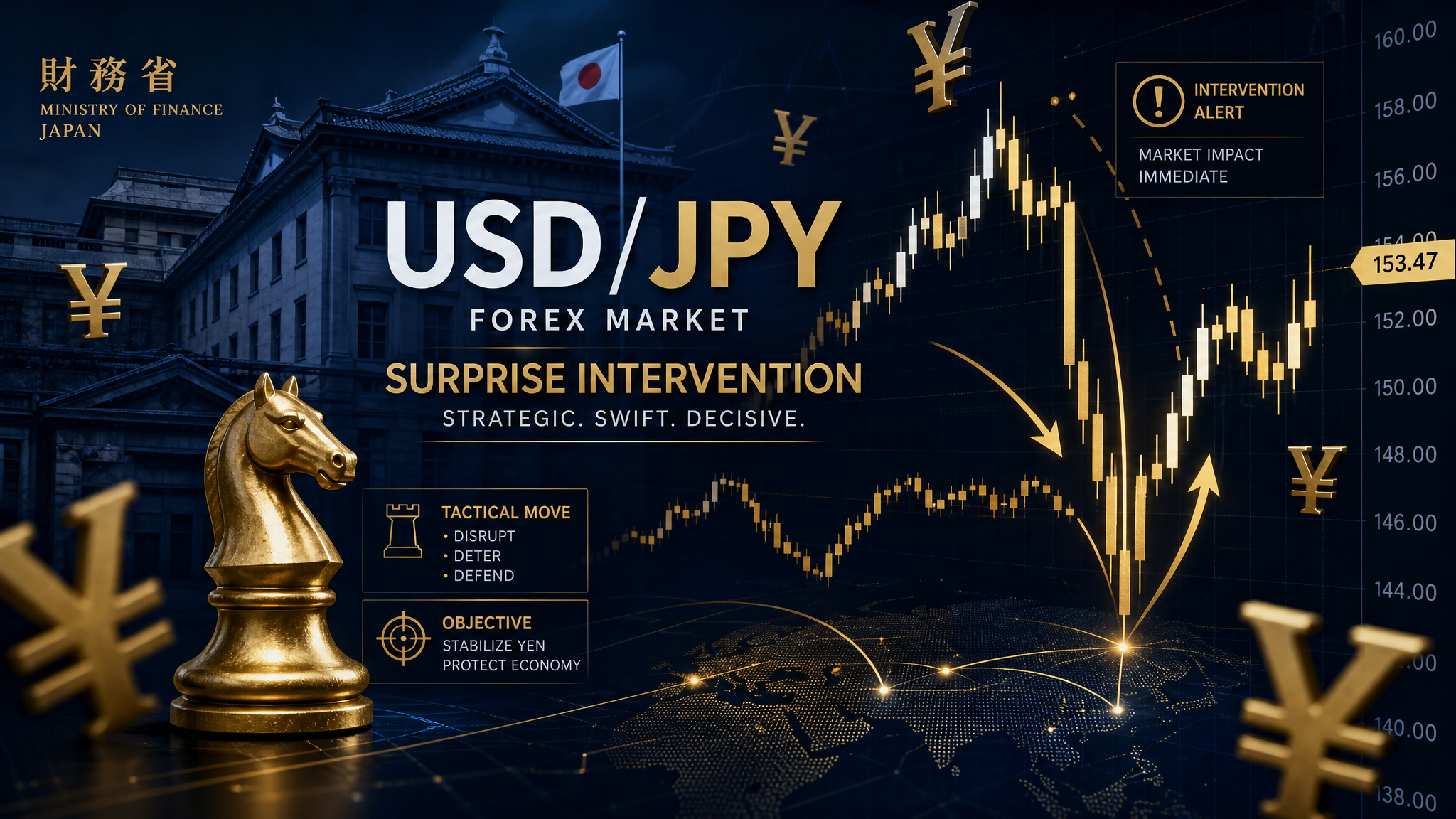
The shift comes after a bruising lesson in 2026. Despite a record 11.7 trillion yen ($72 billion) intervention between late April and early May, the yen's recovery proved short-lived. Speculators, conditioned by years of telegraphed warnings, had learned to front-run official action — buying back yen positions just before intervention and re-establishing shorts once the dust settled. The result: the yen slid to a 40-year low of 162.66 per dollar in early July, rendering the traditional playbook not just ineffective but counterproductive.
Silence as a Policy Weapon
The new MOF approach rests on three pillars. First, officials have adopted deliberate silence, refusing to define any specific USD/JPY level that would trigger intervention. By removing the "line in the sand," the MOF forces traders to price in intervention risk at every tick, raising the cost of maintaining short-yen positions. Second, the timing of any market action is now intentionally unpredictable — interventions may occur during thin Asian trading hours, at the open of London markets, or mid-session in New York, maximising the element of surprise. Third, the Bank of Japan (BOJ) is providing rhetorical cover, maintaining hawkish language around the inflationary risks of a weak yen, which reinforces the threat of coordinated policy action without committing to a specific timeline.
The strategic logic is straightforward: if speculators cannot anticipate when the MOF will act, the risk-reward of holding large short-yen positions deteriorates sharply. Even a modest probability of a sudden 3–4% yen spike — the typical magnitude of a surprise intervention — can wipe out weeks of carry-trade profits accumulated from the wide interest rate differential between Japan's 1% policy rate and the Federal Reserve's 3.50–3.75% range.
The Structural Backdrop: JGB Yields and the Pension Pivot
The MOF's tactical shift does not exist in isolation. It is unfolding against a backdrop of rising Japanese Government Bond (JGB) yields that are reshaping the domestic investment landscape. The 10-year JGB yield reached 2.901% in early July 2026 — levels not seen since 1996 — as the BOJ continues its post-yield-curve-control normalisation. Rising domestic yields are beginning to erode the fundamental driver of yen weakness: the carry trade.
Compounding this dynamic is what analysts are calling the "pension pivot." Finance Minister Satsuki Katayama has reportedly encouraged the Government Pension Investment Fund (GPIF) — the world's largest pension fund with $1.8 trillion in assets — to increase its allocation to Japanese financial assets. Any meaningful reallocation from GPIF's overseas holdings back into domestic JGBs and equities would represent a powerful structural bid for the yen, independent of MOF intervention. In the first quarter of 2026 alone, Japanese investors sold $29.6 billion of U.S. Treasuries, a trend that, if sustained, signals the end of Japan's role as the "silent subsidiser of cheap global borrowing."
Market Implications: USD/JPY, Asian Equities, and Global Bonds
For currency traders, the ambush strategy introduces a new risk premium into USD/JPY positioning. Options markets have already begun pricing in higher implied volatility for the pair, raising the cost of carry-trade financing. A sustained yen recovery — whether driven by MOF action, BOJ rate hikes, or GPIF repatriation — would have cascading effects across Asian equity markets. Japanese exporters, whose earnings have been flattered by yen weakness, would face margin compression. Conversely, domestic consumption-oriented sectors and financials, which benefit from higher rates, could outperform.
Beyond Japan, the implications extend to global bond markets. If Japanese capital repatriation accelerates, U.S. Treasury yields could face upward pressure at the long end, steepening the yield curve and tightening financial conditions globally. Asian central banks with significant USD reserve holdings — particularly in South Korea, Taiwan, and Singapore — are watching the USD/JPY dynamic closely, as a sharp yen appreciation could trigger competitive currency pressures across the region.
What Investors Should Watch
Three indicators will signal whether the MOF's ambush strategy is working. First, watch for a sustained decline in speculative short-yen positioning as reported in the CFTC Commitment of Traders data — a reduction in net shorts would confirm that the strategy is raising the cost of betting against the yen. Second, monitor BOJ communication for any acceleration in rate hike signals; a July or September rate increase would provide fundamental support for the yen that intervention alone cannot sustain. Third, track GPIF's quarterly portfolio disclosures for evidence of a domestic reallocation shift.
The MOF's pivot from transparency to ambiguity marks a genuine evolution in Japan's currency management toolkit. Whether it proves sufficient to reverse the yen's structural weakness — rooted in a still-wide rate differential and decades of ultra-loose monetary policy — remains the central question for Asian currency markets in the second half of 2026.
This content is for informational purposes only and does not constitute financial advice. Always consult with a qualified financial advisor before making investment decisions.
Discussion