Iron Ore Below $100, LNG Squeeze, and China's Refinery Slump: Asia's Commodity Crossroads in Mid-2026
Asian commodity markets are navigating a period of sharp divergence in mid-2026. Iron ore has broken below the psychologically significant $100 per tonne threshold, weighed down by China's contracting steel sector and swelling port inventories. Meanwhile, liquefied natural gas (LNG) markets remain structurally tight, with Japanese spot prices still approximately 50% above pre-conflict levels despite the June ceasefire in the Middle East. And in China's refining sector, independent refinery operating rates have hit a nine-year low of 46%, signalling a demand retrenchment that is rippling across crude oil, petrochemical feedstocks, and Asian trade flows. Together, these three dynamics paint a complex picture for commodity-linked currencies, resource equities, and Asian supply chains.
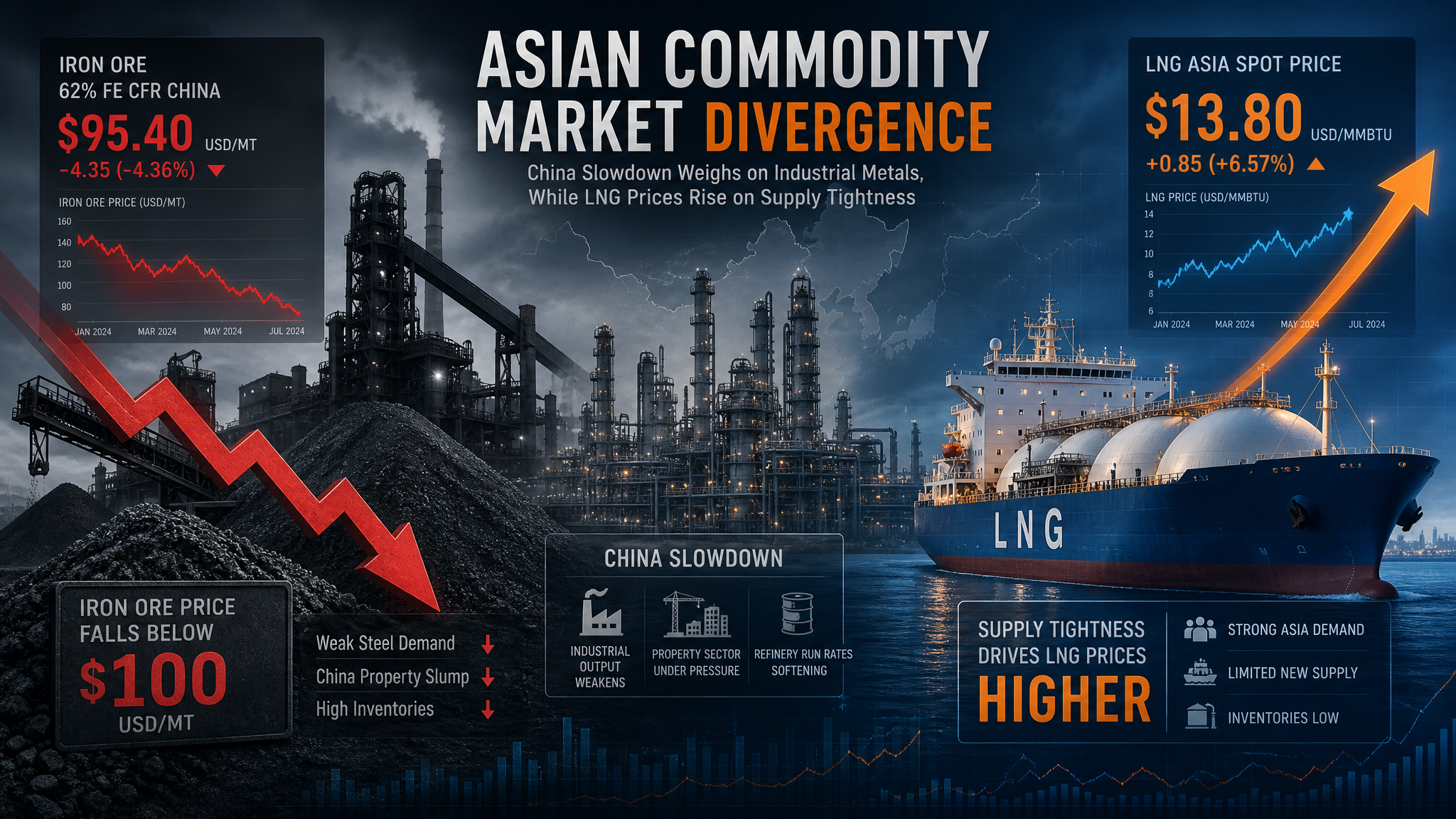
The common thread running through each of these developments is China — the world's largest consumer of iron ore, the fastest-growing LNG importer, and the dominant force in Asian crude oil demand. Understanding the divergence between these commodity markets requires unpacking the specific structural forces at work in each sector, and why the usual assumption that "China demand" moves all commodities in the same direction is breaking down in 2026.
Iron Ore: The $100 Floor Breaks
Iron ore's slide below $100 per tonne reflects a confluence of supply and demand pressures that have been building since early 2026. On the supply side, Australian and Brazilian miners continue to ship at near-record volumes, while port inventories in China have reached historically elevated levels. On the demand side, China's steel sector has been in contraction since April, with steelmaker margins squeezed by higher coking coal prices following a mining disaster in Shanxi province that disrupted domestic supply.
The medium-term outlook is equally challenging. The Simandou iron ore project in Guinea — one of the largest undeveloped iron ore deposits in the world — is expected to begin delivering low-cost output to market within the next 12–18 months, adding further supply pressure to an already well-supplied market. For Australian miners such as BHP, Rio Tinto, and Fortescue, the break below $100 per tonne compresses margins and raises questions about capital allocation priorities heading into 2027. The AUD/USD pair, which has historically tracked iron ore prices closely, faces a structural headwind if the commodity remains under pressure.
LNG: Structural Tightness Persists Despite Ceasefire
In contrast to iron ore, LNG markets remain tight despite the June 17 US-Iran memorandum of understanding that reopened the Strait of Hormuz and triggered a 16.3% decline in Brent crude prices during June. The divergence reflects the structural differences between oil and gas markets: while oil supply normalised relatively quickly as Saudi and UAE exports returned to pre-conflict levels, LNG markets face constraints that cannot be resolved by a ceasefire alone.
Limited vessel availability, constrained liquefaction capacity — particularly following damage to the Ras Laffan complex in Qatar — and long-term contract structures have kept Asian LNG spot prices elevated. Japan, South Korea, and Taiwan, which rely heavily on LNG for power generation, have been using thermal coal as a hedge against potential supply disruptions, supporting coal prices even as other energy commodities have softened. For Japan in particular, elevated LNG import costs are feeding directly into the inflation dynamics that the BOJ is monitoring as it calibrates its rate normalisation path.
China's Refinery Slump: A Demand Signal or a Structural Shift?
Perhaps the most significant commodity signal from Asia in mid-2026 is the collapse in Chinese independent refinery utilisation to a nine-year low of 46%. Independent refiners — known as "teapots" — account for a substantial share of China's crude oil processing capacity, and their operating rates serve as a real-time indicator of domestic fuel demand and refining economics.
The slump reflects several converging pressures: weak domestic gasoline and diesel demand as China's economy continues its uneven post-stimulus recovery, tightening environmental regulations that have forced some smaller refiners offline, and a structural shift toward electric vehicles that is gradually eroding gasoline demand growth. A rebound is expected in the fourth quarter as refiners restock ahead of the Chinese New Year, but the nine-year low in operating rates suggests that the era of China's refinery sector acting as an unconditional floor for global crude demand may be ending.
Investment Implications: Currencies, Equities, and Trade Flows
The commodity divergence has clear implications for Asian asset allocation. Resource-linked currencies — particularly the Australian dollar and the Canadian dollar — face headwinds from iron ore weakness, while the Japanese yen's inflation dynamics are complicated by elevated LNG import costs. In equity markets, diversified miners with iron ore exposure are under pressure, while LNG producers and infrastructure operators benefit from sustained price premiums.
For Asian trade flows, the combination of weak Chinese refinery demand and elevated LNG prices is reshaping energy import patterns across the region. Southeast Asian economies — particularly Indonesia, Malaysia, and Vietnam — are emerging as alternative destinations for LNG cargoes that would previously have flowed to China, a structural shift that is gradually diversifying Asia's energy import geography. Investors tracking Asian commodity demand should monitor China's Q3 refinery operating rate recovery, the pace of Simandou project development, and any further disruptions to Middle Eastern LNG supply infrastructure as the key variables that will determine whether mid-2026's commodity divergence deepens or reverses.
This content is for informational purposes only and does not constitute financial advice. Always consult with a qualified financial advisor before making investment decisions.
Discussion