The Great Divergence: How NBP, SNB, and Riksbank Are Splitting EMEA's Rate Landscape
While global investors remain fixated on the European Central Bank's every move, a quieter but equally consequential story is unfolding across Central and Northern Europe. Three central banks — Poland's National Bank of Poland (NBP), Switzerland's Swiss National Bank (SNB), and Sweden's Riksbank — are charting radically different monetary policy courses in July 2026, creating a mosaic of diverging yields, currency pressures, and investment opportunities that sophisticated EMEA investors cannot afford to ignore.
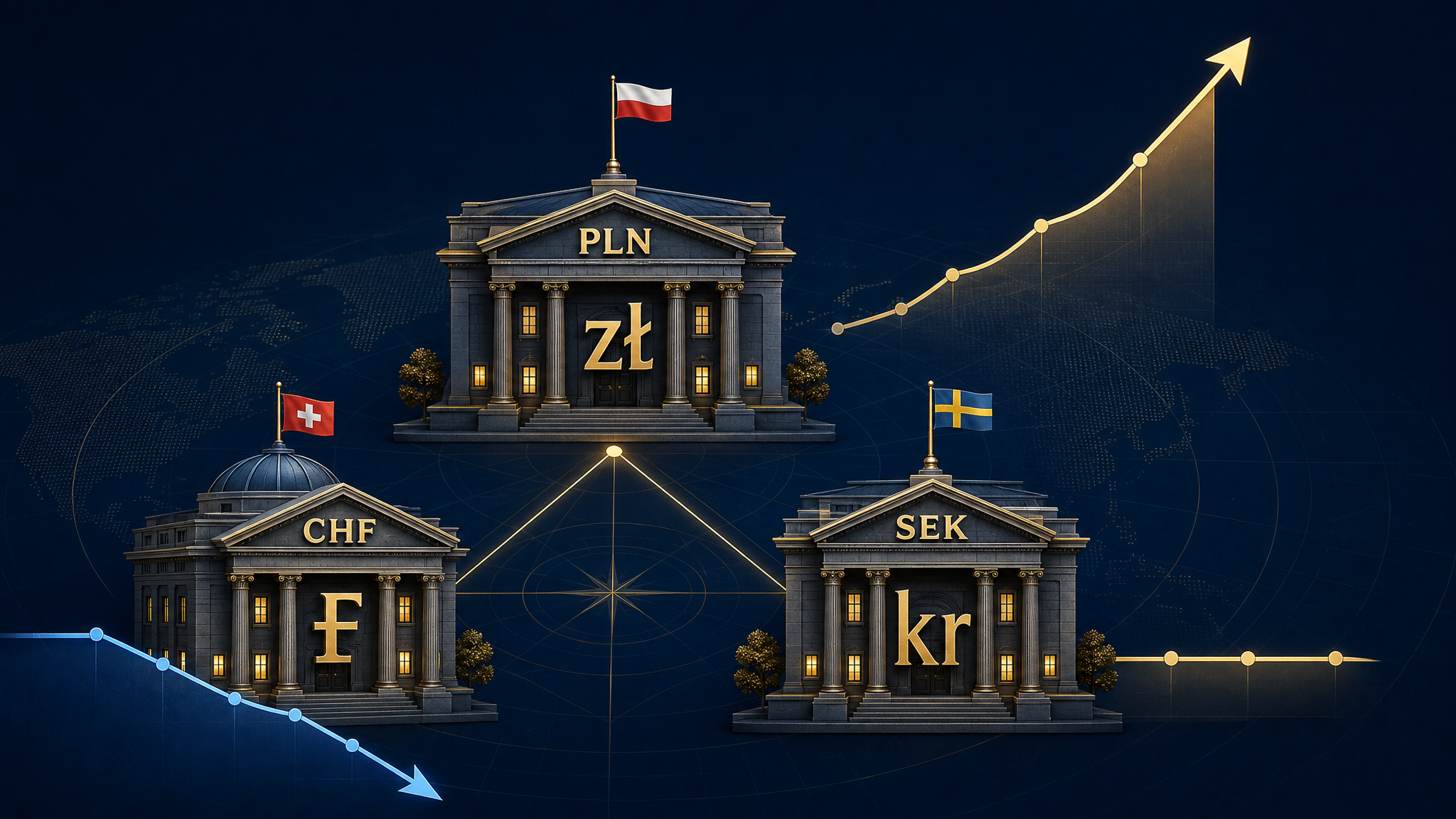
Poland Pivots Dovish: The Zloty Pays the Price
The most market-moving development came from Warsaw. At its July meeting, the NBP's Monetary Policy Council held its reference rate steady at 3.75%, a decision that was widely anticipated. What caught markets off guard was the tone of Governor Adam Glapiński's subsequent communication. Citing a meaningful decline in headline CPI inflation to 2.5% in June — well within the NBP's target band — Glapiński signalled he might propose a 25-basis-point rate cut after the summer, contingent on stable global conditions.
The market reaction was swift and logical. The Polish zloty (PLN) weakened against the euro, depreciating from around 4.305 to 4.33 in the immediate aftermath. Polish government bonds, however, rallied sharply on the prospect of future monetary easing, with yields across the curve falling by 9 to 13 basis points. As of July 20, Poland's 10-year government bond yield stands at 5.63%, still elevated in absolute terms but on a downward trajectory that could accelerate if the NBP follows through on its dovish guidance.
For bond investors, this pivot is significant. Polish government bonds now offer a compelling combination of high nominal yields and the prospect of capital gains from falling rates — a rare combination in the current global environment. The primary risk is a reversal in the NBP's stance should global inflationary pressures, particularly from energy prices, re-ignite. Analysts at ING have pointed to strong fundamentals — including expected EU fund inflows and robust GDP growth — as factors that could support the zloty in the medium term, even as it faces short-term headwinds from the dovish pivot.
Switzerland: When Safe-Haven Status Meets Central Bank Pushback
In stark contrast to Poland's rate-driven narrative, Switzerland's monetary story in 2026 is one of currency management rather than interest rate adjustment. The SNB has maintained its policy rate at 0.00% since June 2025, leaving it with little conventional ammunition. Instead, the central bank's primary tool has been its stated and demonstrated willingness to intervene directly in foreign exchange markets.
Following the outbreak of conflict in the Middle East in late February 2026, the Swiss franc (CHF) experienced significant appreciation pressure from safe-haven inflows. In response, the SNB explicitly increased its willingness to intervene to counter any "rapid and excessive appreciation" that could threaten price stability. This active intervention stance has effectively placed a functional ceiling on the franc's value. As of mid-July 2026, the euro-to-franc exchange rate stood at 0.9227, and the 10-year Swiss Confederation bond yield was a mere 0.480% — reflecting a market that has largely accepted the SNB's implicit cap.
Analysts at Rabobank have highlighted that the SNB's credible threat of intervention makes it difficult to maintain speculative long positions in the franc. The central bank has clearly defined its pain threshold, and its large foreign exchange reserves give it the firepower to back up its words. For investors, this means the CHF remains a bastion of capital preservation but offers limited upside from currency appreciation. Swiss government bonds, with their near-zero yields, are similarly unattractive for return-seeking investors, functioning more as a portfolio hedge than a source of income.
Sweden's Riksbank: Paralysed Between Weak Growth and Sticky Inflation
Sweden's Riksbank presents the most complex and uncertain picture of the three. At its June 2026 meeting, the bank held its policy rate at 1.75% for the sixth consecutive meeting, a streak of inaction that reflects a genuine policy dilemma. Domestic economic activity remains weak, which argues for easing. But the Riksbank has simultaneously identified significant upside inflation risks linked to prolonged supply chain disruptions from the Middle East conflict.
This tension is visible in the bank's own forecasts. While it revised its 2026 inflation projection down to 0.6%, it increased its 2027 projection to 2.7% — well above its 2% target. The Swedish 10-year government bond yield stood at 2.94% on July 20, having risen moderately over the month as persistent inflation concerns weigh on the long end of the curve. Market analysts are split almost evenly on the Riksbank's next move: roughly half expect rates to remain at 1.75% through year-end, while the other half anticipates a hike of 25 to 50 basis points if inflationary pressures intensify.
This ambiguity has kept the Swedish krona in a holding pattern, sensitive to incoming data and shifts in global risk sentiment. The next major catalyst will be the Riksbank's August monetary policy update, which could finally break the deadlock and provide clearer direction for both the krona and Swedish government bonds.
The Investment Takeaway: Relative Value in a Fragmented Landscape
The diverging paths of these three non-euro central banks offer compelling opportunities for investors willing to look beyond the ECB's shadow. Polish government bonds stand out as the most actionable near-term trade, offering high yields with the prospect of capital appreciation as the NBP easing cycle begins. Swiss assets remain a defensive anchor but offer little return potential. Sweden is a tactical play, best approached through relative value strategies — such as positioning for yield curve movements — rather than outright directional bets.
The broader lesson is that EMEA's monetary landscape is far more nuanced than a simple ECB-versus-the-rest narrative. Investors who map the full spectrum of central bank divergence across the region will be better positioned to identify where risk is mispriced and where genuine alpha opportunities lie in the second half of 2026.
This content is for informational purposes only and does not constitute financial advice. Always consult with a qualified financial advisor before making investment decisions.
Discussion