Japan's Hidden Inflation: Why Producer Prices at 7.1% Tell a Different Story Than CPI
Japan's June consumer price index rose 1.7% year-on-year, and the core measure excluding fresh food climbed to 1.6%—its highest reading since March but still below the Bank of Japan's 2% target for the fifth consecutive month. On the surface, this looks like a central bank with room to breathe. Look upstream, however, and a very different picture emerges: producer-price inflation hit 7.1% in June, the highest since March 2023, creating a cost pressure that has not yet fully passed through to consumers but almost certainly will.
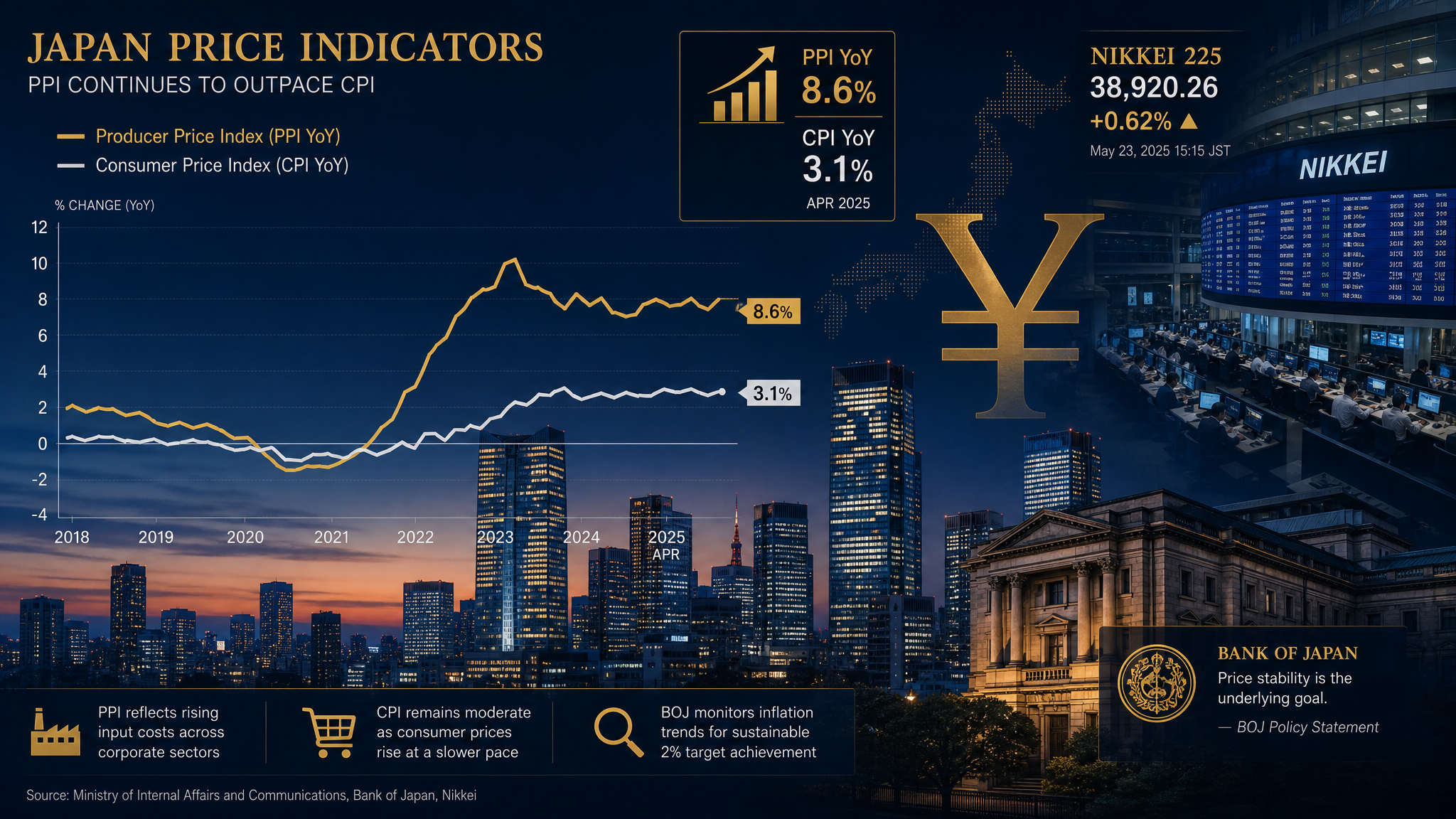
The Deceptive Comfort of 1.6%
Japan's core CPI reading of 1.6% is technically below target, but the composition of that number deserves scrutiny. Food inflation slowed to 3.2%, its weakest since July 2024, while education prices fell 6.0%—both factors that mechanically suppress the headline. Meanwhile, transport inflation accelerated to 2.4% from 1.9%, household-goods inflation rose to 2.4% from 2.2%, and healthcare costs increased to 1.3% from zero. The measure excluding both fresh food and energy actually slowed to 1.7%, its lowest since August 2022, which some analysts interpret as evidence that underlying demand-driven inflation is fading. But this reading misses the structural vulnerability embedded in Japan's energy dependence.
Japan imports more than 87% of its energy. When oil prices rise and the yen weakens simultaneously, the domestic-currency cost of that energy bill compounds rapidly. The value of petroleum imports rose more than 59% year-on-year in the June data, a figure that dwarfs the consumer-price headline and signals that the cost shock is real—it is simply being absorbed elsewhere for now.
The Yen-Oil Multiplier
The transmission chain from global energy markets to Japanese households runs through several stages. First, higher oil prices raise the foreign-currency cost of imports. Second, a weak yen—USD/JPY has been trading in the 162–164 range in late July—magnifies that cost in yen terms. Third, producers initially absorb part of the increase by compressing margins rather than raising prices immediately. Fourth, as margin compression becomes unsustainable, prices eventually rise or investment is cut.
The 7.1% producer-price reading suggests the third stage is well advanced. Manufacturers and distributors are sitting on cost increases that have not yet been fully passed to consumers. When they do pass them through—and competitive dynamics in Japan's retail sector suggest this happens slowly but eventually—the consumer-price index will follow. The question for the Bank of Japan is whether to act on the upstream signal or wait for the downstream confirmation.
The BOJ's Asymmetric Policy Problem
The Bank of Japan raised its short-term policy rate by 25 basis points to 1.0% in June, in a 7–1 vote. That decision reflected confidence that inflation was becoming more durable. The July 30–31 meeting, at which the BOJ will also publish its Outlook Report, now faces a more complex set of inputs.
A further rate increase could support the yen, reducing the import-cost multiplier and signalling that the BOJ takes upstream inflation seriously. But monetary policy cannot create energy supply, and a rate hike that weakens domestic demand precisely when households are already being squeezed by import costs risks amplifying the economic slowdown. Holding rates steady preserves growth momentum but risks allowing imported inflation expectations to become embedded in wage negotiations and price-setting behaviour.
The asymmetry is real: the BOJ can raise rates to signal vigilance, but it cannot lower oil prices. Its credibility challenge is therefore two-sided—prevent a cost shock from broadening without implying it can eliminate a geopolitical energy shock.
What the July Meeting Must Clarify
Markets will be watching the July 31 policy statement and Outlook Report for several specific signals. First, how does the BOJ characterise the gap between producer and consumer inflation? If it treats the divergence as temporary, it implies patience; if it treats it as a leading indicator, it implies urgency. Second, what are the BOJ's revised energy-price assumptions? A higher oil-price path embedded in the forecast would justify a more hawkish stance. Third, what language does the BOJ use on the exchange rate? The yen's level is not a policy target, but its effect on import costs is now a material input to the inflation outlook.
Investors should also watch the BOJ's consumption and wage-growth assessments. If real wages are being eroded by import costs, the demand side of the inflation equation weakens even as the supply side strengthens—a combination that makes the standard monetary-policy toolkit less effective than usual.
The Broader Investment Implication
For equity investors, the producer-consumer price gap has two distinct implications. If producers continue to absorb costs, margins narrow and earnings disappoint even as revenue holds up. If producers pass costs through, consumer spending weakens and demand-sensitive sectors face headwinds. Neither outcome is straightforwardly bullish for the Nikkei 225, which has risen approximately 27% year-to-date on the back of yen-driven export competitiveness and global AI-related demand.
The Nikkei's year-to-date performance reflects a weak-yen tailwind for exporters, but that same weak yen is now generating the import-cost problem described above. The two forces are not independent: a BOJ decision to tighten more aggressively to defend the yen would reduce the export-competitiveness advantage that has supported the index. Japan's inflation story in the second half of 2026 is therefore not simply about whether CPI crosses 2%—it is about whether the BOJ can manage the yen-oil-wage transmission chain without triggering the very demand weakness it is trying to avoid.
This content is for informational purposes only and does not constitute financial advice. Always consult with a qualified financial advisor before making investment decisions.
Discussion