China's Industrial Strength Masks a Domestic Demand Gap That PBOC Cannot Easily Bridge
China's June economic data delivered a familiar contradiction. Industrial output rose 5.3% year-on-year, driven by high-tech equipment manufacturing running at a PMI of 53.5 and strong export demand. Retail sales returned to growth. Yet first-half fixed-asset investment contracted 5.7%, construction PMI remained below 50 at 49.0, and the property sector continued to weigh on household wealth and local government finances. The Shanghai Composite closed July 23 at approximately 3,877, up 0.25% for the session but down roughly 5.7% over the prior month—a market that is pricing the contradiction rather than resolving it.
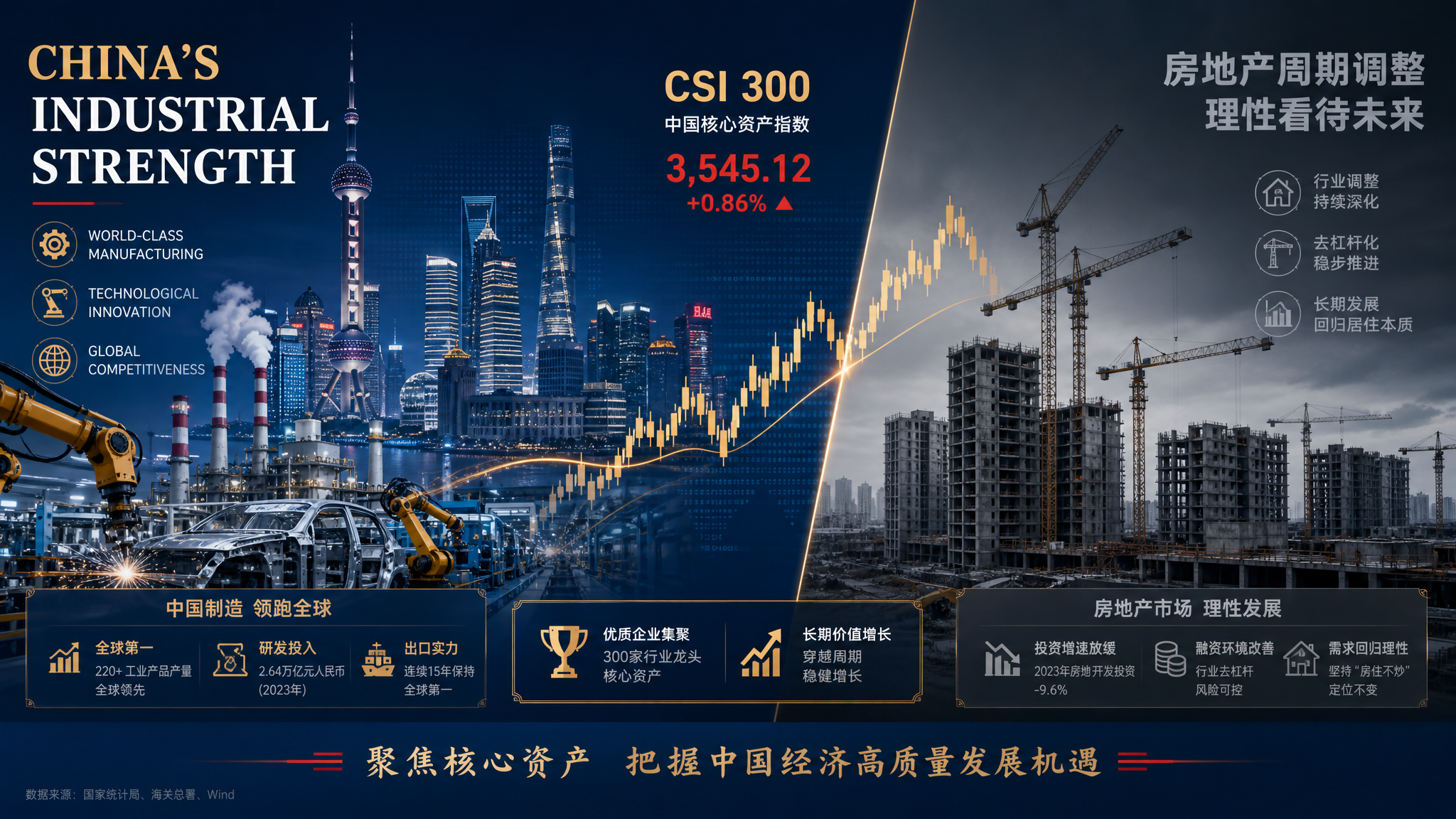
Two Economies in One Data Release
The divergence between China's industrial and investment data reflects a structural split that has been widening since 2023. Export-oriented manufacturing—particularly in electric vehicles, solar panels, batteries and high-tech equipment—is operating at high utilisation rates and generating strong revenue. This segment benefits from global demand for clean-energy technology, competitive pricing and government industrial policy support.
The domestic investment economy tells a different story. Property construction, which historically drove a large share of fixed-asset investment, steel demand and local government land revenue, remains in contraction. The construction PMI at 49.0 confirms that activity is still shrinking, even if the pace of decline has moderated from the acute stress of 2023–2024. The consequence is a two-speed economy where the headline growth rate obscures the weakness in the channels that most directly affect household wealth, employment in construction-related industries and the fiscal health of local governments.
What the PBOC Can and Cannot Do
The People's Bank of China held its Loan Prime Rate announcement on July 20, though the specific numerical rates were not disclosed in available reporting at the time of writing. The PBOC's Q2 Monetary Policy Committee meeting was held on July 8, and its public communications have emphasised support for the real economy while maintaining financial stability.
The PBOC faces a constraint that is structural rather than cyclical: lower interest rates can reduce borrowing costs, but they cannot restore confidence in property values or create demand for new construction when households and developers are still working through existing debt burdens. The transmission mechanism from monetary easing to property investment is broken in a way that rate cuts alone cannot fix. This is why PBOC policy in 2026 has increasingly focused on targeted credit channels—directing lending toward manufacturing, green infrastructure and technology—rather than broad-based stimulus.
USD/CNY has been trading in the 6.78–6.80 range in late July, reflecting a managed exchange rate that balances export competitiveness against capital-flow pressures. A significantly weaker yuan would support exporters but risk accelerating capital outflows and complicating trade relations with major partners.
Copper Demand as a Leading Signal
One of the more informative data points from July is that Chinese copper imports reached a nine-month high by July 20. Copper demand is a useful proxy for the composition of Chinese economic activity because it is consumed heavily in manufacturing, electronics, electric vehicles and grid infrastructure—all areas of current strength—but less so in residential construction, which is the area of weakness. The copper import surge therefore confirms the industrial-strength narrative without contradicting the property-weakness narrative.
Iron ore tells the opposite story. Prices remained under pressure through late June and into July, reflecting weak steel demand from the construction sector. The divergence between copper and iron ore demand is itself a market signal: investors and commodity traders are pricing the two-speed economy in real time through the relative performance of these two metals.
The Equity Market's Pricing Problem
For equity investors, the challenge is that the CSI 300 and Shanghai Composite contain both the export-manufacturing winners and the property-exposed losers. State-backed buying of technology ETFs has provided support to the index at various points in 2026, but this support creates a valuation floor rather than a fundamental re-rating. The underlying earnings divergence between high-tech manufacturers and property-linked companies remains wide.
The market's month-on-month decline of approximately 5.7% despite the positive June data suggests that investors are not yet convinced that the industrial strength is durable enough to offset the property drag. Key questions for the second half of 2026 include whether retail sales growth can be sustained without a property-wealth recovery, whether local government fiscal stress will require central government intervention, and whether the PBOC will deploy additional targeted tools to support the domestic demand side of the economy.
The Trade Surplus as a Double-Edged Signal
China's export strength has produced a large trade surplus, which provides foreign-exchange inflows and supports the yuan. But a surplus driven by weak domestic demand rather than genuine competitiveness gains is politically sensitive and economically fragile. Trading partners in Europe and the United States have responded with tariffs and trade investigations, particularly targeting electric vehicles and solar panels. If export markets become more restricted, the industrial-strength narrative loses its primary engine precisely when the domestic investment engine remains stalled.
The PBOC and Chinese policymakers are therefore navigating a narrow path: support enough domestic demand to prevent a deflationary spiral, manage the exchange rate to preserve export competitiveness, and avoid the kind of broad credit expansion that would re-inflate property prices and create new financial stability risks. The June data confirms they have not yet found a durable solution to this trilemma.
This content is for informational purposes only and does not constitute financial advice. Always consult with a qualified financial advisor before making investment decisions.
Discussion