Hong Kong's IPO Surge Tests Whether Record Turnover Can Absorb a HK$43 Trillion Market's New Supply
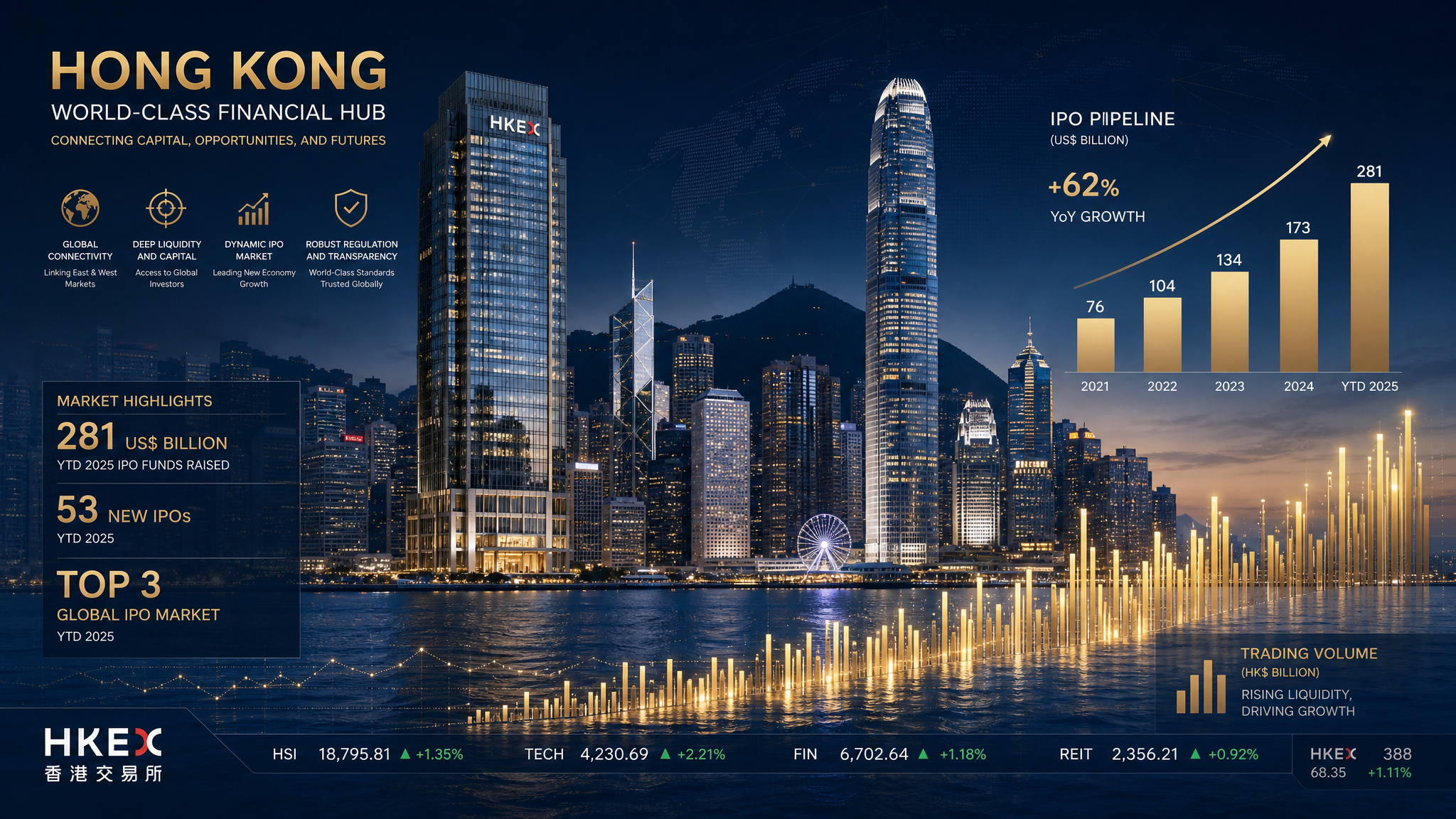
Hong Kong's equity market ended June with a market capitalisation of HK$43.3 trillion and average daily turnover of HK$319.1 billion—up 9% from May and 39% year-on-year. Those are impressive liquidity metrics for a market that spent much of 2022–2024 under pressure from regulatory uncertainty, geopolitical risk and capital outflows. But the same reform momentum that has restored confidence is now generating a supply challenge: 534 IPO applications are in the HKEX pipeline, concentrated in hard-tech, biotech and artificial intelligence companies, and the market must absorb this issuance alongside lock-up expirations and follow-on offerings from recent listings.
Why Issuers Are Rushing to Hong Kong
The surge in IPO applications reflects several converging forces. HKEX's 2023–2024 listing reforms lowered barriers for technology companies, particularly those in semiconductors, artificial intelligence and advanced manufacturing—sectors that Beijing has designated as strategic priorities. The A+H listing structure, which allows mainland-listed companies to simultaneously list in Hong Kong, has attracted issuers seeking access to international capital while maintaining their domestic investor base.
Biotech companies have found Hong Kong particularly attractive because the exchange's Chapter 18A rules allow pre-revenue pharmaceutical companies to list, a structure not available on mainland exchanges. The result is a pipeline that is qualitatively different from the property-developer and state-enterprise listings that dominated Hong Kong's IPO market a decade ago. Companies like Zhipu AI, Shanghai Biren Technology and Zhongji Innolight represent the hard-tech wave that HKEX's reforms were designed to capture.
The proposed Shein IPO, which received Chinese regulatory approval in July, adds a high-profile consumer-technology dimension to the pipeline. Shein's listing would be one of the largest in Hong Kong's recent history and would test international investor appetite for Chinese consumer platforms at a time when regulatory and geopolitical risk premiums remain elevated.
Turnover Versus the Supply Wall
High turnover is a necessary but not sufficient condition for absorbing a large IPO pipeline. The HK$319.1 billion daily average reflects active secondary-market trading, but primary-market absorption requires institutional investors to commit capital to new issues rather than simply trade existing positions. The distinction matters because the same institutional balance sheets that generate secondary turnover are also the primary buyers of IPOs.
When the IPO calendar is dense, institutions face allocation decisions across multiple simultaneous offerings. Cornerstone investors—typically large funds or strategic partners who commit to buying a fixed allocation at the IPO price—provide price support but also reduce the free float available to other investors. A heavy cornerstone structure can create the appearance of strong demand while leaving limited shares for price discovery in the aftermarket.
Lock-up expirations from recent listings add a further supply dimension. When early investors in recently listed companies become free to sell, they create secondary supply that competes with new IPO demand for the same institutional capital. The timing of lock-up expirations relative to the IPO calendar is therefore a material factor in determining whether the market can absorb both simultaneously.
Stock Connect as a Partial Absorber
The Stock Connect mechanism, which links Hong Kong and mainland Chinese exchanges, provides a channel for Southbound flows—mainland investors buying Hong Kong-listed shares. In 2025, Stock Connect recorded its highest-ever annual turnover, and early 2026 Southbound activity has been positive, though the pace has been uneven. Southbound flows can provide meaningful support for newly listed companies that qualify for Connect inclusion, particularly those with strong mainland brand recognition or strategic relevance.
However, Stock Connect is not a guaranteed buyer. Mainland investors have shown selectivity, favouring companies with clear earnings visibility and familiar business models over early-stage technology or biotech names. The hard-tech and AI companies dominating the current pipeline may not immediately qualify for Connect inclusion or may not attract the same Southbound enthusiasm as consumer or financial companies.
Market Infrastructure as a Competitive Asset
HKEX has been investing in market infrastructure to reduce friction and improve the attractiveness of Hong Kong as a listing venue. The Securities and Futures Commission's Uncertificated Securities Market initiative, which moves Hong Kong toward electronic ownership records, is designed to modernise settlement and reduce operational risk. The FINI platform, which streamlined IPO settlement timelines, has already reduced the gap between pricing and trading from five days to two.
These infrastructure improvements lower the cost of participating in Hong Kong's market for international investors and reduce the operational barriers that previously made some institutions reluctant to engage with Hong Kong IPOs. They do not, however, substitute for fundamental valuation discipline or guarantee that every listing will find durable aftermarket support.
The Exchange Operator Versus the Investor Perspective
It is worth distinguishing between HKEX's interests as an exchange operator and the interests of investors in individual IPOs. HKEX benefits from listing fees, trading commissions and data revenues regardless of whether individual IPOs perform well in the aftermarket. A dense pipeline is therefore unambiguously positive for HKEX's revenue. For investors, the relevant question is whether the quality of companies coming to market justifies the valuations at which they are being offered, and whether the aftermarket liquidity will be sufficient to allow position management.
Hong Kong's recovery as a listing venue is real and reflects genuine reform progress. Whether the current pipeline represents a sustainable new chapter or a supply overhang that will test the market's absorption capacity is a question that the second half of 2026 will answer.
This content is for informational purposes only and does not constitute financial advice. Always consult with a qualified financial advisor before making investment decisions.
Discussion