Korea's Rate Hike Exposed the KOSPI's Semiconductor Concentration Risk
The Bank of Korea raised its base rate by 25 basis points to 2.75% on July 16 in a unanimous decision, citing stronger growth supported by semiconductor exports and investment, alongside elevated inflation at 3.2% and financial-stability concerns. The decision was textbook: inflation above target, growth holding up, financial risks building. Yet the KOSPI's reaction was anything but textbook. Samsung Electronics, which posted preliminary Q2 operating profit of approximately KRW 89.4 trillion—roughly 19 times the year-earlier figure—saw its share price fall more than 6% after the guidance release. The juxtaposition of record profits and a falling stock price reveals something important about how the KOSPI actually works.
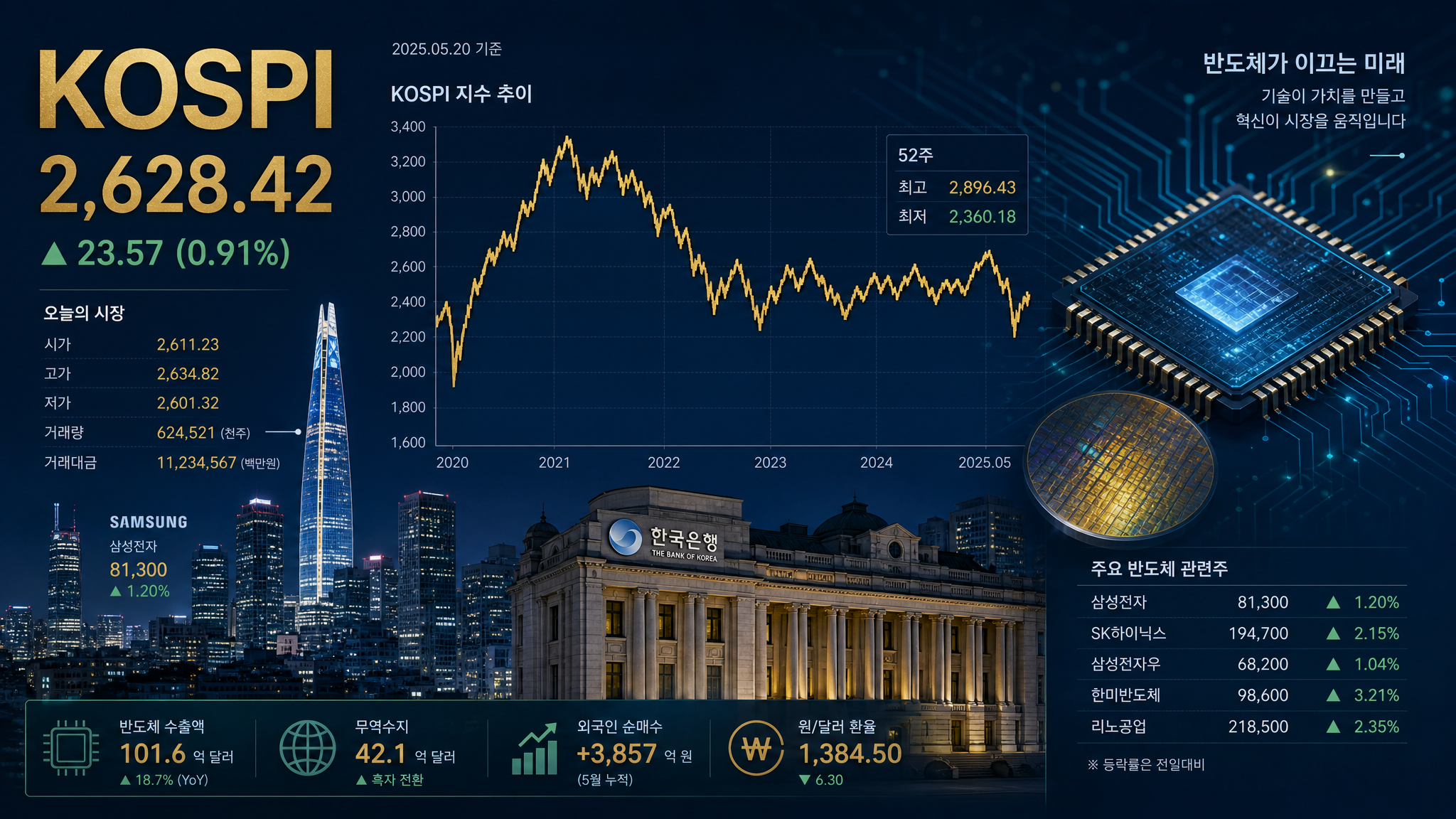
When the Index Is Really a Chip Trade
The KOSPI is nominally a broad market index covering Korean companies across sectors. In practice, Samsung Electronics and SK Hynix together account for a dominant share of the index's market capitalisation and earnings. This concentration means that KOSPI movements often say more about global memory-chip pricing cycles and AI-infrastructure spending expectations than about the median Korean company. A rate decision that would be straightforwardly negative for a diversified equity market—higher discount rates, tighter financial conditions—can be partially offset or overwhelmed by chip-cycle dynamics that have nothing to do with Korean monetary policy.
The BOK's July 16 decision was driven partly by semiconductor-export strength. Korea's chip exports have been a primary engine of the current-account surplus and GDP growth. But that same export strength increases the index's concentration in a sector whose valuations are driven by global AI-capex expectations rather than domestic economic conditions. The BOK is therefore in the unusual position of tightening policy partly because of a sector that makes the equity market more sensitive to global technology spending than to domestic interest rates.
Record Profit, Falling Stock: The Expectations Mechanism
Samsung's preliminary Q2 guidance put sales at approximately KRW 171 trillion and operating profit at approximately KRW 89.4 trillion. These are extraordinary numbers by any historical standard. Yet the share price fell more than 6% after the announcement. This outcome illustrates a fundamental principle of equity valuation: what matters is not the level of earnings but the change in expectations about future earnings.
If investors had already priced in strong Q2 results and were looking for guidance on Q3 and beyond, a strong backward-looking number without forward reassurance can disappoint. In Samsung's case, concerns about the sustainability of AI-infrastructure spending, the competitive dynamics of the high-bandwidth memory market and the timing of the next memory-price cycle all create uncertainty about whether Q2's extraordinary profitability will persist. Samsung's detailed Q2 results were scheduled for July 30, meaning the July 7 preliminary figures were not accompanied by the full management commentary that would normally address these forward-looking questions.
Four Transmission Channels From the BOK Decision
The BOK's rate increase affects the KOSPI through at least four distinct channels. First, a higher discount rate mechanically reduces the present value of future earnings, particularly for growth-oriented technology companies with long earnings duration. Second, higher borrowing costs increase financing expenses for leveraged domestic investors, including retail investors who use margin accounts to amplify their equity exposure. Third, the rate decision affects the Korean won: if the hike attracts foreign capital seeking higher yields, the won strengthens, which reduces the won-denominated value of foreign investors' Korean equity holdings and can trigger outflows. Fourth, higher rates increase mortgage and consumer-credit costs, affecting household spending and the domestic-demand side of the economy.
The won had touched 1,561.5 per dollar on June 5 and was indicated around 1,484.86 by mid-July—a meaningful appreciation that reflects both the BOK's tightening signal and broader dollar dynamics. A stronger won reduces the currency drag for foreign investors but also compresses the won-denominated earnings of Korean exporters when translated back from foreign-currency revenues.
What Would Stabilise the Index
For the KOSPI to find durable support, several conditions would need to align. First, Samsung's July 30 full results would need to include forward guidance that reassures investors about the sustainability of memory-chip demand, particularly from AI-infrastructure customers. Second, the won would need to stabilise at a level that does not create excessive currency drag for foreign investors or excessive earnings compression for exporters. Third, the BOK's tightening cycle would need to be perceived as limited in scope—one or two hikes rather than a sustained campaign—so that the discount-rate effect on technology valuations remains manageable.
The broader lesson from Korea's July experience is that index concentration creates a feedback loop between sector-specific expectations and macroeconomic policy signals. When two companies dominate an index, monetary policy decisions are filtered through chip-cycle dynamics in ways that make standard equity-market analysis less reliable. Investors in the KOSPI are, in effect, making a bet on global AI-infrastructure spending as much as on Korean economic conditions.
This content is for informational purposes only and does not constitute financial advice. Always consult with a qualified financial advisor before making investment decisions.
Discussion