Nikkei 225 Correction Deepens as Japan's AI Trade Collides With BOJ Tightening
Japan's benchmark Nikkei 225 index plunged 4.03% to 64,141.12 on July 17, 2026, capping a brutal week that saw the index shed 6.44% — its worst seven-day stretch in months. The selloff, concentrated in AI-linked semiconductor names, has pushed the Nikkei roughly 11.4% below its reported June 25 peak of 72,366.34, raising urgent questions about whether Japan's equity rally has run its course or whether this is a healthy valuation reset within a longer bull market.
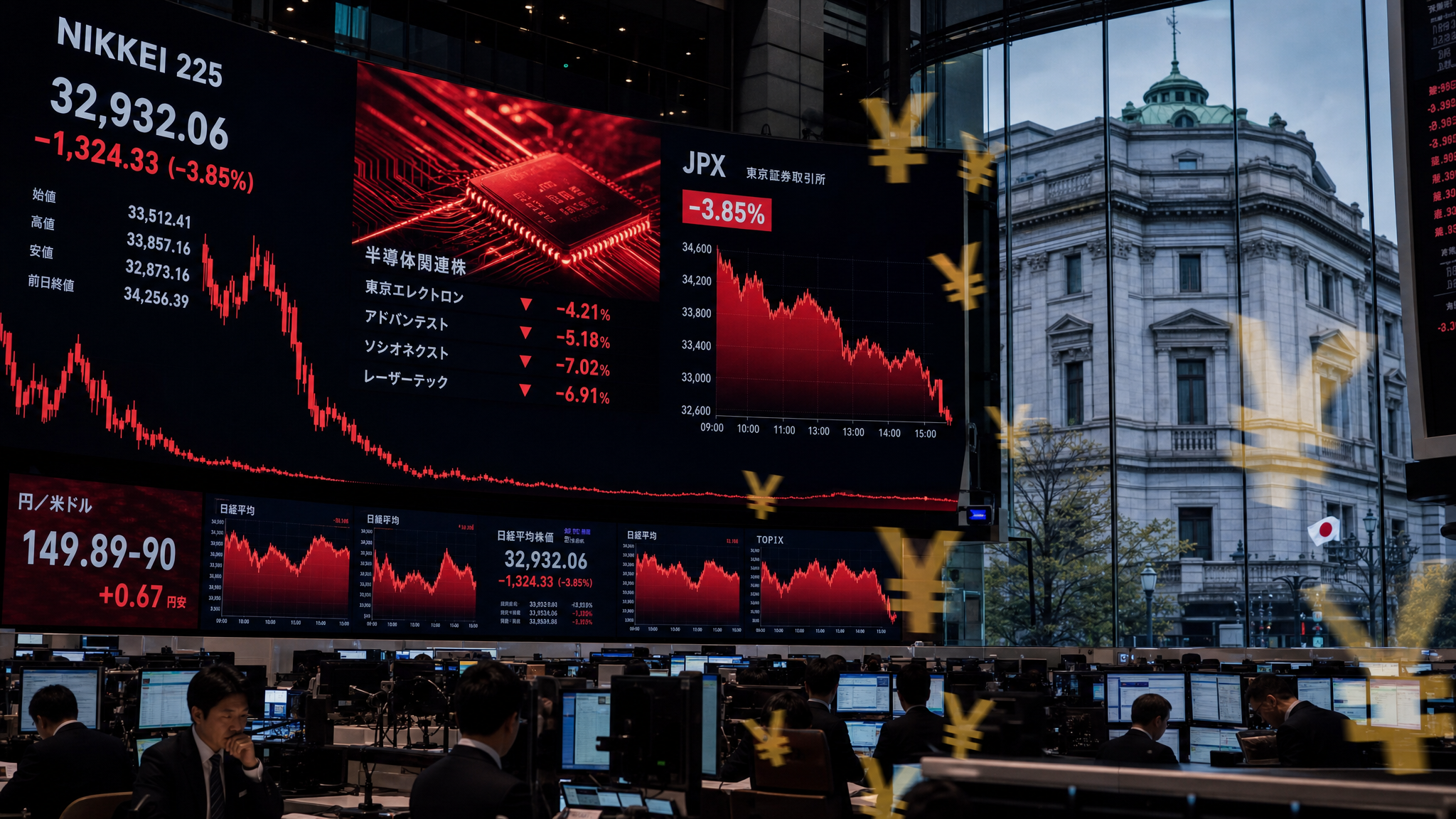
The correction is not a uniform collapse across Japanese equities. It is, at its core, a technology-concentration shock — and understanding that distinction is critical for investors navigating the current turbulence.
The Anatomy of the Selloff: Semiconductors Lead the Decline
The damage was heavily concentrated in Japan's most prominent AI and chip-related stocks. Kioxia Holdings led the carnage with a 16.1% single-day drop, followed by Sumco (-15.17%), Screen Holdings (-12.04%), SoftBank Group (approximately -9%), Tokyo Electron (-8.1%), and Advantest (-7.2%). These names had been among the biggest beneficiaries of the global AI investment boom, and their outsized declines reflect the unwinding of crowded positions rather than a fundamental deterioration in Japan's broader economy.
The contrast with the broader Topix index is telling. While the Nikkei fell 4.03%, the Topix declined a comparatively modest 2.72% on the same session. This divergence stems from the Nikkei's price-weighted methodology, which gives disproportionate influence to high-priced technology constituents. The Nikkei's severity, therefore, says more about prior concentration of AI expectations than about the median Japanese company.
Financial institutions were eventually pulled into the decline, with Mitsubishi UFJ and Sumitomo Mitsui Financial Group each losing around 4.6%. However, Toyota sustained only minor losses, and Sony actually gained approximately 1.22% — a reminder that Japan's corporate landscape extends well beyond the semiconductor supply chain.
BOJ Normalization: A New Variable in the Equation
The Bank of Japan raised its uncollateralized overnight call-rate target to approximately 1.0% in June 2026, following a 7-1 vote — the highest policy rate since 1995. The central bank cited rising underlying inflation, elevated inflation expectations, and a commitment to continue tightening if economic activity and prices develop in line with its outlook. One board member, Asada Toichiro, dissented, arguing that downside risks to production and employment outweighed upside price risks.
The BOJ's April outlook projected FY2026 core CPI in the 2.5%–3.0% range, with moderation to 2.0%–2.5% in FY2027. June wholesale inflation came in at 7.1%, reinforcing the case for continued vigilance. Most Reuters-polled analysts anticipate a further increase to 1.25% by year-end, though the BOJ is widely expected to hold at 1.0% at its July 30–31 meeting.
The Yen Paradox: Weakness That No Longer Helps
USD/JPY remained near 160–162 throughout the selloff — a level that would historically have been seen as a tailwind for Japanese exporters. Yet the translation benefit was overwhelmed by technology selling and growing concern that currency weakness was raising imported input costs. The BOJ's own April outlook linked high crude-oil prices to weaker corporate profits and household real income through deteriorating terms of trade.
This dynamic represents a structural shift in how markets interpret yen weakness. A weak yen is now a sector-specific benefit — helping exporters like Toyota — while simultaneously pressuring importers, consumers, and energy-intensive businesses. Investors can no longer treat USD/JPY as a simple market-wide positive for Japanese equities.
What Investors Should Watch Next
Four variables will determine whether the Nikkei stabilizes or extends its correction. First, the 64,000 area represents a key technical reference level; a sustained break below it would signal further deterioration. Second, semiconductor breadth — whether the selling broadens beyond the most crowded AI names into broader industrials and financials — will indicate whether this is a valuation reset or something more systemic. Third, USD/JPY behavior around the 160–162 range will signal whether intervention risk is rising. Fourth, the BOJ's July 30–31 guidance on its fiscal-2026 growth and inflation projections will set the tone for rate expectations through year-end.
For long-term investors, the correction offers an opportunity to distinguish between Japan's AI-exposed technology names — which remain vulnerable to further multiple compression — and its more resilient banks, defensives, and domestic-demand companies, which have held up considerably better. The Topix's relative outperformance during the selloff is a useful guide to where that resilience lies.
The Bigger Picture: A Valuation Reset, Not a Structural Break
Japan's economic fundamentals have not deteriorated materially. The BOJ's tightening cycle reflects confidence in the inflation outlook, not alarm about growth. Corporate earnings outside the semiconductor sector remain broadly supportive. The correction is best understood as the inevitable repricing of an AI-driven rally that had pushed valuations in certain segments to levels that required near-perfect execution to justify.
The key question for the weeks ahead is whether the BOJ's July meeting produces any dovish surprise — such as a downgrade to its growth or inflation forecasts — that could provide relief to rate-sensitive technology stocks. Absent such a signal, the path of least resistance for the Nikkei's most crowded names remains lower until valuations reach levels that attract fresh institutional buying.
This content is for informational purposes only and does not constitute financial advice. Always consult with a qualified financial advisor before making investment decisions.