State-Backed Tech Buying Lifts China Stocks, but Property Still Blocks the Wealth Channel
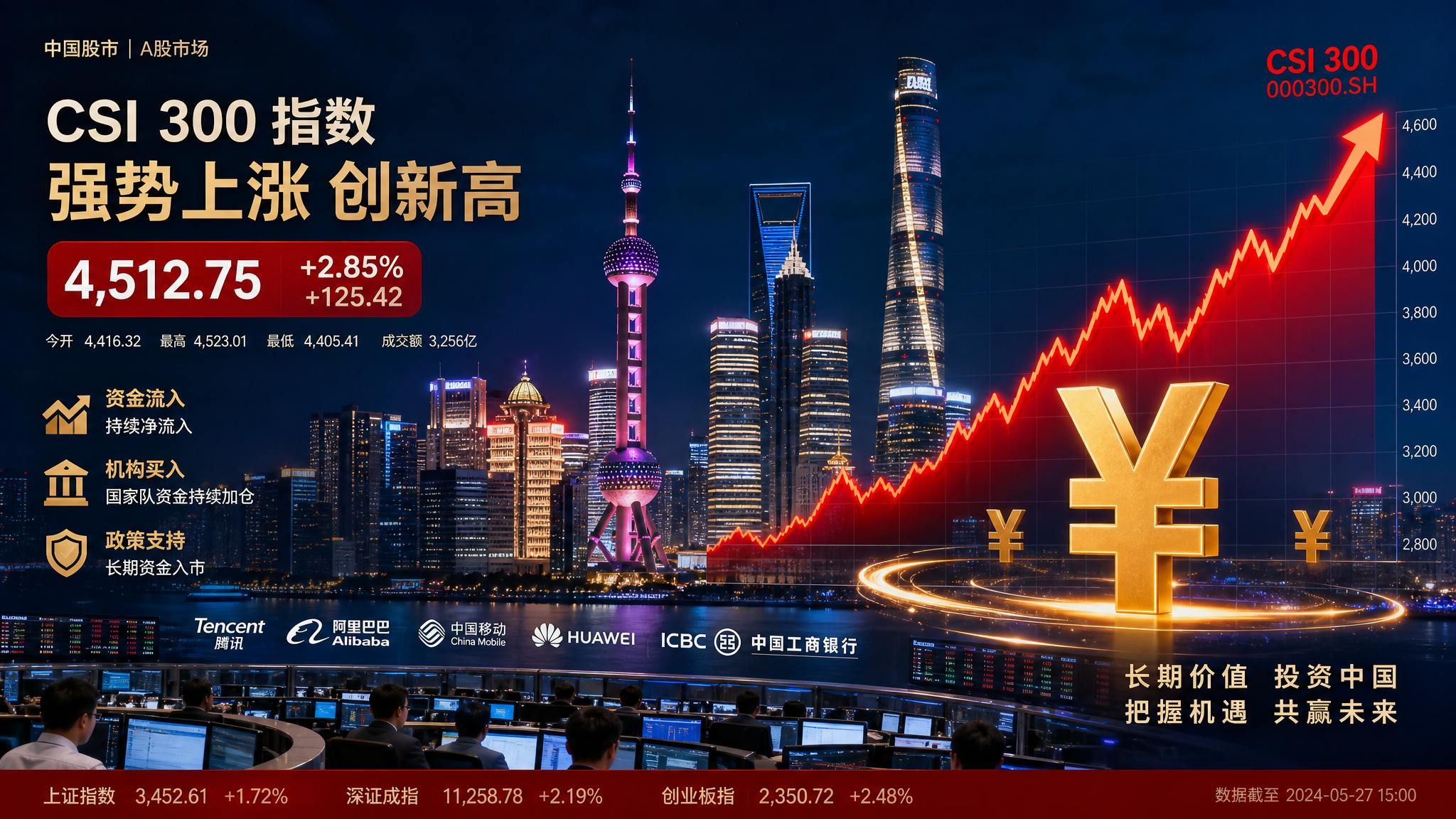
China's CSI 300 closed at 4,739.23 on July 21, gaining 3.06% in a session driven by record technology ETF inflows and coordinated insurer commitments to equities. The Shanghai Composite rose 1.79% to 3,864.4 in the same period. The moves were real and the mechanisms behind them were visible — but they did not resolve the deeper question that has defined China's economic story for three years: can targeted equity support substitute for a property sector that continues to drag on household wealth, local government finances and consumer confidence?
The Mechanics of the Rally
The ChinaAMC STAR 50 ETF received a reported record 13.8 billion yuan — approximately $2 billion — in net inflows on July 21. China Life, People's Insurance Company of China and Ping An simultaneously announced plans to increase allocations to equities and mutual funds, with a focus on emerging-growth industries. The result was a concentrated surge in technology names: Cambricon Technologies rose 11.58%, SMIC gained 11.2% and Eoptolink Technology advanced 7.25%.
This is not organic retail enthusiasm or foreign capital returning to Chinese equities. It is a deliberate policy mechanism — state-linked institutions directing capital into specific sectors to support prices and signal confidence. The PBOC's preference for targeted support over broad rate reductions has been consistent: the one-year Loan Prime Rate remained unchanged at 3.00% on July 20, the 14th consecutive monthly hold, while the five-year mortgage reference rate stayed at 3.50%.
What the Rally Does Not Fix
Real-estate investment reportedly fell 18% in the first half of 2026. New-home prices recorded a 36th consecutive annual decline. Earlier official data showed new housing starts down 23.1% year on year in the January–February period, commercial building sales value down 20.2% and residential floor space sold down 15.9%. These are not cyclical fluctuations — they represent a structural adjustment in an asset class that accounts for approximately 70% of Chinese household wealth.
The property-wealth channel matters because it connects asset prices to consumption. When home values fall, households feel poorer, reduce discretionary spending and delay major purchases. That dynamic is not reversed by a 3% gain in the CSI 300, particularly when the equity market's ownership base is narrower than the property market's. Most Chinese households hold their savings in real estate, not stocks.
Local Government Finances: The Hidden Constraint
Local governments in China have historically relied on land-sale revenue to fund infrastructure, social services and housing programs. That revenue fell by more than 50% between 2021 and 2025. The consequence is a structural fiscal constraint that limits the capacity of local authorities to deploy the kind of demand-side stimulus that could accelerate property stabilization. Beijing's policy approach has emphasized whitelist financing for developers, urban renewal programs, lower mortgage costs and city-level removal of purchase restrictions — all of which are supply-side or credit-access measures rather than direct demand creation.
The PBOC's seven-day reverse-repo rate, which has served as the primary policy anchor since July 2024, remained at 1.4% and unchanged since May 2025. The central bank's preference for targeted liquidity tools over broad rate cuts reflects both the limited transmission of rate reductions through a property-impaired banking system and the risk that further easing could weaken the yuan at a time when export competitiveness is already a policy priority.
The K-Shaped Economy
China's Q2 GDP growth slowed to 4.3%, described as the weakest since late 2022. Yet June private manufacturing and services surveys showed stronger-than-expected activity, and exports reportedly surged on strong international demand. Official June customs data put total imports at $286.764 billion, with Australia supplying $17.818 billion — illustrating the continuing commodity linkage between Chinese industrial demand and regional suppliers.
This divergence — strong exports and technology manufacturing alongside weak property and consumption — is the defining feature of China's current economic structure. The equity rally fits the technology side of that picture. It does not address the consumption side, where property-wealth effects, cautious household balance sheets and limited income growth continue to suppress demand.
What to Watch in Late July
The key policy question for late July is not whether the PBOC will cut rates — the 14-month hold suggests it will not — but whether fiscal deployment can accelerate enough to complement the equity-support mechanism. Urban renewal spending, infrastructure bonds and targeted consumption subsidies are the instruments most likely to move the needle on domestic demand. Without them, the CSI 300's technology rally remains a market-structure event rather than a signal of broad economic recovery.
Investors distinguishing between tactical mainland-equity support and a genuine macro recovery should note that both the CSI 300 and Shanghai Composite remained below their June 30 closing levels even after the July 21 rally. The gap between where markets were at month-end and where they are now is a measure of how much ground the support mechanisms still need to recover.
This content is for informational purposes only and does not constitute financial advice. Always consult with a qualified financial advisor before making investment decisions.
Discussion