Banks Drag, Miners Wait: The Two-Speed Market Holding the ASX Near 8,800
Australia's S&P/ASX 200 closed at 8,791 on July 22, down just 0.03% — a number that suggests stability but conceals a genuine tug-of-war between the index's two dominant sectors. Banks are absorbing the cost of the Reserve Bank of Australia's restrictive rate settings, while major miners are navigating iron ore below $100 per tonne and uncertain Chinese steel demand. The index's near-flat performance is not consensus — it is the arithmetic result of opposing forces that have been pulling in different directions throughout July.
The Bank Sector: Funding Costs and Housing Softness
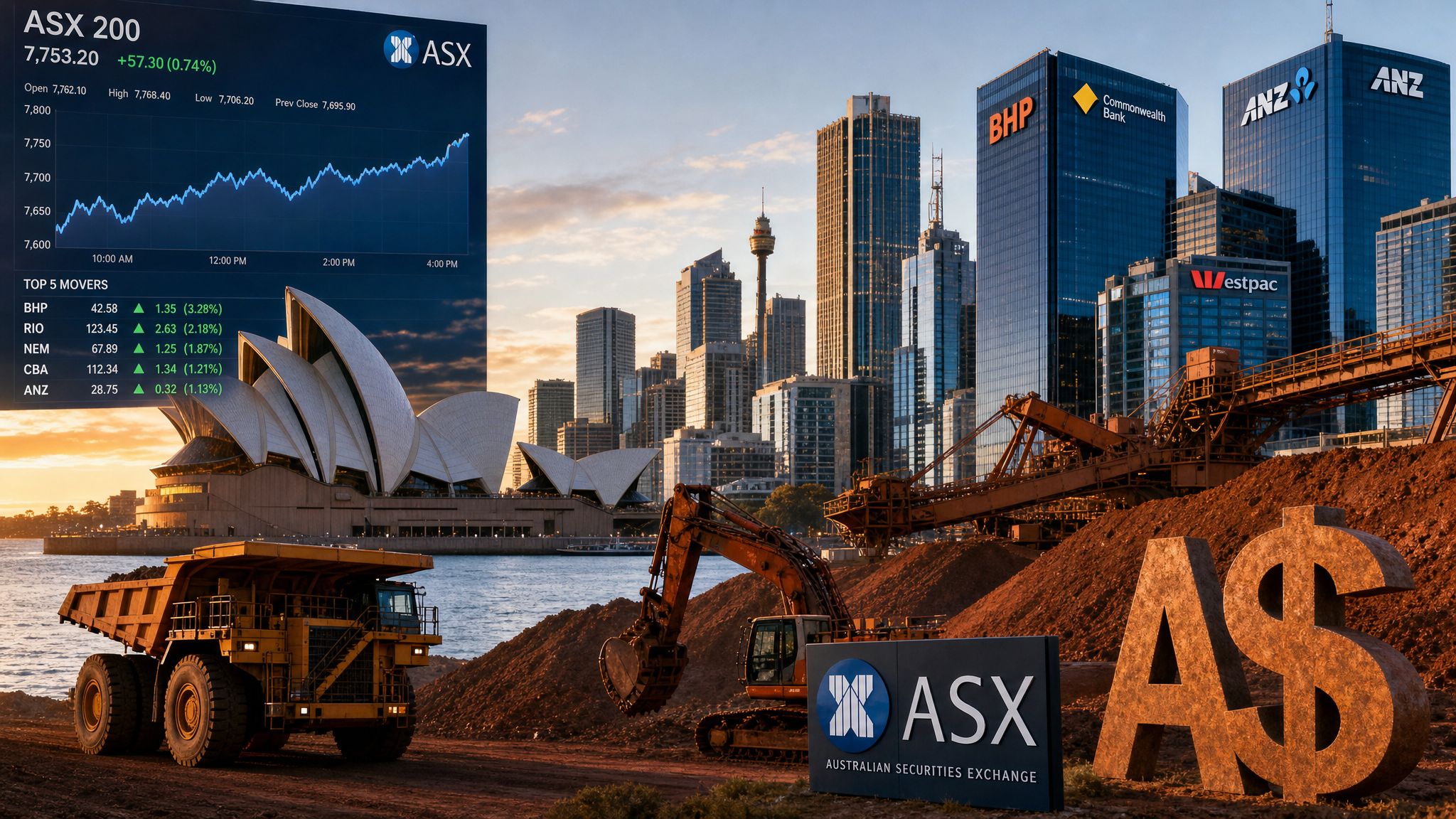
ANZ, Westpac and Commonwealth Bank were among the financial shares experiencing pressure during July. The RBA held its cash-rate target at 4.35% on June 16, following three consecutive increases earlier in 2026. There is no July RBA policy meeting — the next decision is scheduled for August 11 — so banks are operating in a period of rate uncertainty without an imminent catalyst for relief.
Higher rates affect Australian banks through multiple channels. Funding costs rise as deposit competition intensifies and wholesale borrowing becomes more expensive. Mortgage demand softens as higher repayments reduce affordability and slow new lending volumes. Credit quality concerns emerge as borrowers with variable-rate mortgages face higher monthly payments. Australia's Q1 GDP growth was 0.3% and unemployment reached 4.5% in April — a combination that suggests the economy is slowing without yet showing the kind of stress that would force the RBA to pivot.
For bank investors, the question is whether net interest margins can hold up as funding costs rise and loan growth slows. The RBA's stated willingness to tighten further if needed to return inflation to its 2%–3% target means that the rate ceiling for this cycle may not yet have been reached. That uncertainty is reflected in bank share performance.
The Mining Sector: Iron Ore Below $100 and Chinese Inventory Dynamics
BHP and Rio Tinto faced a more complex set of pressures in July. Iron ore traded near $98.65 per tonne in late July, after falling 7.2% in June. The price decline reflected a counterintuitive combination: China's iron-ore imports rose 6.3% year on year in the first half of 2026, with June imports up 15.3% month on month, yet Chinese crude-steel production fell 2.7% year on year in May and was down 3.9% for the January–May period. The explanation is inventory accumulation — China is importing ore at a faster pace than it is consuming it in steel production, building stockpiles rather than driving end-demand.
For Australian miners, this distinction matters. Strong import volumes support shipping and port activity, but they do not necessarily translate into sustained price support if the accumulated inventory eventually weighs on future purchasing decisions. BHP and Rio Tinto also faced company-specific headwinds including guidance reductions, labor disruption at export infrastructure and analyst downgrades during July.
The longer-term picture for iron ore is more nuanced. India's iron-ore imports were projected to reach a seven-year high in fiscal 2025–26 due to insufficient domestic high-grade ore supply, and global miners are increasingly viewing India and ASEAN as growth markets beyond China. But that demand shift is a multi-year story, not a July catalyst.
Energy and Gold: Imperfect Hedges
Energy companies including Woodside and Santos periodically outperformed when crude prices rose during July, as Middle East supply disruptions kept Brent elevated. But energy is a double-edged sector for the ASX: higher oil prices benefit producers while simultaneously raising input costs for the broader economy and increasing inflation pressure that could prompt further RBA tightening. Gold miners provided some diversification, though gold's performance in 2026 has been complicated by rising real yields and profit-taking.
NextDC, the data-center operator, provided a smaller technology link through AI infrastructure demand and contract activity — a reminder that the ASX is not exclusively a banks-and-miners story, even if those two sectors dominate the index's daily price action.
AUD/USD: The Commodity and Rate Proxy
AUD/USD traded near 0.7009 on July 22, a level that reflects the currency's dual sensitivity to RBA rate expectations and Chinese commodity demand. A hawkish RBA can support the Australian dollar by attracting yield-seeking capital, but weak Chinese iron-ore consumption can offset that benefit by reducing the commodity-export revenues that underpin Australia's current account. The two forces have been roughly balanced in July, producing a currency that has held above 0.70 without making a decisive move in either direction.
The July 29 CPI release — scheduled for 11:30 a.m. AEST — is the next significant data point for both the RBA's August decision and the AUD. If inflation comes in above expectations, it increases the probability of another rate increase, which would support the currency but add further pressure to bank margins and housing affordability. If it comes in below, it opens the door to a pause or eventual easing, which would relieve bank pressure but potentially weaken the AUD if commodity prices remain soft.
The Two-Speed Reality
The ASX's near-flat July 22 close is a product of genuine sector opposition rather than market calm. Banks need lower rates; miners need stronger Chinese steel demand; energy companies benefit from the same geopolitical conditions that keep inflation high and rates restrictive. These interests are not easily reconciled within a single index, and the July 29 CPI release will not resolve all of them simultaneously. What it will do is shift the probability distribution for the RBA's August decision — and that shift will determine which side of the two-speed market gets the next catalyst.
This content is for informational purposes only and does not constitute financial advice. Always consult with a qualified financial advisor before making investment decisions.
Discussion