Why Singapore's Market Plumbing Is Beating Southeast Asia's Risk Premium
Southeast Asia's equity markets are not a single trade. On July 22, Indonesia's Jakarta Composite Index fell 1.43% to 6,807 as the rupiah weakened 0.53% to 17,505 per dollar ahead of an MSCI rebalancing review. Malaysia's KLCI had declined 0.53% on July 20 and another 0.11% on July 21. Vietnam's VN-Index sat at 1,730.56, well below its May record of 1,936.55. Thailand's SET had closed at 1,602.52 on July 7. Singapore, by contrast, was trading in a range around 5,500–5,550 on the Straits Times Index, supported by a government-backed equity development program and Q2 GDP growth of 5.7% year on year. The divergence is not primarily about growth rates or commodity exposure — it is about market accessibility, institutional confidence and the quality of capital-market infrastructure.
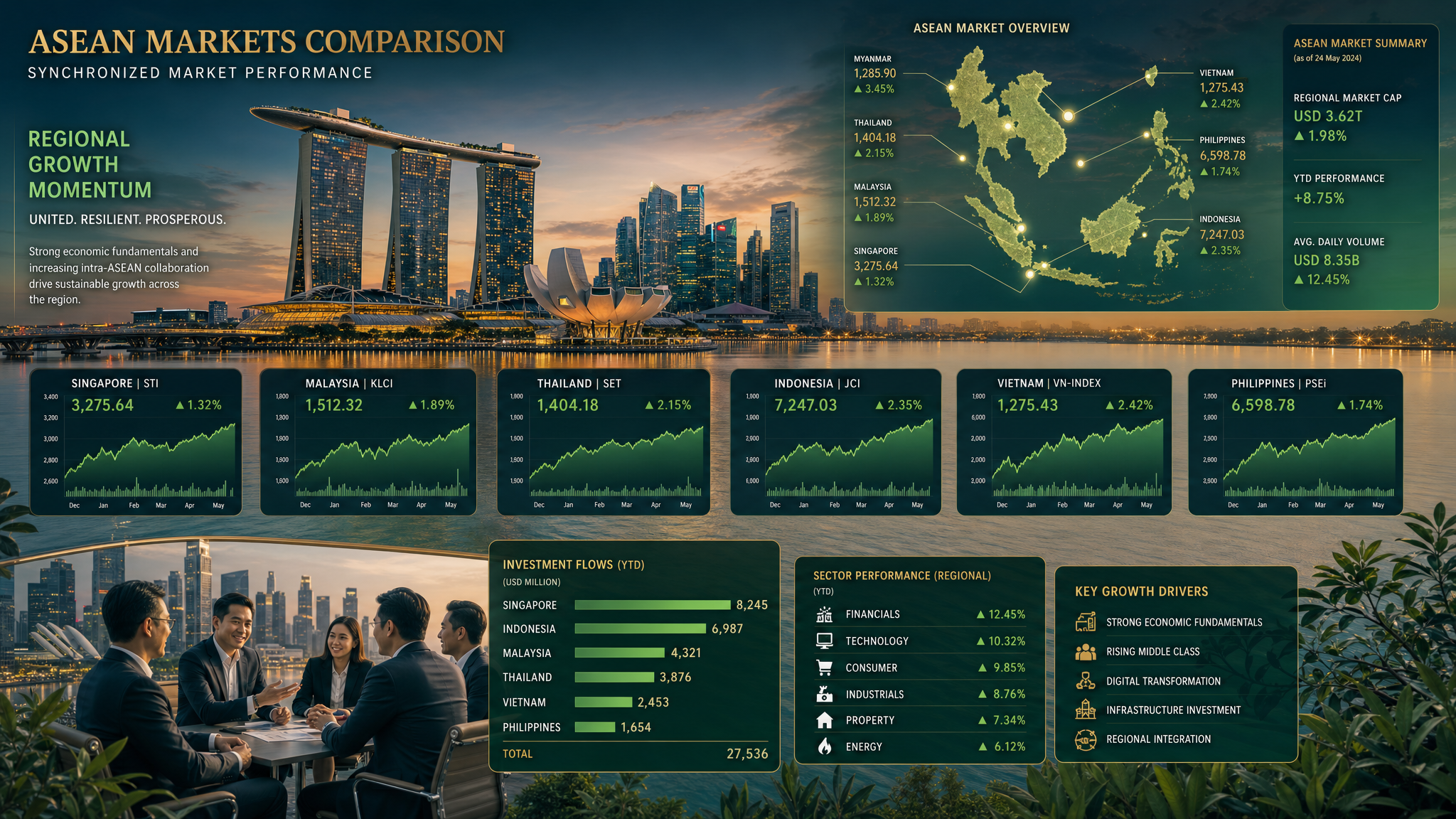
Singapore: Plumbing as Competitive Advantage
Singapore overtook Indonesia as Southeast Asia's largest stock market by total market value in 2026, a milestone that reflects years of deliberate market-development investment rather than a sudden shift in economic fundamentals. The government's Equity Market Development Programme, valued at S$6.5 billion, has funded dual-listing bridges, market-making incentives and institutional mandates designed to deepen local equity participation. DBS, OCBC and UOB — the three major Singapore banks — remain the STI's most influential components, providing a stable earnings base that has benefited from the region's higher interest-rate environment.
Singapore's Q2 GDP grew 5.7% year on year, though growth slowed from Q1. The next major catalysts for the STI include Monetary Authority of Singapore review expectations and bank earnings. The MAS has not held a July policy meeting — its framework operates through semi-annual reviews — so the near-term market driver is corporate results rather than central-bank action. What Singapore offers that its ASEAN peers struggle to match is predictable settlement, deep securities lending, transparent price discovery and a regulatory environment that institutional investors can model with confidence.
Indonesia: MSCI Anxiety and Rupiah Pressure
Indonesia's July 22 decline illustrated the vulnerability of a market where foreign ownership is significant and index-methodology concerns can trigger coordinated selling. MSCI rebalancing reviews periodically reassess the weight of individual markets in global emerging-market indices. When investors anticipate a reduction in Indonesia's weight, they sell ahead of the rebalancing to avoid holding positions that passive funds will be forced to reduce. The result is a self-reinforcing outflow that weakens both the equity market and the currency simultaneously.
The rupiah's move to 17,505 per dollar on July 22 reflected this dynamic. Foreign selling generates dollar demand as investors convert rupiah proceeds, which puts downward pressure on the currency, which in turn reduces the dollar returns that remaining foreign investors earn on their Indonesian positions. Bank Indonesia's policy response — whether to raise rates to defend the currency or hold to support growth — was a subject of market speculation rather than a completed decision as of July 22.
Indonesia's market also faces structural accessibility concerns. Price-discovery limitations, including "auto rejection" limits that halt trading when prices move beyond defined thresholds, and liquidity constraints in smaller-cap names create friction that institutional investors price into their required returns. These are not insurmountable problems, but they represent a meaningful gap relative to Singapore's market infrastructure.
Thailand: Stimulus-Supported but Low-Growth
Thailand's SET closed at 1,602.52 on July 7, up 0.9%, supported by foreign inflows as geopolitical tension eased and technology sentiment improved. The Bank of Thailand held its policy rate at 1.00% on June 24, the second consecutive unanimous hold, while raising its 2026 GDP forecast to 2.3% — a figure that the central bank itself described as reflecting a low and uneven recovery. A 400-billion-baht emergency-loan decree provided fiscal support, but the baht had fallen to its weakest level since late April 2025 by mid-July, with low carry appeal and a deteriorating current account cited as headwinds.
Thailand's market offers fiscal stimulus and a low policy rate, but neither translates directly into equity returns when the currency is under pressure and growth remains below regional peers. Foreign investors who buy Thai equities in baht and convert returns to dollars face a currency drag that partially offsets any local-market gains.
Malaysia: Range-Bound and Externally Sensitive
Malaysia's KLCI has been trading in a narrow range during July, with thin volumes and limited directional conviction. The ringgit weakened to a seven-month low in late June, leaving local assets sensitive to regional dollar strength. The KLCI's composition — dominated by financial, plantation and utility companies — provides some defensiveness but limited growth exposure. Malaysia's market is not in distress, but it is not attracting the kind of institutional attention that would drive a sustained re-rating.
Vietnam: Strong Earnings, Persistent Foreign Selling
Vietnam presents the most striking paradox in ASEAN. Q1 index earnings increased 51% year on year, far above a 15% consensus estimate. Vinhomes' Q1 earnings rose 850% year on year. The VN-Index traded at approximately 13 times forward earnings, while more than 70% of shares reportedly traded below 10 times — a valuation profile that looks compelling on paper. Yet foreign investors have been net sellers for extended periods in 2026, and the index has fallen from its May record of 1,936.55 to 1,730.56 by July 21.
The explanation lies in market accessibility. Vietnam's settlement system, foreign ownership limits, currency convertibility constraints and the absence of a derivatives market that international investors can use for hedging all raise the effective cost of investing. Strong earnings cannot rerate a market when the infrastructure for foreign participation remains underdeveloped. Vietnam's trade deficit exceeded 6% of GDP by mid-May, yet the dong remained relatively resilient due partly to high-technology export revenues — a sign that the underlying economy is performing, even if the equity market cannot fully capture that performance for foreign investors.
The Accessibility Premium
The ASEAN performance gap in 2026 is a lesson in how market infrastructure determines how much of a country's economic fundamentals reach foreign investors. Singapore's plumbing advantage — settlement certainty, liquidity depth, institutional mandates and regulatory predictability — commands a premium that shows up in index levels and capital flows. Indonesia, Thailand, Malaysia and Vietnam all have genuine economic stories to tell, but the friction costs of accessing those stories vary enormously. Until that gap narrows, the divergence between Singapore and the rest of ASEAN is likely to persist.
This content is for informational purposes only and does not constitute financial advice. Always consult with a qualified financial advisor before making investment decisions.
Discussion