India's Earnings Floor Meets an $85 Oil Ceiling
India's BSE Sensex closed 238.41 points lower at 77,470.11 on July 21, a decline of 0.31%, marking its second consecutive lower close. The Nifty 50 fell 50.80 points, or 0.21%, to 24,187.70. The headline numbers understated the market's internal complexity: mid- and small-cap indices gained on the same day, autos, metals and realty advanced 0.6%–1%, while IT, FMCG, oil and gas, and public-sector banks fell 0.3%–0.8%. India's equity market is not in retreat — it is in a tug of war between company-level earnings delivery and a set of external pressures that heavyweight sectors cannot easily absorb.
The Earnings Cushion
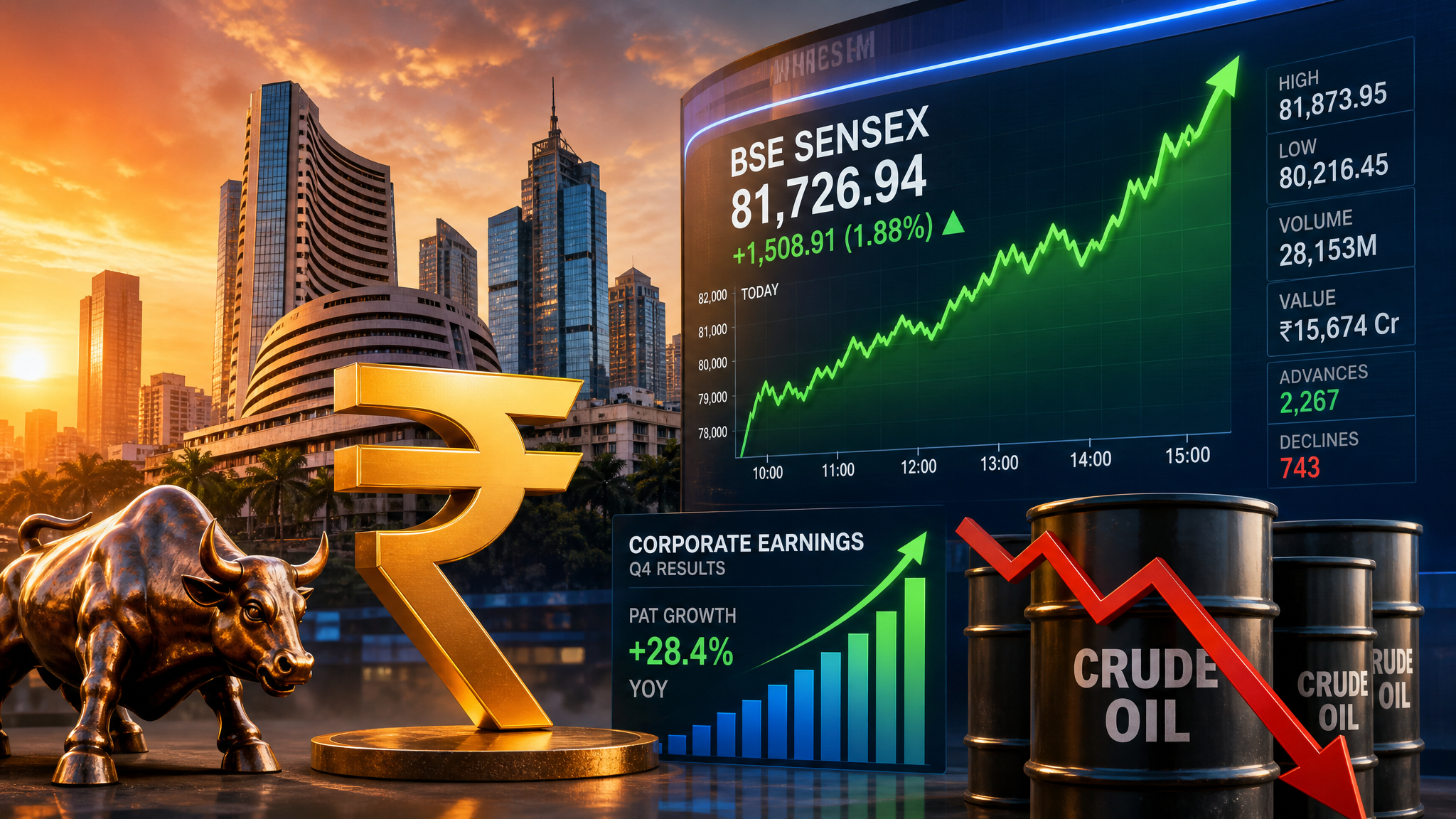
The Q1 FY27 earnings season provided the most important support for Indian equities in July. TCS reported a 14% revenue increase to ₹72,275 crore, with AI-related revenue exceeding $2.6 billion — a figure that positioned India's largest IT exporter as a credible participant in the global AI infrastructure buildout. Tech Mahindra's results supported the broader IT sector's recovery narrative, even as the sector index lagged on July 21 due to profit-taking after earlier gains.
JSW Steel's first-quarter net profit reportedly doubled to ₹4,696 crore, reflecting strong domestic infrastructure demand and improved steel pricing. TVS Motor and Bajaj Auto both recorded significant revenue and profit increases, consistent with India's sustained two-wheeler and premium vehicle demand. These results matter because they demonstrate that India's corporate sector is generating real earnings growth rather than relying on multiple expansion or financial engineering.
Where the Pressure Is Concentrated
HDFC Bank shares remained under pressure because investors were dissatisfied with net interest margins — a concern that reflects the broader challenge facing Indian banks as the RBI's rate cycle and deposit competition compress the spread between lending and funding costs. Havells India faced margin pressure from higher input costs linked to West Asian conflict, illustrating how geopolitical events translate into corporate earnings through commodity and component prices.
Reliance Industries and large banks remained critical pending earnings checkpoints as of July 21. Their results will determine whether the Sensex's heavyweight composition can support the index at current levels or whether the earnings cushion is thinner than the mid-cap and small-cap performance suggests.
Foreign Institutional Investors: Persistent Sellers
Foreign institutional investors were net sellers of approximately ₹1,305 crore in the session preceding July 21, partly offset by domestic institutional buying. The pattern of FII selling and domestic institutional support has been a recurring feature of India's market structure in 2026. Earlier macro-flow data showed a $4.7 billion current-account surplus in April alongside $8.7 billion of net portfolio outflows — a combination that illustrates how strong trade performance can coexist with financial-account pressure.
FII selling is partly a function of oil. India imports approximately 85% of its crude oil requirements, and when Brent trades above $85 per barrel — as it did at points during July — the current-account arithmetic deteriorates. Higher oil prices increase the import bill, widen the current account, put pressure on the rupee and reduce the dollar returns that foreign investors earn on Indian equity positions. The feedback loop connects energy markets directly to equity flows.
The RBI's Stabilization Toolkit
The Reserve Bank of India responded to rupee pressure through a combination of market intervention and deposit-incentive measures. The rupee strengthened approximately 21–22 paise to 96.23–96.24 per dollar on July 21, helped by FCNR (Foreign Currency Non-Resident) deposit flow data and improved capital inflows. The RBI temporarily lifted the interest-rate ceiling on new three- to five-year FCNR(B) deposits to encourage overseas Indian deposits, and approximately $10 billion reportedly entered through this special program.
The RBI's approach was to stabilize the currency without raising policy rates in a way that markets might interpret as defensive. Derivatives turnover weakened in mid-July amid new funding restrictions and higher taxes, suggesting that the central bank was also managing speculative positioning in the currency market. The rupee had touched around 96.32 per dollar during July before the FCNR-supported recovery — a level that, while not a record low, represented meaningful pressure on import costs and corporate margins.
Oil as the Unifying Variable
Crude oil above $85 per barrel is the single variable that connects the most important pressures on India's market simultaneously. It raises the import bill and widens the current account. It increases input costs for manufacturers and reduces margins for energy-intensive sectors. It puts downward pressure on the rupee, which reduces FII dollar returns and encourages further selling. And it creates inflation risk that limits the RBI's ability to cut rates to support growth.
India's earnings season has demonstrated that the corporate sector can generate strong results even in this environment — TCS, JSW Steel and the auto companies are proof of that. But the oil ceiling is real, and it constrains how far the earnings floor can lift the market when heavyweight sectors are simultaneously absorbing energy, currency and flow pressure. The resolution will come either from lower oil prices, stronger FII inflows or a broadening of earnings delivery to include the financial and energy sectors that have so far lagged.
This content is for informational purposes only and does not constitute financial advice. Always consult with a qualified financial advisor before making investment decisions.
Discussion