Samsung, SK Hynix and the 44% Problem Behind the KOSPI's Violent Swings
South Korea's KOSPI rose 5.95% to 7,149.23 on July 22, with SK Hynix gaining 8.66% and Samsung Electronics advancing 5.41% in the session. The rebound was dramatic, but it followed an equally dramatic decline: the index had reached a record 8,801.49 on June 2, fallen 8.3% on June 8 amid Federal Reserve concerns, plunged nearly 10% on June 23 after regulators cautioned about leveraged ETFs, and was reported to be 20% below its June record close by July 8. Understanding why the KOSPI moves this violently requires looking not just at semiconductor demand but at the index's structural architecture.
The Concentration Problem
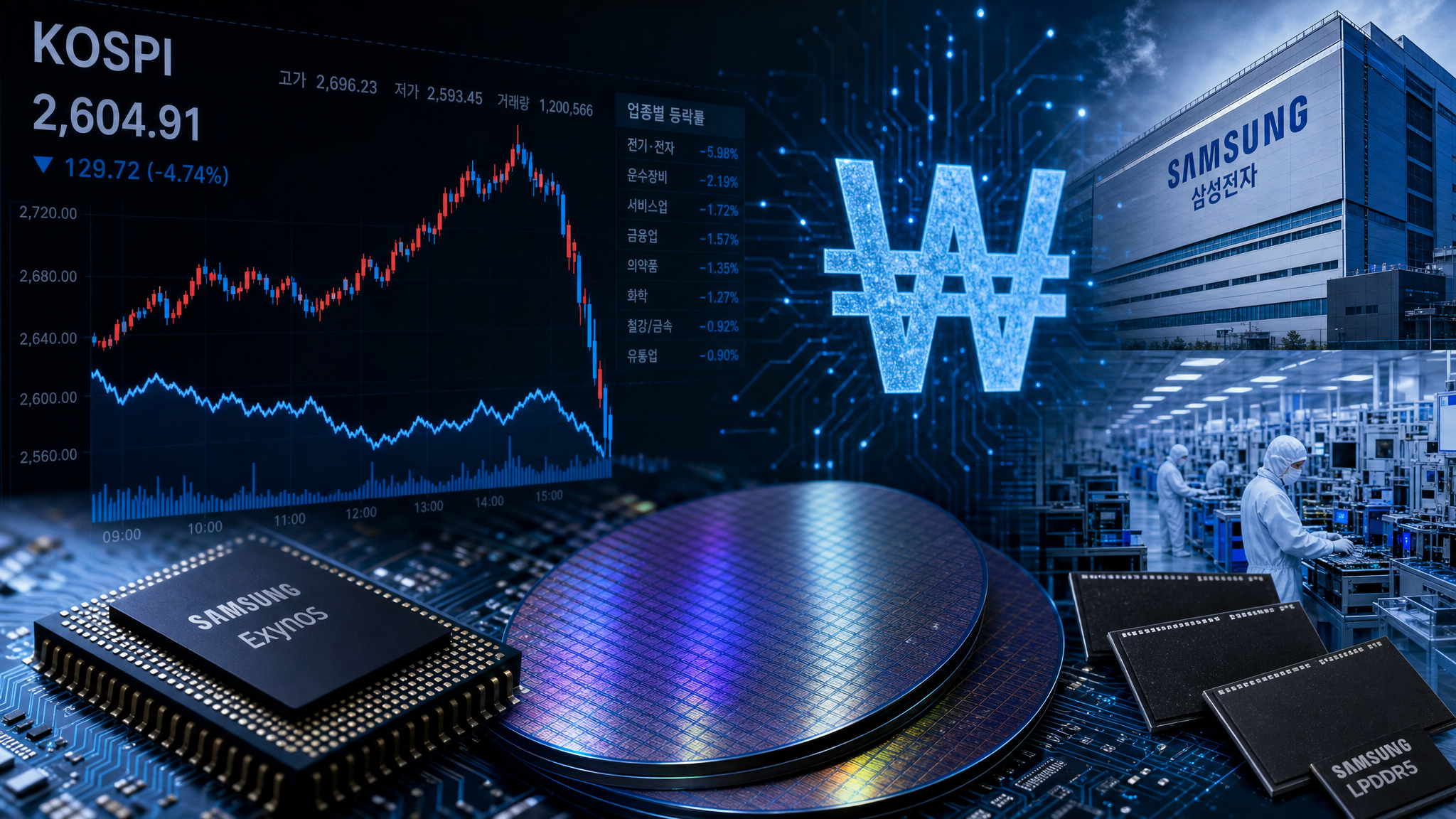
Samsung Electronics and SK Hynix represented 44% of the KOSPI's total market value as of May 2026. Another source described the pair as accounting for "over 40%" — figures that are consistent rather than contradictory. The practical consequence is that the KOSPI functions less like a diversified national equity benchmark and more like a leveraged instrument on memory-chip demand. When AI infrastructure spending accelerates and HBM (high-bandwidth memory) orders increase, both companies benefit simultaneously, and the index surges. When AI enthusiasm cools or supply concerns emerge, the same concentration amplifies the decline.
This is not a new feature of the Korean market, but it has become more consequential as the absolute size of the two companies has grown relative to the rest of the index. A 5% move in Samsung and SK Hynix combined produces roughly a 2.2% move in the KOSPI regardless of what happens to the other 56% of the market. On July 22, that arithmetic worked in investors' favor. On June 8 and June 23, it did not.
Leveraged ETFs as an Amplifier
South Korea's regulator specifically cautioned about leveraged ETFs in late June, identifying them as an additional source of market volatility. Single-stock leveraged ETFs — products that deliver two or three times the daily return of an underlying share — had proliferated in the Korean retail market as AI enthusiasm drove interest in Samsung and SK Hynix. When those shares fell sharply, the leveraged products required rebalancing that involved selling the underlying stocks, creating a feedback loop that accelerated the decline.
The June 23 near-10% drop was partly attributed to this mechanism. Leveraged ETF rebalancing is not a cause of market weakness in the fundamental sense — it does not change earnings expectations or demand forecasts — but it can transform a moderate correction into a severe one by concentrating selling pressure in a short time window. The July 22 rebound suggests that the rebalancing pressure had largely cleared, allowing the underlying semiconductor thesis to reassert itself.
Corporate Fundamentals: The Earnings Case
Samsung reported record quarterly profits, with chip income increasing 49-fold year on year, and warned that supply shortages in advanced memory could deepen in 2027. SK Hynix pursued a U.S. listing valued at roughly $28–$29 billion — figures that varied slightly across sources — with an ADR debut scheduled for July 10. The listing was designed to broaden the company's investor base and access U.S. capital markets directly, reflecting confidence in sustained AI-driven demand for HBM products.
South Korean semiconductor exports rose 180% year on year in the first 20 days of July, while total exports for the same period increased 52.3%. June exports had already risen 70.9% year on year, supported by semiconductors, computers and ships. The trade balance for June was reported at $36.1 billion. These are not marginal improvements — they represent a fundamental shift in Korea's export composition toward high-value technology products that command premium pricing in global markets.
Inflation, the BOK and the Won
June CPI rose 3.2% year on year, with transportation prices up 11.1% and core inflation at 2.5%. The Bank of Korea's policy rate was reported at 2.75% following a 25-basis-point increase, though corroborating details were limited and the figure should be treated with appropriate caution. The BOK's stated focus remained price stability amid cost pressures and global uncertainty.
USD/KRW was approximately 1,485 in mid-July, having traded as high as 1,540–1,550 in early July. The won's volatility reflects the same technology-flow dynamic that drives the KOSPI: when foreign investors sell Korean equities, they convert won proceeds into dollars, creating currency pressure. When they buy, the reverse occurs. The won is therefore partly a derivative of semiconductor sentiment rather than a pure reflection of Korea's macroeconomic fundamentals.
The Structural Question
The KOSPI's July 22 rebound demonstrated that the earnings case for Samsung and SK Hynix remains intact. Record chip profits, surging exports and a major U.S. listing all support the fundamental thesis. What the rebound did not resolve is the structural question: an index where two companies represent 44% of value will continue to experience outsized volatility relative to its underlying economic diversity. Korea has a sophisticated industrial base beyond semiconductors — shipbuilding, petrochemicals, automotive, consumer electronics — but those sectors are largely invisible in the KOSPI's price action when memory chips dominate sentiment.
For investors, the practical implication is that KOSPI exposure is effectively a concentrated bet on AI infrastructure spending and memory-chip pricing cycles, amplified by leveraged products and concentrated benchmark weights. That bet has been highly rewarding in 2026, but the path from 8,801 to 7,149 in six weeks illustrates the cost of the concentration when the cycle turns.
This content is for informational purposes only and does not constitute financial advice. Always consult with a qualified financial advisor before making investment decisions.
Discussion