Bitcoin Is Rebounding, but Asia's Bigger Crypto Story Is the Regulated Stablecoin
Bitcoin rose above $66,000 on July 21, within a reported recovery range of approximately $65,500–$66,850, supported by five consecutive days of U.S. spot ETF inflows totaling approximately $727.3 million and roughly $182 million of short-position liquidations over 24 hours. Ether traded around $1,930–$1,950 and gained approximately 11% over seven days, with ETF funds receiving more than $600 million over five days. BlackRock's ETHA was identified as a major destination for institutional demand. The rebound was real, but its drivers — ETF flows, short covering and improved technology risk appetite — are cyclical rather than structural. Asia's more consequential crypto development is happening in regulatory offices rather than on trading screens: Hong Kong, Japan, Singapore and South Korea are constructing materially different stablecoin frameworks that could determine how digital money functions in the region's payments and financial systems.
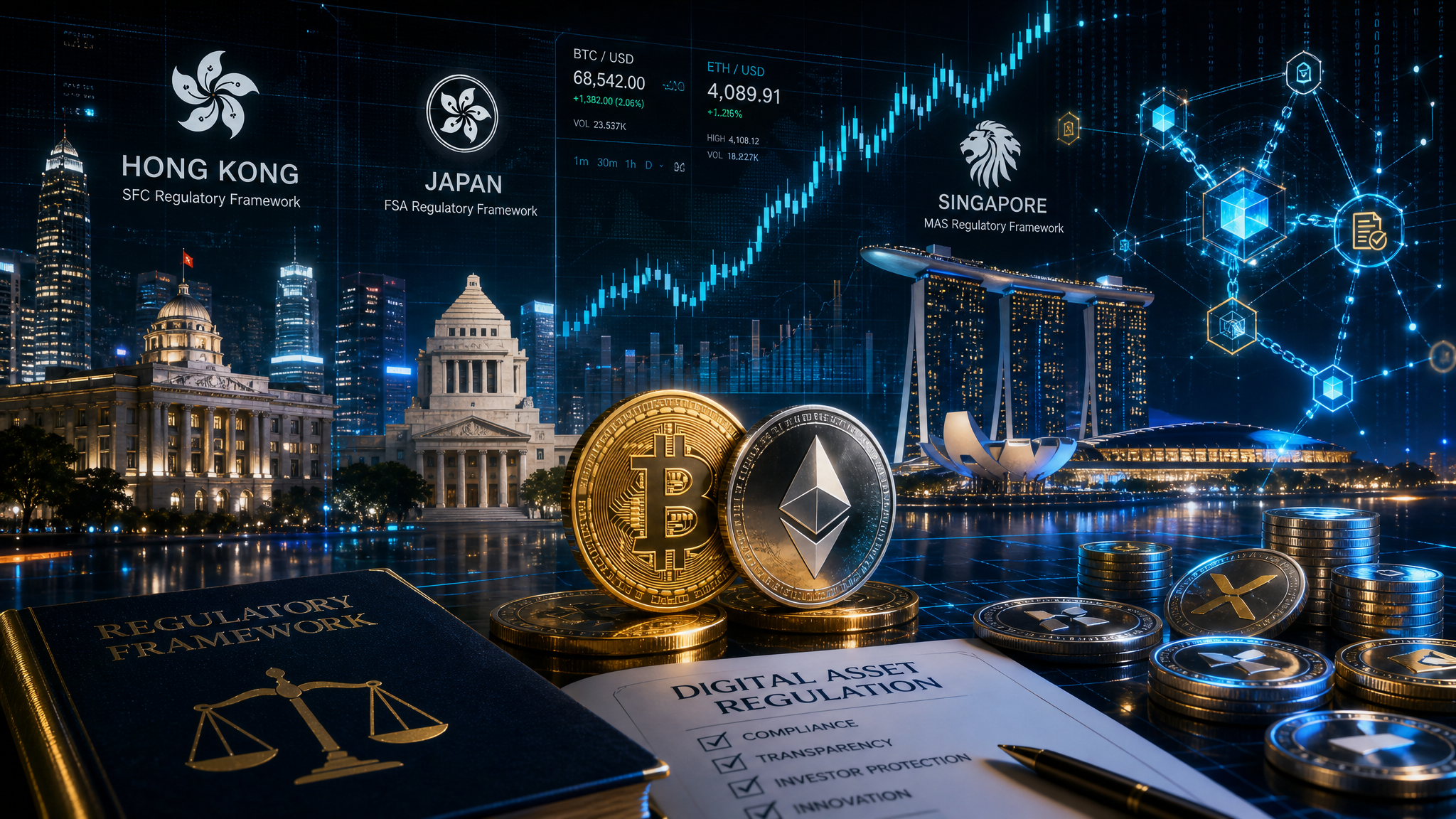
The ETF Rally: Institutional but Narrow
The concentration of ETF inflows in Bitcoin and Ether is striking. Combined July 20 inflows to XRP, Solana and Hedera funds were below $6 million, compared with hundreds of millions flowing into the two largest assets. This concentration reflects institutional risk management rather than broad crypto enthusiasm: large allocators are comfortable with Bitcoin and Ether as regulated, liquid, ETF-accessible assets, but remain cautious about smaller tokens with less established regulatory status and liquidity profiles.
Ether's outperformance relative to Bitcoin during the recovery period — gaining roughly 11% in seven days versus Bitcoin's more modest move — reflects the market's reassessment of Ethereum's utility as a platform for tokenized assets and decentralized finance. Standard Chartered reportedly targeted $7,500 for Ether by year-end, while Citi lowered its outlook to $2,240 on July 1. The range is too wide to support a confident forecast, but the dispersion itself is informative: institutional analysts disagree fundamentally about whether Ether's value derives from its network utility or its speculative premium.
Hong Kong: Licensing and AML Controls
Hong Kong's approach to stablecoins emphasizes licensing and anti-money-laundering controls. The Stablecoins Ordinance was passed in May 2025 and established regulation for specified stablecoin issuance and redemption. By April 2026, the HKMA register included Anchorpoint Financial and HSBC as licensed stablecoin issuers — a notable development because it placed a major global bank within a regulated digital-money framework. Licensees must apply customer-due-diligence and AML/CFT controls, including procedures for custodial and unhosted wallets.
Hong Kong applies a "same activity, same risk, same regulation" principle, meaning that stablecoin issuers are subject to requirements comparable to those applied to traditional financial institutions performing equivalent functions. The HKMA also established a Tokenised Bond Expert Group, signaling interest in extending the regulated digital-asset framework beyond payments to capital-market instruments. The exchange's virtual-asset trading-platform licensing regime, which began in June 2023, provides the broader context within which stablecoin regulation sits.
Japan: Trust-Type Issuance and Bank Participation
Japan classifies fiat-linked, par-redeemable stablecoins as "digital-money type" stablecoins, a category that restricts issuance to banks, fund-transfer providers and trust companies. Trust-company issuers must hold underlying assets as bank deposits, creating a direct link between the digital token and the regulated banking system. SBI Group announced Japan's first trust-type yen stablecoin on June 24, 2026, and Japan expected three large banks to issue yen-denominated stablecoins by 2027.
Japan's framework is notable for what it excludes: algorithmic or non-redeemable stablecoins do not qualify as digital-money type stablecoins and are treated as crypto-assets subject to different regulatory requirements. This distinction reflects the lessons of the 2022 Terra/Luna collapse, which demonstrated that algorithmic stability mechanisms can fail catastrophically. By restricting the digital-money category to fully backed, bank-issued instruments, Japan is prioritizing systemic safety over innovation speed.
Singapore: Reserve Standards and Redemption Speed
Singapore's Monetary Authority has finalized a single-currency stablecoin framework covering tokens pegged to the Singapore dollar or a G10 currency. Reserve assets must equal at least 100% of outstanding par value and be held in cash, cash equivalents or sovereign debt with no more than three months to maturity. Issuers must redeem at par within five business days. Minimum base capital is the higher of S$1 million or 50% of annual operating expenses.
These requirements are designed to ensure that a regulated Singapore stablecoin is genuinely redeemable at face value under normal and stressed conditions. The five-business-day redemption window is longer than the instant redemption that some stablecoin users expect, but it provides a defined and enforceable standard. Legislative amendments implementing the framework were still being prepared as of July 22, so the regulatory architecture is established but not yet fully enacted.
South Korea: User Protection and Cold Storage
South Korea's Virtual Asset User Protection Act, which took effect on July 19, 2024, established a different set of priorities. Customer deposits must be held at banks, and customer virtual assets must be segregated from service-provider assets. Service providers must keep at least 80% of customer virtual assets in cold wallets and maintain insurance or reserves against hacking and system failures. The authorities planned to extend travel-rule coverage below KRW1 million and develop AML measures for stablecoins.
South Korea's framework is primarily focused on protecting retail users from exchange failures and fraud rather than on enabling institutional stablecoin issuance. The emphasis on cold storage, segregation and insurance reflects the country's experience with exchange collapses and the political sensitivity of retail crypto losses.
Four Frameworks, One Question
Hong Kong, Japan, Singapore and South Korea are building stablecoin regimes that reflect different regulatory philosophies and different visions of what digital money should do. Hong Kong emphasizes licensing and AML controls for a broad range of issuers. Japan restricts issuance to regulated financial entities and has launched a trust structure. Singapore sets explicit reserve, capital and redemption requirements. South Korea focuses on user protection and cold storage. These designs may matter more for banks, payment companies and institutional investors than the next Bitcoin price milestone — because they determine whether a digital token can function as regulated money in cross-border payments, trade finance and tokenized asset settlement.
The ETF-driven Bitcoin and Ether rally is a market event. Asia's stablecoin frameworks are an infrastructure project. Both are happening simultaneously, but only one of them is likely to still be relevant in five years.
This content is for informational purposes only and does not constitute financial advice. Always consult with a qualified financial advisor before making investment decisions.
Discussion