EUR/USD, GBP/USD and EUR/TRY Outlook: Comparing Currency Drivers in 2026
Three currency pairs that are often grouped under the "European currencies" label are in fact driven by very different forces. EUR/USD is primarily a function of relative ECB and Federal Reserve rate expectations, dollar safe-haven demand and Europe's energy sensitivity. GBP/USD adds a layer of UK-specific rate repricing and labour-market dynamics. EUR/TRY is dominated by Turkish inflation, reserve credibility and policy transmission — with the euro's own cycle playing a secondary role. Treating these three pairs as one trade is a category error that can produce unexpected results when the drivers diverge.
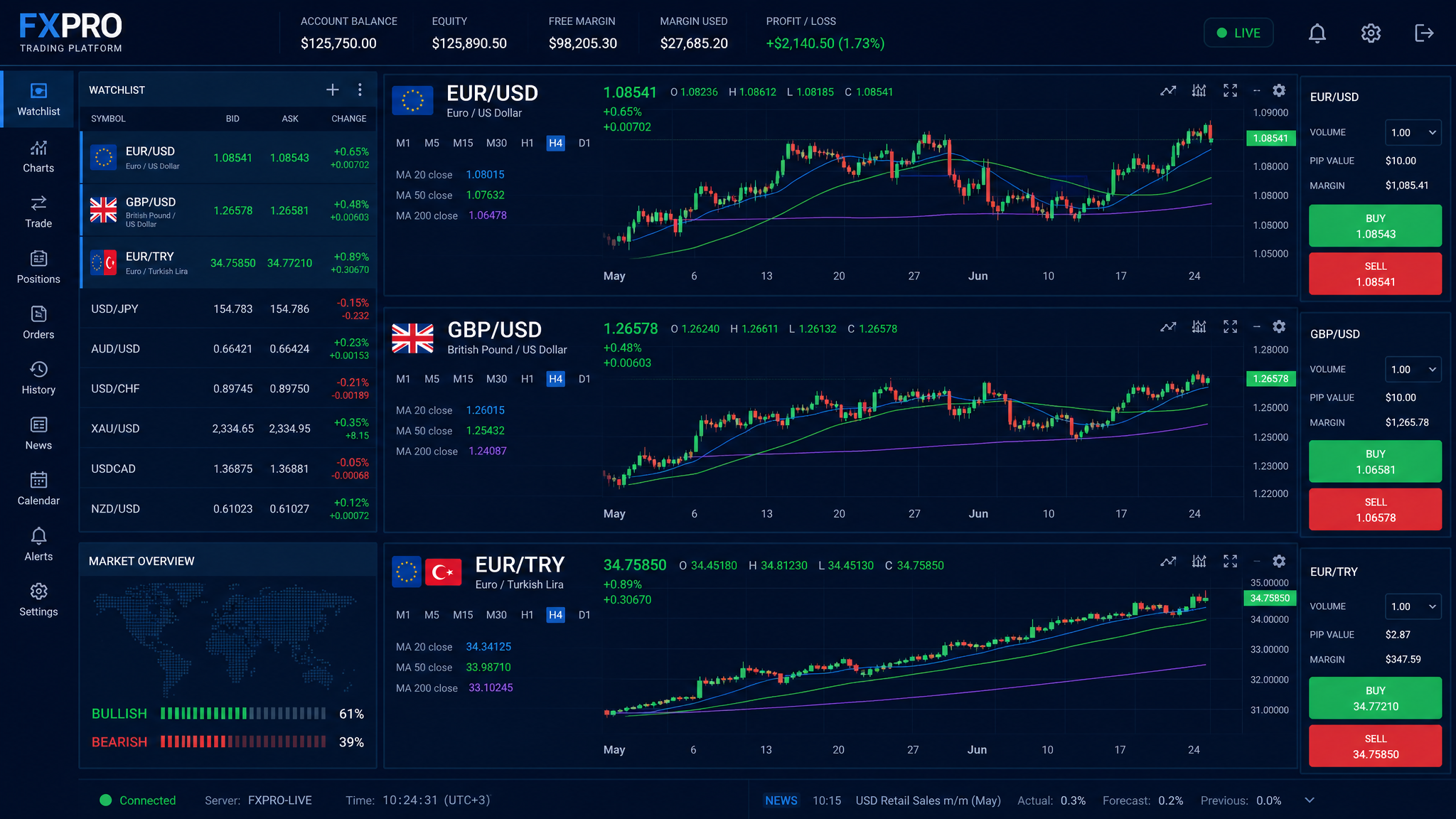
EUR/USD: Dollar Resilience Meets ECB Patience
The latest available snapshot placed EUR/USD near 1.1697, though the exact observation timestamp was not confirmed at the time of writing. The dollar entered the second half of 2026 stronger than many strategists had expected, benefiting from safe-haven demand and relatively firm U.S. policy expectations even as some forecasters continued to anticipate dollar weakness. Earlier energy shocks had disproportionately hurt the euro because investors viewed Europe as more import-dependent on oil and gas than the United States.
The ECB raised its deposit facility rate to 2.25% in June, but June euro-area inflation then fell to 2.8% from 3.2% in May, strengthening the case for a pause. The ECB's July Bank Lending Survey showed simultaneous tightening across business, mortgage and consumer credit, suggesting that effective financing conditions are already more restrictive than the policy rate alone implies. For EUR/USD, this creates a two-sided picture: rate support from the June increase, but growth and credit headwinds that limit the euro's upside against a dollar that continues to attract safe-haven flows.
GBP/USD: Rate Expectations and Labour-Market Risk
Sterling reached a one-year high against the euro and a three-week high against the dollar during July 2026, supported by UK rate expectations and domestic sentiment. The Bank of England held Bank Rate at 3.75% in June by a 7–2 vote, with the next decision scheduled for 30 July. June CPI was 2.6%, but the Bank projects inflation rising toward 3.3% by year-end as energy costs feed through — a trajectory that could justify further tightening.
The complication for sterling is the labour-market picture. Private-sector regular pay grew only 2.9% in March–May, while vacancies fell to 712,000 and payrolled employment declined by an estimated 30,000 over three months. If private-sector pay is a better guide to underlying inflationary pressure than the aggregate 3.4% figure, the labour market may be cooling faster than the headline data suggest. A Bank of England hold accompanied by a downward inflation revision on 30 July could remove some of the rate support that has underpinned sterling's recent strength. GBP/USD is therefore more sensitive to the 30 July decision than EUR/USD, which faces its next major ECB event later in the summer.
EUR/TRY: Inflation, Reserves and Policy Credibility
EUR/TRY is a fundamentally different trade from the other two pairs. The ECB reference rate stood at 53.8103 on 23 July, while USD/TRY reached 47.3453 on 24 July. The lira has fallen 16.73% against the dollar over the past 12 months, reflecting Turkey's ongoing inflation challenge: annual CPI was reported at 32.11% in June, with the TCMB holding its one-week repo rate at 37% on 23 July.
The nominal carry on the lira — the difference between Turkey's 37% policy rate and the ECB's 2.25% deposit rate — is substantial. But that carry is largely offset by the pace of lira depreciation, which has been consistent and predictable enough to erode the real return for foreign investors. The reserve picture adds another layer of complexity: total official reserves were $160.5 billion for the week ending 17 July, but the foreign-currency component was only $57.7 billion, while short-term public-sector foreign-exchange liabilities stood at $122.8 billion. The coverage ratio is tight, and any deterioration in the current account or a reversal of tourism inflows could test the reserve buffer.
EUR/TRY therefore isolates Turkish policy credibility and inflation risk from direct dollar exposure. An investor who holds EUR/TRY is taking a view on whether Turkey's disinflation path is credible and whether the reserve position is adequate — not primarily on the ECB's rate cycle, which plays a secondary role in the cross.
A Practical Hedge Map
The three pairs serve different portfolio functions. EUR/USD is the broadest expression of Europe-versus-dollar macro positioning, suitable for investors who want exposure to the ECB-Fed rate differential and European growth dynamics. GBP/USD is more sensitive to UK-specific rate repricing and global risk appetite, making it useful for investors with a view on the Bank of England's next move or on UK economic resilience. EUR/TRY is a high-carry, high-volatility pair that concentrates Turkish policy and inflation risk — appropriate for investors with a specific view on Turkey's disinflation trajectory and reserve adequacy, but not as a general European currency trade.
No directional recommendation is appropriate without current forward points, options pricing and confirmed intraday quotes. The analytical framework above is intended to help investors identify which pair matches their intended risk exposure, not to predict near-term price movements in any of the three.
This content is for informational purposes only and does not constitute financial advice. Always consult with a qualified financial advisor before making investment decisions.
Discussion