Iran Sanctions July 2026: New Risks for Shipping Finance and Commodity Traders
The U.S. Treasury's mid-July sanctions actions against Iran-linked networks have expanded the compliance risk map well beyond Iranian oil cargoes. On 14 July, Treasury targeted more than 50 individuals, entities and vessels linked to a shipping and commodities network. On 15 July, it sanctioned seven individuals and entities involved in procurement for the Islamic Revolutionary Guard Corps. For banks, insurers, commodity traders and shipping firms operating in EMEA markets, the practical question is not whether they deal directly with Iran — it is whether any counterparty in their transaction chain does.
The 14 July Action: The Shamkhani Network
The 14 July designation covered more than 50 individuals, entities and vessels linked to a network described as using container shipping, commodity trading, front companies, financiers and foreign transport providers. Treasury named financiers Hossein Ghorbani Zahed and Mohammad Reza Rahbar Madani, along with shipping executives Martin Austin Kaalund and Alessandra Ronco. Singapore-based Sea Lead Shipping and its subsidiaries were identified as front-company elements used to manage vessels carrying both licit and illicit goods.
The use of Singapore-incorporated entities illustrates the geographic reach of the network. Front companies incorporated in jurisdictions with strong commercial reputations can create beneficial-ownership uncertainty for counterparties who conduct only surface-level due diligence. The designation of named individuals in multiple countries signals that Treasury is targeting the human infrastructure of the network, not just the vessels or corporate shells.
The 15 July Action: IRGC Procurement
The 15 July action targeted seven individuals and entities involved in weapons procurement for the Islamic Revolutionary Guard Corps, taken under Executive Order 13382. Named parties included Behrouz Namazi of Tehran-based Nika Jet Company and Russian national Mariya Vladimirovna Selina. The inclusion of a Russian national in an Iran-linked procurement action reflects the increasingly interconnected nature of sanctioned networks and the challenge this poses for compliance teams that screen counterparties by nationality or jurisdiction alone.
Treasury explicitly warned financial institutions and foreign companies that dealing with designated parties or networks could create secondary-sanctions exposure. This warning is directed not only at U.S.-domiciled firms but at any institution that uses the U.S. financial system or deals in dollar-denominated transactions — a category that encompasses most major global banks and commodity trading houses.
How Risk Transmits Through the Market
The compliance premium created by these designations operates through several channels. First, new designations expand the number of parties requiring screening, increasing the operational burden for compliance teams. Second, front-company and subsidiary structures increase beneficial-ownership uncertainty, making it harder to confirm that a counterparty is not connected to a designated entity. Third, banks and insurers may reduce exposure even where a transaction is nominally legal, because the reputational and regulatory cost of a false negative outweighs the commercial benefit of the transaction.
For shipping firms, the practical consequence is that vessels associated with designated networks may find it harder to obtain port services, insurance and trade finance. For commodity traders, the risk is that a cargo's chain of custody passes through a front company or intermediary that has not been fully screened. For lenders, the risk is that a borrower's counterparties include entities that are several steps removed from the designated list but still within the network's orbit.
The Diplomacy-Enforcement Tension
The July designations occurred against a backdrop of ongoing U.S.–Iran diplomatic contacts. Iran has sought sanctions relief, access to frozen oil revenues and crude-export waivers in talks with the United States. The coexistence of negotiations and new designations illustrates that enforcement and diplomacy can proceed simultaneously — and that a future political agreement would not automatically remove every entity-level designation. The sanctions architecture has been described as a "tangled nest" that would be lengthy and complex to unwind even if a political deal were reached.
This tension is relevant for investors assessing the medium-term outlook for Iranian oil supply and for firms considering whether to re-engage with Iranian counterparties in anticipation of a deal. The entity-level designations create a legal and compliance barrier that persists independently of the diplomatic track.
A Practical Checklist for Affected Firms
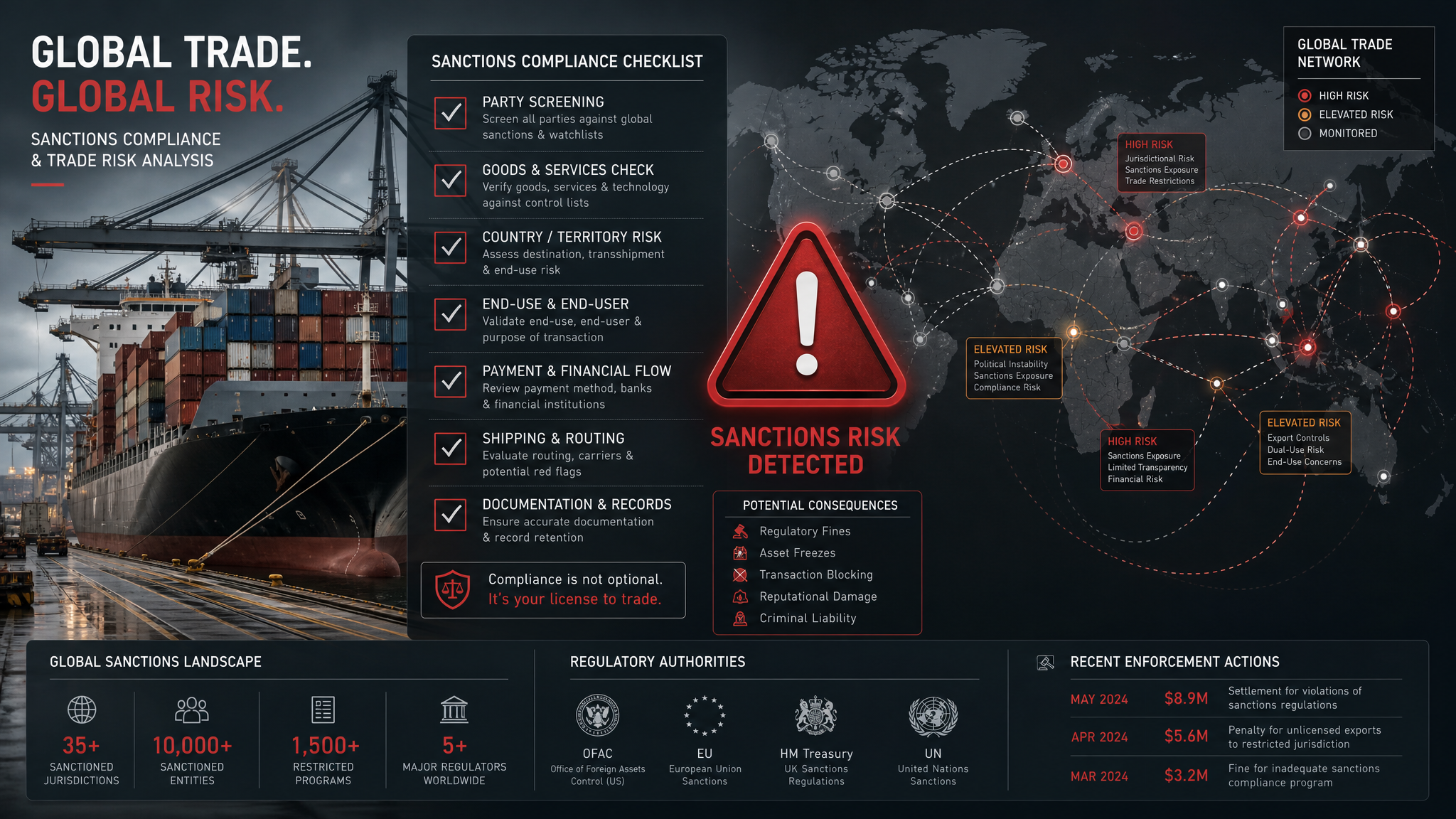
Firms operating in EMEA markets with exposure to shipping, commodity trading or trade finance should apply a three-part checklist. First, screen all counterparties — including subsidiaries, agents and intermediaries — against the updated OFAC Specially Designated Nationals list. Second, verify beneficial ownership for any entity incorporated in jurisdictions commonly used for front-company structures. Third, assess secondary-sanctions exposure for any transaction that involves dollar clearing or U.S.-person involvement, even if the primary counterparty is not U.S.-based.
The market risk from Iran's July sanctions is increasingly about who sits behind the transaction, not just who is named on the invoice. As Treasury continues to target the human and corporate infrastructure of sanctioned networks, the compliance perimeter expands with each new designation round.
This content is for informational purposes only and does not constitute financial advice. Always consult with a qualified financial advisor before making investment decisions.
Discussion